
 Buy Crypto
- Markets
 Futures
- Spot
- Copy Trade
- Earn
- More
2024 Crypto ETF Landscape Review: AUM Surpasses $120 Billion; Shifting from the Fringe to the Mainstream

Original Article Title: "2024 Crypto Spot ETF Landscape Review: 1 Year, $400 Billion"
Original Article Author: Fairy, ChainCatcher
2024 was a historic year for the cryptocurrency market. Over the past decade, the U.S. Securities and Exchange Commission had rejected at least 30 Bitcoin spot ETF applications, but on January 11, 2024, a historic turning point was reached. The U.S. Bitcoin spot ETF was officially approved for listing, achieving a record $46 billion in trading volume and $6.28 billion in net inflows on its first day. Subsequently, several countries including Hong Kong and Australia also launched Bitcoin spot ETFs, further driving the global legitimization of crypto assets. As of the time of writing, the U.S. crypto ETF's assets under management have surpassed $1,223.9 billion, with Hong Kong reaching $4.67 billion.
2024 was the year crypto assets truly shifted towards mainstream assets. According to the latest 13-F filings, all types of institutions are now holders of crypto ETFs, including endowments, pension funds, hedge funds, investment advisers, and family offices. In this wave of mainstreaming crypto assets, ETFs for other digital assets such as Solana and XRP have also gradually come into the public eye, further laying the groundwork for the developments in 2025.
This article will review the key milestones of the 2024 crypto spot ETFs, analyze in detail the market performance of crypto ETFs over this year, and provide an outlook on the 2025 development prospects of crypto ETFs.
Key Milestone Review: The Birth Year of Crypto Spot ETFs
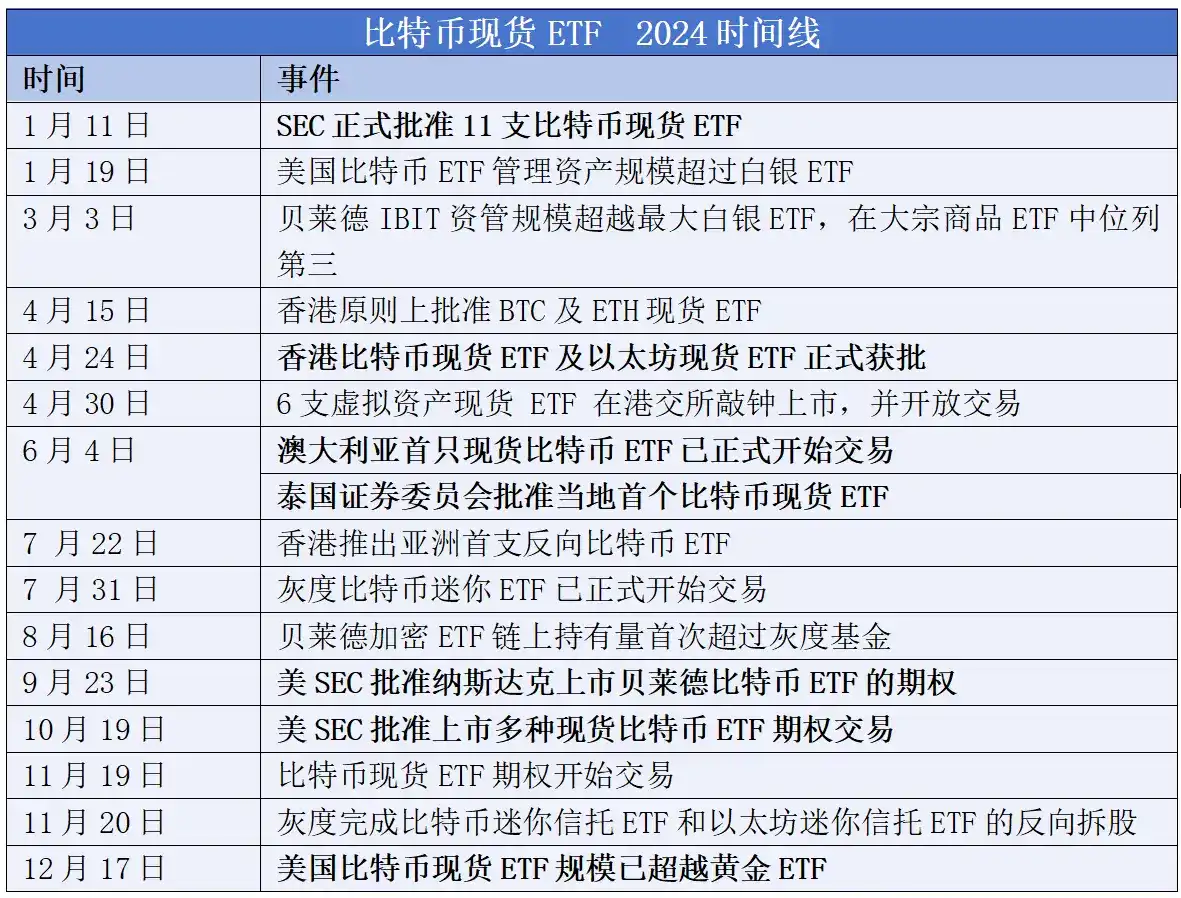
Bitcoin Spot ETF 2024 Time Retrospect
Let's rewind to the early hours of January 11, 2024. The entire cryptocurrency industry held its breath as global investors anxiously awaited the final decision on the U.S. Bitcoin spot ETF. Finally, the words "formal approval" appeared, and the Bitcoin spot ETF successfully emerged, fulfilling everyone's years of anticipation.
On its first day, the Bitcoin spot ETF traded over $46 billion, with a net inflow of $6.28 billion. Within the first three days of listing, the trading volume had already approached $100 billion.
On January 19, just one week after trading began, the U.S. Bitcoin ETF's AUM had already surpassed the Silver ETF, becoming the second-largest ETF commodity category in the U.S.
With the United States approving a Bitcoin spot ETF, Hong Kong did not want to fall behind. On April 15, Hong Kong provisionally approved BTC and ETH spot ETFs; on April 24, Hong Kong Bitcoin spot ETF and Ethereum spot ETF were officially approved; on April 30, 6 virtual asset spot ETFs were listed on the Hong Kong Stock Exchange and opened for trading.
On the first day, the Hong Kong cryptocurrency spot ETF raised approximately HKD 2 billion, with a calculated net asset value of USD 293 million. The total trading volume of the 6 ETFs on the first day was approximately HKD 87.58 million (about USD 12.70 million).
The launch of Hong Kong's cryptocurrency spot ETF has had a profound impact on the Chinese financial landscape and is also an important step towards further legitimizing cryptocurrencies globally. The Hong Kong crypto ETF uses a physical creation and redemption mechanism, providing a channel for converting crypto assets into traditional financial assets.
Subsequently, various countries have gradually begun to approve and trade Bitcoin spot ETFs. On June 4, Australia's first Bitcoin spot ETF officially started trading, and the Thai Securities and Exchange Commission also approved the first local Bitcoin spot ETF.
By September 23, the US SEC approved the listing of the BlackRock Bitcoin ETF on Nasdaq, and on October 19, the SEC approved the trading of various Bitcoin spot ETF options. The range of Bitcoin-related derivatives has further expanded, bringing options products to the market that combine compliance and trading depth. Bitcoin ETF options allow investors to engage in term-based portfolio allocations, particularly suited for long-term investments, injecting more regulatory compliance and trading depth into the market.
Ethereum Spot ETF 2024 Retrospective
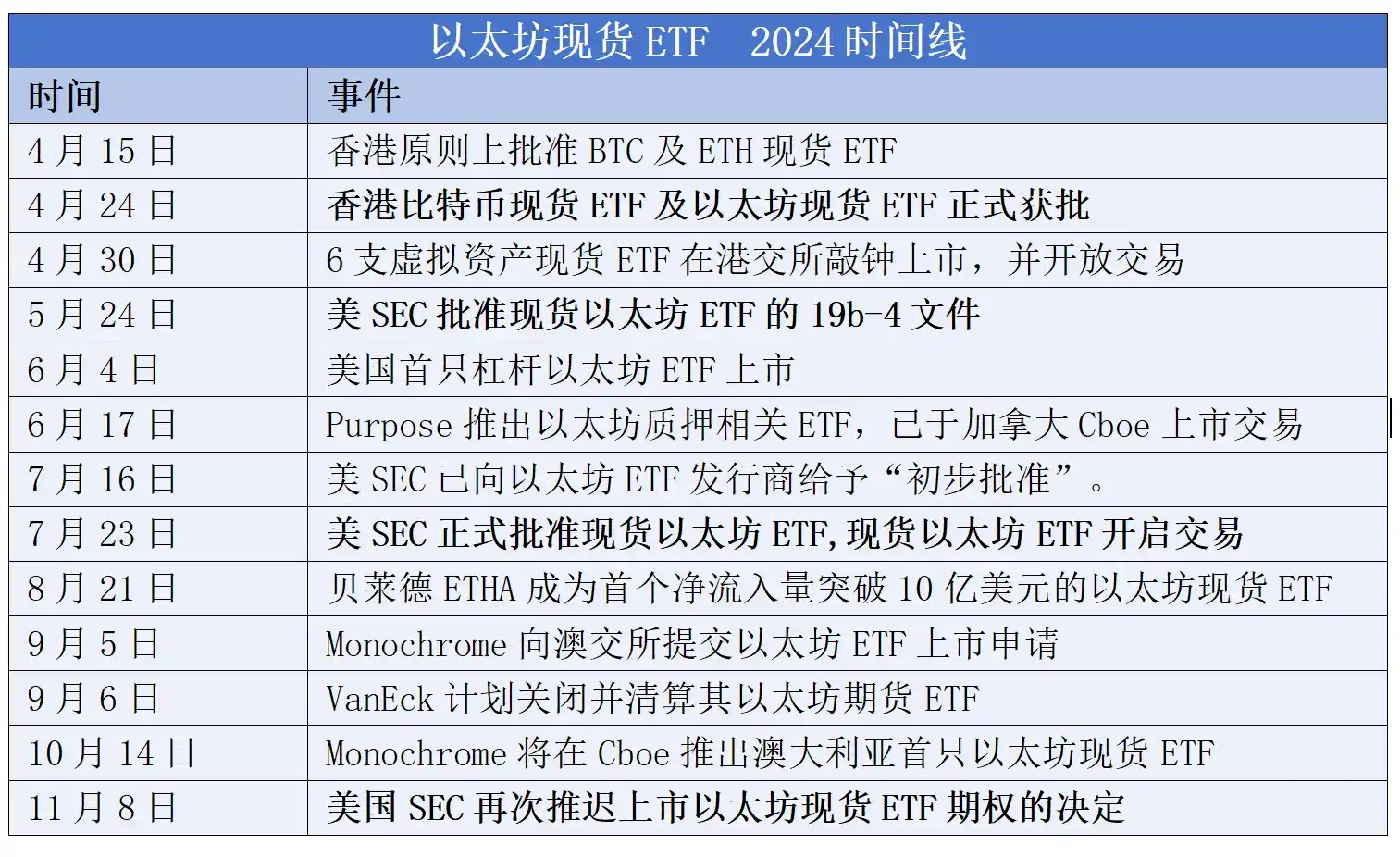
In 2024, the Ethereum spot ETF saw a series of significant developments globally. From Hong Kong to the United States, and then to Australia, multiple regions around the world were actively advancing the approval and listing of Ethereum spot ETFs. Ethereum, as the "Number Two" of the crypto market, officially stepped in front of traditional investors.
On April 24, the Hong Kong Bitcoin spot ETF and Ethereum spot ETF were officially approved, marking the first landing of an Ethereum spot ETF on a major exchange. The Hong Kong Ethereum spot ETF saw a net inflow of 14,200 ETH on the first day, with a trading volume of USD 2.99 million.
On May 24, the US SEC approved the 19b-4 filing of the first Ethereum spot ETF. This filing was a key step in the legal trading of the Ethereum spot ETF in the US market, opening the door for Ethereum spot products to formally enter the US market.
On July 23, the crypto market once again witnessed a historic moment as the U.S. SEC officially approved the Ethereum spot ETF. The Ethereum spot ETF saw a first-day trading volume of over $1.019 billion, with a net inflow of $106.6 million.
On November 8, the U.S. SEC once again delayed its decision on the New York Stock Exchange's listing of Ethereum spot ETF options. The filing stated that the delay is to conduct further analysis and gather public input, particularly on whether the proposed rule changes comply with the Securities Exchange Act.
Further Look Back at Crypto-Related ETFs in 2024
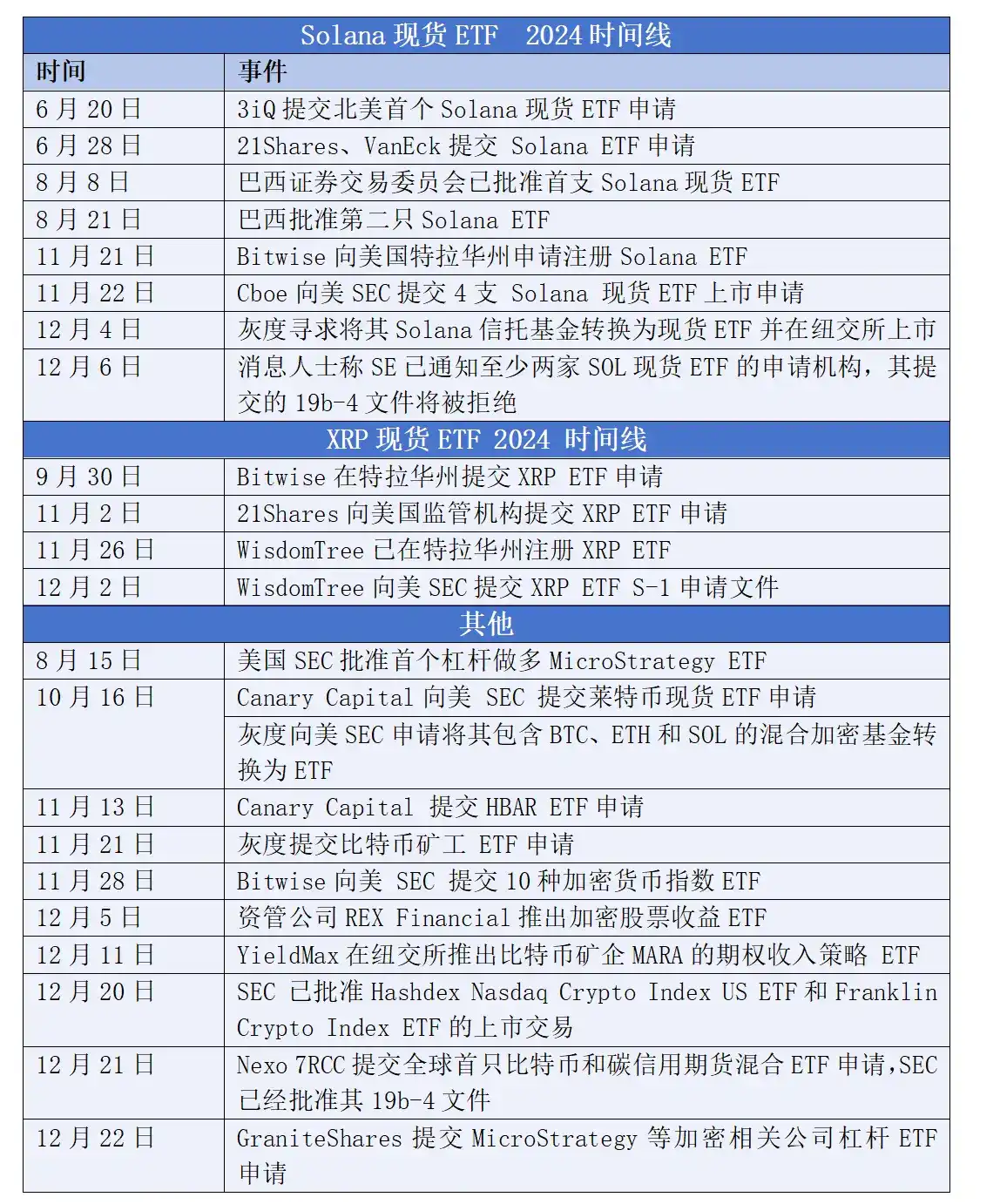
Following the approval of Bitcoin and Ethereum spot ETFs, the Solana spot ETF also saw significant progress in 2024. On June 20, the first North American Solana spot ETF application was submitted, marking the official entry of Solana ETF into the public eye. Subsequently, 21 Shares and VanEck also submitted applications for Solana ETF to the SEC.
On August 8, the Brazilian Securities and Exchange Commission approved the world's first Solana spot ETF, followed by the approval of a second Solana ETF on August 21. This groundbreaking move in Brazil brought more optimism to crypto supporters.
Applications for Solana spot ETFs in the U.S. are ongoing. On November 22, Cboe submitted applications for 4 Solana spot ETF listings to the SEC, and on December 4, Grayscale sought to convert its Solana Trust Fund into a spot ETF and list it on the NYSE. However, shortly after, sources revealed that the SEC had informed at least two Solana spot ETF applicant institutions that their submitted 19b-4 filings would be rejected. This news indicates that the U.S. remains cautious towards Solana spot ETFs.
In addition to Solana, XRP is also a focus of institutional attention. Currently, Bitwise, 21 Shares, and WisdomTree have submitted XRP spot ETF applications in the U.S.
Furthermore, various types of crypto-related ETFs have been launched or entered the application stage in November and December, ranging from single crypto assets to multi-asset portfolios, from index-based to yield-based. This trend signifies the crypto market's gradual move towards mainstream adoption and further demonstrates its increased integration with the traditional financial system. Crypto assets are gradually evolving into one of the core assets recognized by global investors.
How Did ETFs Perform This Year?
The total assets under management of ETFs listed in the U.S. have surpassed $10 trillion, with $400 billion allocated to the cryptocurrency space. Cryptocurrency ETFs currently represent 0.4% of the overall ETF market. However, according to K 33 Research data, the net inflow of Bitcoin spot ETFs in 2024 accounted for 3.5% of all net inflows into U.S. ETFs in 2024, a proportion significantly higher than traditional asset classes.
Since the launch of Bitcoin ETFs, their liquidity is 4.5 times that of gold ETFs adjusted for inflation. Although the cumulative flow still lags behind gold, the asset under management of U.S. Bitcoin ETFs has exceeded that of gold.
Furthermore, the BTC holdings of U.S. Bitcoin spot ETFs have surpassed 1.13 million coins, surpassing Satoshi Nakamoto's Bitcoin holdings, becoming the world's largest "Bitcoin holder." These achievements undoubtedly demonstrate that Bitcoin spot ETFs are the "most successful ETF ever."
As of December 24, the total cumulative net inflows of U.S. Bitcoin spot ETFs reached $35.49 billion, with a total net asset value of $110 billion. Among them, the net asset value of BlackRock's BIT accounts for nearly 50%, reaching $53.7 billion. It is noteworthy that BIT's asset size is now equivalent to the sum of 50 ETFs focused on Europe (region + single country), and these European ETFs have been in existence for 20 years.
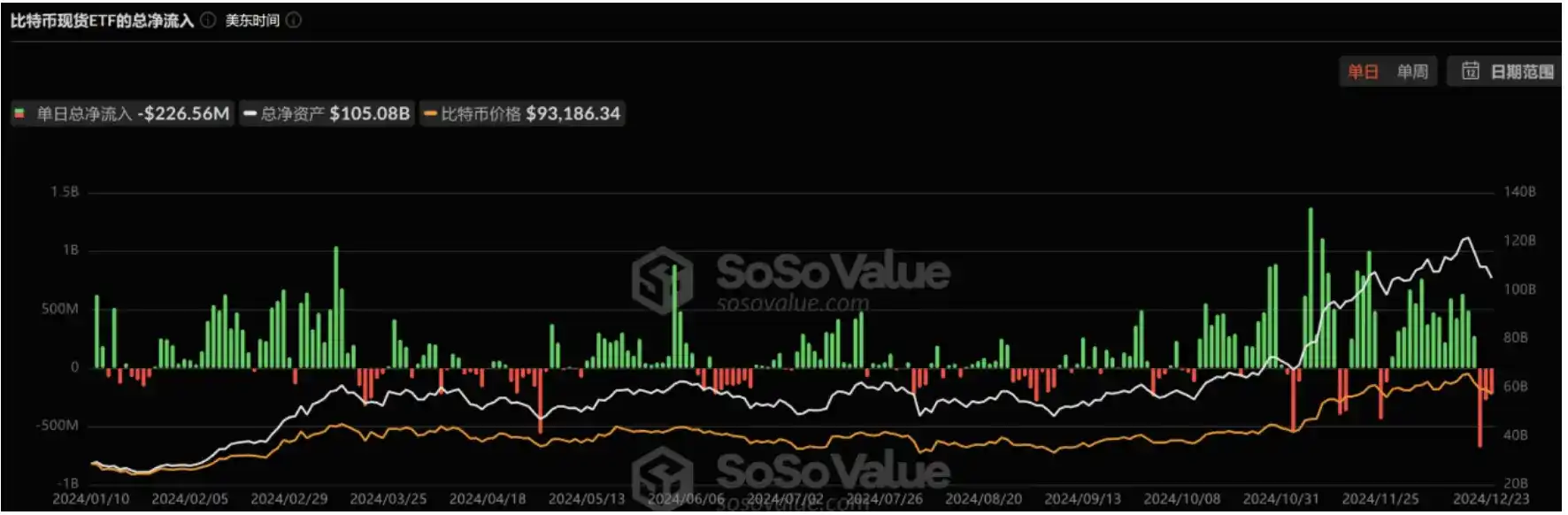
Bitcoin Spot ETF Net Inflows vs. Bitcoin Price Chart, Source: sosovalue
The U.S. Ethereum spot ETF previously had a mediocre performance, but since November, its inflow and liquidity have increased significantly.
On November 13, ETF issuer Bitwise announced the acquisition of Ethereum staking service provider Attestant. On November 20, 21Shares announced the addition of staking functionality to its Ethereum Core ETP product and renamed it "Ethereum Core Staking ETP" (ETHC). With the news of Trump's victory, the market's expectation for the introduction of staking functionality in the Ethereum spot ETF has grown stronger.
As of December 24, the total cumulative net inflows of the U.S. Ethereum spot ETF reached $2.51 billion, with a total net asset value of $12.35 billion. On December 5, the net inflow reached $428 million, setting a record.
In the United States Ethereum Spot ETF, the highest net asset value is held by Grayscale's ETHE, reaching $4.91 billion, followed by BlackRock's ETF with a net asset value of $3.65 billion. Together, they account for 69.3% of the total assets of the US Ethereum Spot ETF.
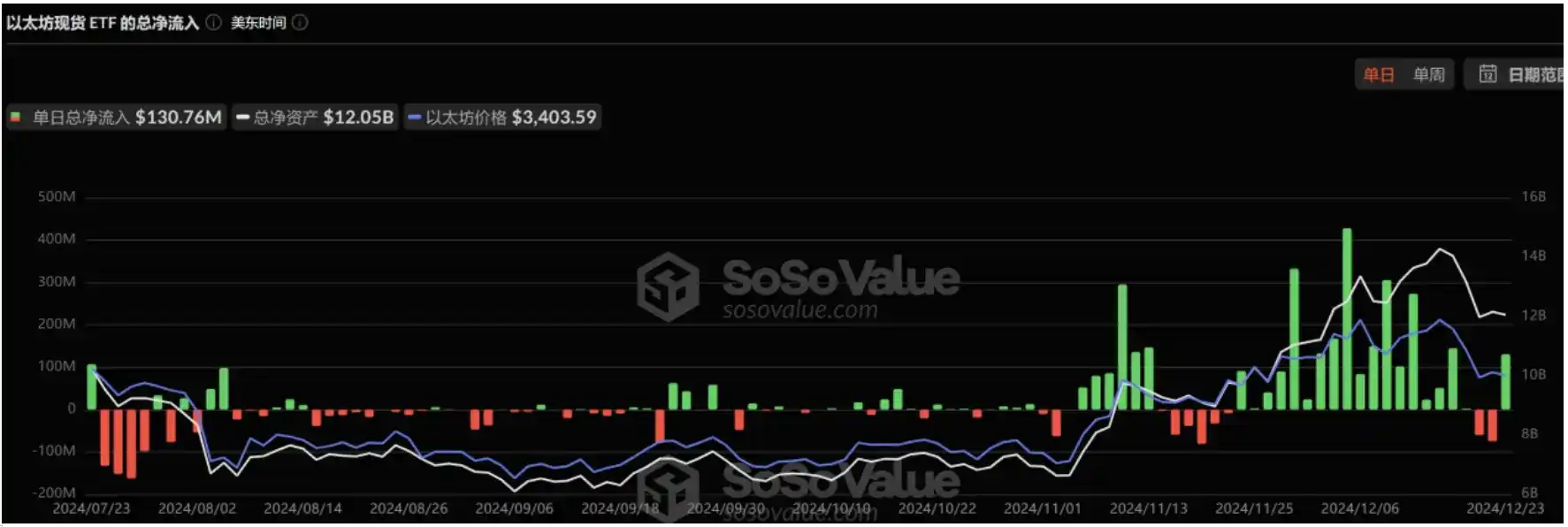
Ethereum Spot ETF Net Inflows vs. Bitcoin Price Chart, Source: sosovalue
Which Cryptocurrency ETFs Will Be Approved in 2025?
Multiple Solana ETF applications will face their first review period from January 23 to 25, 2025. However, according to FOX Business reporter Eleanor Terrett, the US Securities and Exchange Commission (SEC) has notified at least two SOL spot ETF applicant institutions that their submitted 19b-4 filings will be rejected. Meanwhile, sources familiar with the matter have revealed that during the current government's tenure, the SEC may not approve any new cryptocurrency ETF applications.
Bloomberg Senior ETF Analyst Eric Balchunas expects issuers to resubmit applications after the appointment of the new SEC Chairman Paul Atkins. Paul Atkins serves as Co-Chair of the Digital Chamber's Token Alliance, focusing on researching and advancing the digital asset industry. His appointment may bring new possibilities for the approval of Solana ETFs.
Bitwise has its first review period for 10 cryptocurrency index ETFs submitted to the SEC on January 18, 2025. This ETF includes a variety of mainstream crypto assets currently in the market, including BTC, XRP, Solana, Cardano, Uniswap, Polkadot, Chainlink, Ethereum, Avalanche, and Bitcoin Cash.
The Bitwise Bitcoin and Ethereum ETFs will have their first review period on January 30, 2025. This ETF is a proposed spot cryptocurrency index fund composed of BTC and ETH, aiming to "provide investors with a balanced exposure to the world's two largest cryptocurrencies in an easily accessible form."
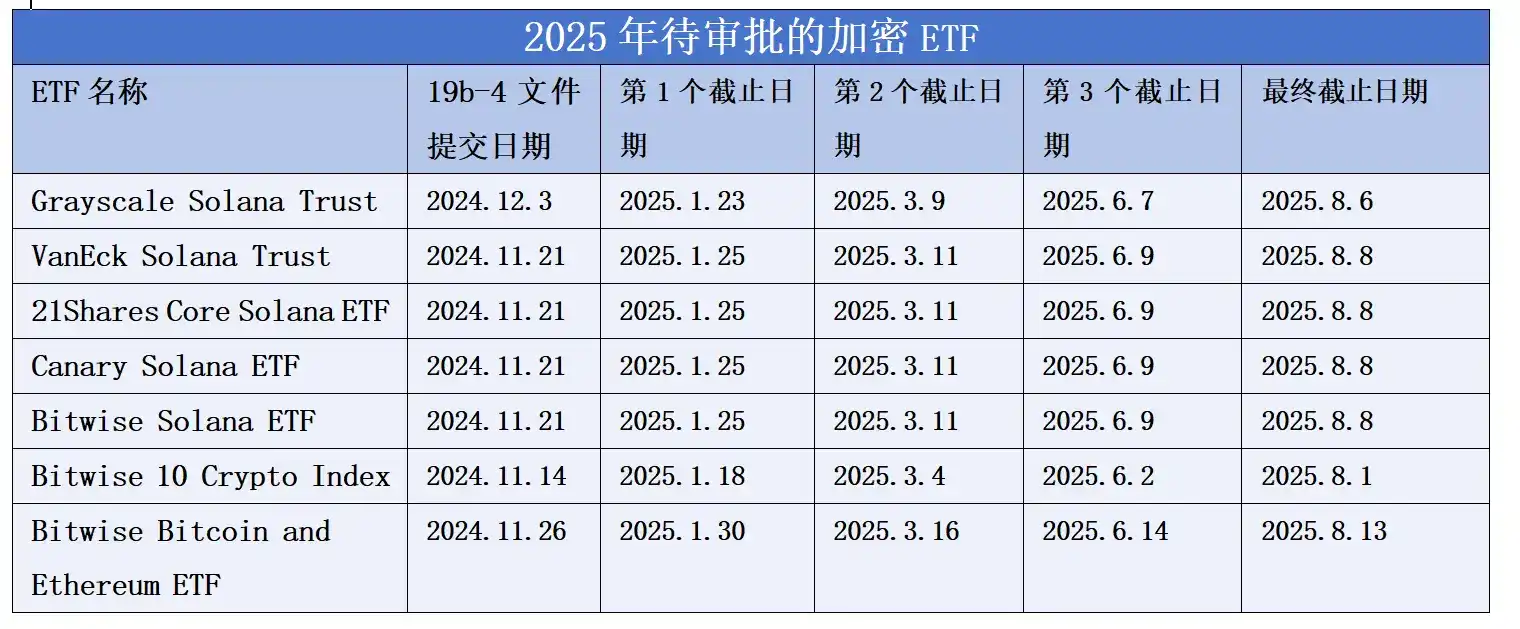
In addition, the following cryptocurrency ETFs are also awaiting approval:
XRP ETF
· Bitwise XRP ETF
· Canary XRP ETF
· 21 Shares Core XRP Trust
· Wisdomtree XRP Fund
Litecoin ETF
· Canary Litecoin ETF
HBAR ETF
· Canary HBAR ETF
In addition to ETFs, approval for Ethereum spot ETF options will also take place in 2025. Bloomberg ETF analyst James Seyffart said the SEC's final decision could come around April 9, 2025. However, the SEC is not the sole decision-making body, as approval from the OCC and CFTC is also required.
Outlook for 2025
In 2025, more cryptocurrency assets may enter the ETF space. Despite ongoing regulatory challenges, the continued involvement of institutional investors and the gradual maturation of the market will provide further impetus for the future development of the cryptocurrency industry. We can anticipate that cryptocurrency assets will no longer be merely speculative tools, but will become a significant part of global investment portfolios, driving deep integration between traditional finance and digital assets.
Below are predictions from industry insiders and KOLs on the development of cryptocurrency ETFs in 2025:
Forbes Prediction: Staking will be incorporated into an Ethereum ETF for the first time in 2025. ETFs for other cryptocurrencies (such as Solana) will be launched soon, and there may be the introduction of weighted cryptocurrency index ETFs.
Framework Co-Founder Vance Spencer's Prediction: Listing plans for ETFs of cryptocurrencies other than Bitcoin and Ethereum will be delayed until 2026.
Messari Research Prediction: ETF inflows will continue to rise in 2025, especially as Grayscale's GBTC pivots to positive net flows, making the launch of a Solana spot ETF in the next year or two seem inevitable.
Coinbase states: Looking ahead, industry focus is on the possibility of ETF issuers expanding the assets underpinning ETFs to include more tokens like XRP, SOL, LTC, and HBAR, but we believe these potential approvals may only benefit a limited group of assets.
ETF issuer VanEck predicts: The new SEC leadership (or possibly the CFTC) will approve several new US spot cryptocurrency exchange-traded products (ETPs), including the VanEck Solana product. The Ethereum ETP will feature staking, further enhancing its utility for holders, while both Ethereum and Bitcoin ETPs support in-kind creation/redemption. The path will be cleared for banks and brokers to custody spot cryptocurrency whether the US Securities and Exchange Commission or Congress repeal SEC Rule SAB 121.
ETF issuer Bitwise forecasts: Bitcoin ETF inflows in 2025 will surpass those of 2024. Trillions of dollars managed by the company will begin to flow into Bitcoin ETFs.
You may also like

The New Yorker in-depth investigation interpretation: Why do OpenAI insiders consider Altman untrustworthy?
Two Divided Worlds: Insights from the New York Digital Asset Summit, the Most Institutionalized Blockchain Conference

Top Ten Reveals of CZ's New Book: Advance Knowledge of "94", the Inside Story of Huobi's Change of Ownership Made Public for the First Time

Ceasefire Overnight Erases War Premium, Three Fault Lines Only One Sealed | Rewire News Morning Brief

Robinhood Secures 'Trump Account': Enabling Millions of Newborns to Access the Stock Market

Afraid to Open the Pandora's Box? Anthropic's Most Powerful Model Ever Dares Not Be Disclosed

US-Iran Ceasefire: A Temporary Pause or Prelude to Renewed Conflict? Market Outlook for Oil, Gold, and Bitcoin
April 8, 2026 – A temporary ceasefire between the U.S. and Iran has provided some immediate relief to the global markets, but the fundamental question remains: Will the cessation of hostilities hold, or is this merely a brief reprieve before a resumption of conflict? As the situation unfolds, market observers are closely monitoring how key assets like oil, gold, and Bitcoin will react in the coming weeks. This article explores whether the ceasefire is a sign of lasting peace, assesses the short-term market implications, and delves into the evolving role of Bitcoin in the global financial landscape.

WEEX Market Update: U.S.-Iran Ceasefire Sparks Bitcoin Price Surge
April 8, 2026 – In a significant shift in global geopolitics, U.S. President Donald Trump has announced a temporary two-week ceasefire with Iran, resulting in a notable market reaction across various asset classes. This development comes after discussions between Trump, Pakistani Prime Minister Shahbaz Sharif, and Army Chief General Asim Munir. The announcement is already reverberating through markets, particularly in oil, gold, and cryptocurrencies.
Morning Report | South Korean financial institutions pilot stablecoin payments for foreign users; Morgan Stanley Bitcoin ETF is about to be listed; CME plans to launch AVAX and SUI futures contracts

EigenCloud Founder: AI and Cryptocurrency are Creating the Next Trillion-Dollar Asset Class
From Panic to Pumps: How Bitcoin Traders Are Playing the 2-Week US-Iran Ceasefire
For most people, the two-week US-Iran ceasefire is about geopolitics, oil prices, and whether World War III gets postponed. But for crypto traders glued to their screens late Sunday night, it was something else entirely: the clearest risk-on signal in months.

US-Iran Ceasefire Triggers Oil Plunge, Bitcoin Surge, and Gold Rally
Despite the sharp rally, caution is warranted. The $70,000–$72,000 zone has historically been strong resistance. The ceasefire is only temporary (two weeks), and any breakdown in negotiations could trigger a sell-off toward the $62,000–$65,000 support zone. For now, Bitcoin needs to close decisively above $72,500 to confirm a true breakout; failure to do so within 48–72 hours could lead to a swift retracement.

OpenAI has no "New Deal," a blueprint for AI that refuses to pay.

Wall Street Flash Mob Run? Mega-Cap Stock Plunge, Goldman's Great Escape, Illustrated Guide to Private Credit Crisis

OpenAI Feud: Power, Trust, and the Uncontrollable Boundaries of AGI
「AI Doomsday Cult」 Sends Operatives into the Strait of Hormuz: What Did They Find?
Everyone is waiting for the war to end, but is the oil price signaling a prolonged conflict?


 App
App