
 Buy Crypto
- Markets
 Futures
- Spot
- Copy Trade
- Earn
- More
3-Day 500% Surge, $28,500 Airdrop per Person: What Makes Hyperliquid Go Wild in the Market?

Original Article Title: "Largest Airdrop of the Year? Hyperliquid Airdrops $2.85k Per Capita, HYPE Fever Sparks New Gold Rush"
Original Article Author: Frank, PANews
The long-awaited moment has finally arrived. On November 29, decentralized derivatives exchange Hyperliquid announced the genesis event of its native token, HYPE. Following the token's launch, the price of HYPE surged significantly, starting at $2 on November 29 and peaking at $9.8 on December 1, nearly quintupling in less than 3 days.
Compared to other major airdrop projects this year, HYPE's market performance has been truly impressive. In this airdrop, Hyperliquid distributed a total of 310 million tokens, meaning that even at the $2 opening price, the airdrop's value reached $620 million. Among this year's airdrops, it can certainly be considered one of the largest.
However, strangely, prior to Hyperliquid's airdrop announcement, there was little discussion among Chinese KOLs on social media, and there were not many Chinese bloggers sharing their experiences afterwards. It seems that those focused on other activities missed out on this truly big opportunity.
Airdrop Sent to 94k Addresses, Highest Airdrop Nearly $10M
According to ASXN Data, the actual airdrop amount by Hyperliquid was around 274 million tokens (some users missed out on claiming due to not signing the Genesis Event terms). A total of 94,000 addresses received the airdrop, with an average of 2,915 HYPE tokens per address. Based on the $9.8 price on December 1, this is equivalent to $2.85k. From this perspective, Hyperliquid is indeed one of the largest airdrops of the year.
However, behind the average of 2,915 tokens is the Pareto Principle, with whales pulling up the average, and the median airdrop being only 64.53 tokens. Looking at the overall distribution, around 38.7% of users received between 10 and 100 tokens, while 17.9% received less than 10 tokens. Therefore, about 56.6% of users received less than 100 tokens. The percentage of accounts receiving fewer than 1,000 tokens is 83.9%. In this light, most people did not reach the average of 2,915 tokens, but even with a few hundred dollars, Hyperliquid's airdrop could still buy you an Apple iPhone.
On a single address, the highest amount claimed is 970,000 tokens, calculated at a price of $9.8, making the airdrop on this address worth $9.56 million. This should be the address with the highest claimed value in the 2024 airdrop projects (Starknet's highest claimed value address is $360,000, Jupiter's highest claimed value address is $130,000).
Airdrop Brings 10,000 New Users in 2 Days
Despite limited promotion on social media, the results of the lavish airdrop brought in many new users to Hyperliquid. Historical data shows that prior to the airdrop, Hyperliquid's daily new users were mostly below 500, often around 150 new users. However, on November 29th and 30th, there were 10,993 new users in two days, even surpassing the number of new users in the past month. On November 30th, the total number of transactions even exceeded 3.44 million, growing over 10 times compared to pre-airdrop levels.

However, the surge in user activity does not seem to have brought a significant change in transaction volume. The total transaction volume from November 29th to November 30th was approximately $18 billion and $19 billion, showing no substantial increase. Nevertheless, compared to the sharp decline in user numbers after the airdrop in other projects, Hyperliquid's performance is indeed unique.
The growth trend of Hyperliquid has long been established. According to data from defillama, Hyperliquid Perp ranks second among all derivative protocols, slightly below Jupiter Perpetual. On November 17th, Hyperliquid briefly surpassed Jupiter to become number one. Back in July of this year, Hyperliquid was ranked fourth, following GMX and DYDX. As a rising star in decentralized derivative exchanges, Hyperliquid's ascent has long begun.
Hyperliquid Ecosystem Tokens Experience Collective Surge
As of December 1st, the market cap of HYPE exceeded $3.3 billion, ranking around 44th among all tokens, on par with OKB. ARB's market cap is currently around $4 billion. If HYPE's price continues to rise, it may directly surpass ARB.
For those who received the airdrop, the significant surge in HYPE is undoubtedly the best morale booster. On social media, many Key Opinion Leaders (KOL) have expressed that Hyperliquid, compared to those airdrops with complex rules and user gamification but received a large amount of funding, is simply a beacon of integrity for this year. However, some individual users have also pointed out that currently, HYPE is just a standalone coin that can only be traded on Hyperliquid.
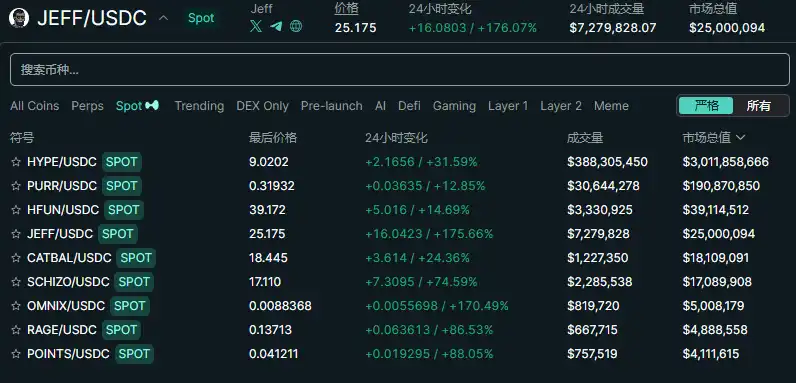
With the hype surrounding HYPE, Hyperliquid seems to have become a new gold rush territory. Apart from HYPE, other tokens on Hyperliquid have also experienced rapid price surges in this wave of excitement. From November 29 to December 1, native tokens on Hyperliquid such as PURR, JEFF, HFUN, etc., saw significant price increases. Particularly, JEFF (a MEME coin themed after Hyperliquid's founder Jeff) saw an almost 10x increase in price within three days. OMNIX has also seen exponential growth in recent days.
However, it remains unknown how long this strong uptrend can be sustained.
So far, on-chain deposits and withdrawals to Hyperliquid still need to be bridged through Arbitrum. Over 60% of USDC tokens on Arbitrum's chain belong to Hyperliquid addresses. This seems to be a mutually beneficial process where Hyperliquid brings ample active addresses and funds to Arbitrum, while Arbitrum provides stable and cost-effective infrastructure to Hyperliquid before its mainnet launch.
Up to now, Hyperliquid has not accepted any investments. In the announcement of its Genesis event, the Hyperliquid Foundation stated regarding token distribution: "There is no allocation for private investors, centralized exchanges, or market makers." Previously, PANews conducted an in-depth study on Hyperliquid's development philosophy and other related topics. (Related reading: Head MEME Coins Worth Billions, Will Hyperliquid, an L1 public chain focusing on derivative trading, become the new MEME gold rush territory?)
According to official information from Hyperliquid, the Hyperliquid EVM is currently live on the testnet, but integration with other L1 chains is not yet complete. In the short term, it seems that asset transfers through cross-chain bridges like other L1 chains cannot be performed. Furthermore, as an L1 chain, Hyperliquid's ecosystem is not yet robust, with everything from browsers to DEX being in a Hyperliquid self-operated model. This approach has its pros and cons: the benefit is that all technological innovations and development efforts are focused on improving the performance of a decentralized derivative trading platform, aiming to create a decentralized Binance. The downside is that it may be challenging to expand brand influence through ecosystem expansion.
From the official social media management of Hyperliquid, it can be seen that apart from announcements, almost no other content is posted. This is a kind of persistent simplicity, which is indeed unique in the enthusiastic but hype-driven crypto field.
However, Hyperliquid's recent surge once again confirms the idea that any marketing gimmick is insignificant in the face of price gains.
You may also like
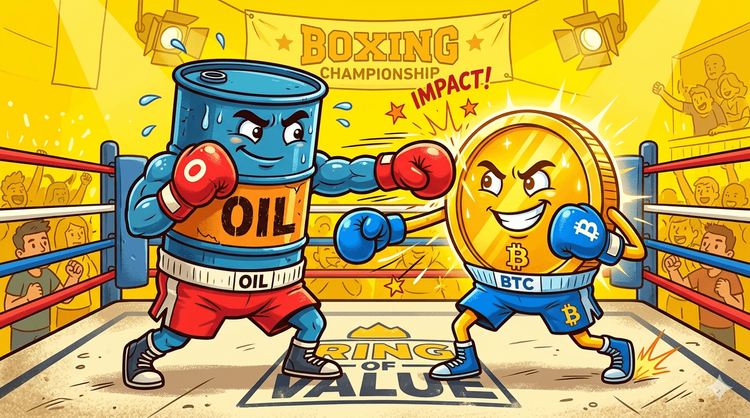
How the US-Iran War Could Affect Oil and Bitcoin Prices (Latest Analysis)
The outbreak of the US-Iran war on February 28, 2026, has provided an unprecedented real-time laboratory for understanding how geopolitical oil shocks interact with an increasingly institutionalized cryptocurrency market. This article examines the relationship between crude oil prices and Bitcoin throughout the conflict, analyzing price movements, correlation patterns, and the underlying transmission mechanisms.

OpenAI Wants to Write Its Own Rules|Rewire News Brief

Chaos Labs Exits, Who Will Pick Up Aave's Risk?
Stealthy Financial War? Iran Collects Strait Transit Fees in Stablecoin

OpenAlice: One Person, That's a Jane Street | Project Overview

The Small-Town Youth Labeling Big AI Models

Morning Report | Strategy increased its holdings by 4,871 BTC last week; Toss plans to develop its own blockchain and issue a native cryptocurrency; OpenAI's CFO privately questioned the timing of the IPO in 2026

Research: Stablecoins have a trading volume of 35 trillion a year, how much of it is real payment?

Galaxy Research: AI agents are giving rise to new species on the blockchain, how zero-human companies activate the financial flywheel

Data Research: How big is the liquidity gap between Hyperliquid and CME crude oil?
Why Are GPU Prices Skyrocketing Out of Control?

How to Master Claude Cowork Completely?

70-Page Confidential Letter Alleges First Charge of 'Lying,' Altman Tells Board 'I Can't Change My Personality'

Is Altcoin Season Starting in 2026? What Traders Should Watch Now
Altcoin season signals are becoming clearer in 2026 as capital rotation across crypto markets accelerates. Here’s what traders should watch and how strategy-based participation is evolving in the current market cycle.
Bitcoin ETF Inflows in 2026: Impact on BTC Price and Crypto Market Trends
Bitcoin ETF inflows are reshaping BTC price trends and crypto market liquidity in 2026. See how institutional capital is influencing volatility, trading behavior, and portfolio allocation strategies across crypto markets.
Visa's Stablecoin Strategy: Cards, Settlement, and the Future

Stock Market Split

How to capture the next Alpha in the narrative of predictive markets?
How the US-Iran War Could Affect Oil and Bitcoin Prices (Latest Analysis)
The outbreak of the US-Iran war on February 28, 2026, has provided an unprecedented real-time laboratory for understanding how geopolitical oil shocks interact with an increasingly institutionalized cryptocurrency market. This article examines the relationship between crude oil prices and Bitcoin throughout the conflict, analyzing price movements, correlation patterns, and the underlying transmission mechanisms.


 App
App