
 Buy Crypto
- Markets
 Futures
- Spot
- Copy Trade
- Earn
- More
After canceling a multi-billion dollar contract, which bizarre government agency has Musk's D.O.G.E. uncovered now?

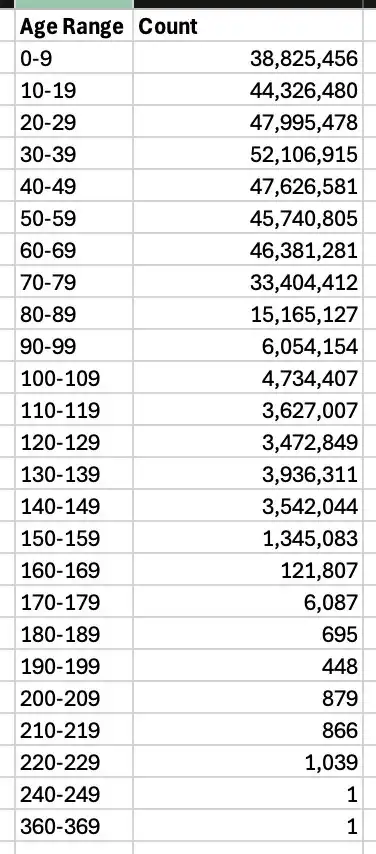
On February 17, Musk tweeted sarcastically: "According to the Social Security database, these are the number of people in each age group with the death flag set to FALSE! Maybe 'Twilight' is real and there are many vampires collecting Social Security benefits." Accompanied by the following image. The image shows that there are still over 2,000 individuals in the U.S. who are above 200 years old receiving Social Security benefits, with the oldest one being over 360 years old. Obviously, this is a case of fraudulent benefit claims. The Department of Government Efficiency is currently investigating this matter.
Since January 2025 when the newly elected U.S. President Trump appointed Elon Musk to lead the "Department of Government Efficiency" (DOGE), this reform action that transforms government institutions with corporate thinking has quickly garnered global attention. During the World Government Summit from February 11 to 13, when Musk was asked about the mission of the Department of Government Efficiency (DOGE), he bluntly stated that government efficiency reform is like corporate transformation, just on a much larger scale. He cited his Twitter as an example, pointing out that during the reform process, 80% of the workforce was cut but productivity was enhanced through technology, achieving what would have taken five years in just one year. Through the dynamic updates and public information on the official Twitter account "DOGE," the DOGE team is pushing for government cost reduction and efficiency enhancement through radical means, which has brought significant results while also sparking controversies.
Related Article: "Terminating Hundreds of Contracts in 18 Days, Musk Leads a Generation Z Revolution in the U.S."
Here is a summary of Musk's recent key actions with the Department of Government Efficiency:
On February 11, the Department of Agriculture terminated 18 contracts totaling around $9 million; the Department of Education terminated 29 DEI training grant contracts amounting to $101 million and terminated 89 contracts worth $881 million;
On February 13, the Department of Education verified the cancellation of unnecessary expenditure contracts totaling $9 million; the EPA canceled 3 DEI contracts, saving $45 million; in addition, 58 contracts were canceled, saving over $150 million, involving categories such as media, DEI, and consulting;
On February 14, 167 plans were canceled, saving approximately $115 million; the Department of Education terminated funding to four "Equal Aid Centers," totaling $33 million; canceled the $50 million environmental justice grant to the Climate Justice Alliance during the Biden era, which the alliance believes is how "climate justice is achieved through a free Palestine";
On February 15, 10 institutions terminated 586 contracts with a total ceiling value of $21 billion, securing savings of $4.45 billion; the Department of Education terminated 70 DEI training grants totaling $3.73 billion; canceled 9 wasteful EPA DEI and environmental justice contracts, saving approximately $60 million; recovered $1.9 billion in funds misappropriated by the Department of Housing and Urban Development (HUD) during the Biden administration, which the Treasury Department can now reallocate for other purposes;
On February 16, DOGE canceled a series of foreign aid contracts totaling $7.29 billion, some of which were for seemingly outlandish projects:
Providing $10 million for "Mozambique Voluntary Male Circumcision Surgeries";
Providing $9.7 million to the University of California, Berkeley, for training "a group of Cambodian youth with entrepreneurship-driven skills";
Appropriating $486 million to the "Election and Political Process Strengthening Alliance," with $22 million for Moldova's "inclusive and participatory political processes" and $21 million for voter turnout in India;
$29 million for "strengthening the political landscape in Bangladesh";
......
In addition to the major budget cuts mentioned above, Musk's Department of Government Efficiency has also been streamlining government personnel and intervening in auditing the government's financial system. These two paths have become Musk's gradual approach to the center of power, triggering significant controversy in American society.
Massive Layoffs Extend to Key Public Sectors, Triggering Concerns About Social Services
According to CCTV News reports, as of February 16, the plan initiated by Trump and Musk to significantly reduce the number of federal government employees has resulted in the dismissal of over 9,500 individuals. On February 16 local time, an internal email from the National Institutes of Health (NIH) in the United States indicated that the planned layoff of 1,500 individuals had been adjusted to 1,165, with affected employees placed on leave starting from the 17th. This adjustment is believed to be related to pressures on public health services, but the specific layoff criteria have not been disclosed, raising questions about the continuity of medical research. In addition, several departments under the U.S. President announced the number of layoffs and layoff plans on that day:
The Environmental Protection Agency stated that 388 employees have been laid off;
The Centers for Disease Control and Prevention in the U.S. will have nearly 1,300 probationary employees forced to resign, constituting approximately one-tenth of the agency's total workforce;
The U.S. Forest Service will dismiss approximately 3400 new employees;
The National Park Service will eliminate about 1000 positions;
......
Such a large-scale layoff plan has caused a huge uproar in the United States. The Democratic Party has sharply criticized this, and the public has taken to the streets, launching multiple protest activities. Personnel changes in the public sector directly affect people's quality of life and the stable development of society.

Image Source: YouTube Channel TVBS
The Battle for Sensitive Data: Taxpayer Privacy and National Security Controversy
The Washington Post
revealed on February 17 that the DOGE team requested access to IRS taxpayer information, claiming it was for auditing government expenditure efficiency, but did not specify the data usage scope. This has sparked strong opposition from privacy advocates and Democratic lawmakers, who say it could lead to data misuse or threaten citizen privacy.Although the Treasury Department claims that DOGE only has "read-only" access, many government employees are not convinced and have directly sued the Treasury Department, accusing it of illegally granting the Musk team access to the payment system. Previously, the DOGE team had already used AI to analyze sensitive data from the Department of Education, undoubtedly intensifying concerns about the lack of data security protocols. Data security is no trivial matter, especially when it involves sensitive information of government departments and the public. Once a loophole occurs, it could trigger a trust crisis.
In this battle for sensitive data, DOGE's radical experiment has taken a path of no return. If successful, it may provide a new way of thinking and a model for global government reform, becoming a reference example. However, if it fails, the United States will undoubtedly be mired in political division and a societal trust crisis. Just as Musk said on Twitter: "Either make the government operate like a tech company or be eliminated." However, in this risky experiment, whether the U.S. government can find the right direction for efficient operation is still unknown. And how this storm will ultimately end is a subject of global anticipation.
Recent developments have shown that DOGE's reform has shifted from the initial "cutting contracts, downsizing departments" phase to the deep end: touching on national security data, core public services, and political games. Musk's Silicon Valley-style "disruption" has accelerated the process but also intensified constitutional conflicts and social contradictions. If efficiency and credibility cannot be balanced, this experiment may become the most controversial chapter in U.S. bureaucratic history.
You may also like

Bitcoin ETF Inflows Just Turned Positive After 5 Months of Outflows: What Does That Mean for BTC Price Now?
The Hidden Risks Behind Bitcoin ETF Inflows in 2026: What Traders Should Know. The question now isn't whether inflows are happening. It's what they're telling you about the next phase and whether your portfolio is positioned for it.
Decoding 2026's Bitcoin ETF Data: How to Trade Alongside Institutional Smart Money in 2026
After months of sustained outflows, rolling 30-day net ETF inflows just crossed 30,000 BTC. That's not noise. Historically, when institutional capital rotates back in at this scale, it marks a regime shift — not just a bounce.

Auto Earn Bonus 2026: WEEX vs Binance vs Bybit vs OKX vs Kraken (Only 1 Pays Extra)
Auto Earn 2026: Binance? Bybit? No extra bonus. Only WEEX gives +0.5% + 300% APR referral. Limited-time. See exactly how much more you can earn.

Auto Earn 2026: WEEX Offers 0.5% Extra + 300% APR Bonus — More Than Binance & Bybit?
Most exchanges offer Auto Earn, but only WEEX adds an extra 0.5% bonus on balance growth + 300% APR referral rewards in 2026. Here’s how WEEX compares to Binance, Bybit, OKX, and Kraken — and why you might earn more with a simple toggle.

Seven Green Candles Meet Three White Soldiers | Rewire News Morning Brief

Gold Revisits $4800, Where Is the Top This Year?

Anthropic's Earth's Most Powerful AI So Strong It Made Wall Street Hold Emergency Meeting, But JPMorgan Was Missing Its "Antidote"

Why did Covenant AI flee from Bittensor?

March Exchange Rankings: Market Shrinks Overall, Spot Trading Volume Sees Rare Over 20% Decline

After the node dropped by 70%, Solana is anxious this time

Morning News | Binance officially launches prediction market; Circle introduces stablecoin settlement solution; Bitmine listed on the NYSE main board
WEEX OTC Now Supports EUR Deposits via SEPA Bank Transfer
To provide a smoother, more accessible fiat on-ramp, WEEX OTC has added SEPA Bank Transfer.

Hyperbeat, to launch a "bank" on Hyperliquid
Crypto Market Macro Research: US-Iran Ceasefire, Time to Reassess Risk Assets

Is Bitcoin Forming a Bottom in 2026? How the Tariff Shock and Ceasefire Could Push BTC Toward $75K
Bitcoin may be forming its 2026 bottom near $65K. See how tariff shocks, ETF inflows, and the Iran ceasefire could shape BTC’s next breakout toward $75K.

Stablecoins Hit $315 Billion in 2026: Why This Is the Biggest Trend in Crypto Right Now
Bitcoin may be forming its 2026 bottom near $65K. See how tariff shocks, ETF inflows, and geopolitical signals could shape BTC’s next breakout toward $75K.
Tiger Research: A Comprehensive Analysis of the Most Profitable Businesses and Their Business Models in Crypto
Why is the ceasefire between the U.S. and Iran destined to be unsustainable?
Bitcoin ETF Inflows Just Turned Positive After 5 Months of Outflows: What Does That Mean for BTC Price Now?
The Hidden Risks Behind Bitcoin ETF Inflows in 2026: What Traders Should Know. The question now isn't whether inflows are happening. It's what they're telling you about the next phase and whether your portfolio is positioned for it.
Decoding 2026's Bitcoin ETF Data: How to Trade Alongside Institutional Smart Money in 2026
After months of sustained outflows, rolling 30-day net ETF inflows just crossed 30,000 BTC. That's not noise. Historically, when institutional capital rotates back in at this scale, it marks a regime shift — not just a bounce.
Auto Earn Bonus 2026: WEEX vs Binance vs Bybit vs OKX vs Kraken (Only 1 Pays Extra)
Auto Earn 2026: Binance? Bybit? No extra bonus. Only WEEX gives +0.5% + 300% APR referral. Limited-time. See exactly how much more you can earn.
Auto Earn 2026: WEEX Offers 0.5% Extra + 300% APR Bonus — More Than Binance & Bybit?
Most exchanges offer Auto Earn, but only WEEX adds an extra 0.5% bonus on balance growth + 300% APR referral rewards in 2026. Here’s how WEEX compares to Binance, Bybit, OKX, and Kraken — and why you might earn more with a simple toggle.


 App
App