
 Buy Crypto
- Markets
 Futures
- Spot
- Copy Trade
- Earn
- More
CEX Exchange's New Coin Liquidation Exceeds $65 Million, Is the "Bear Market Bull" Coming to an End?

Summary: When retail investors' mindset is formed, the next step is harvesting
Today's best joke must be "Auntie transferred money to OKX, found that there was no such coin as PI, then saw IP at the top of the gainers list, angrily cursed the exchange for being too careless, got on board decisively."
As you can see, waking up this morning, the gainers list is full of new coins, as of the time of writing:
IP is up 47% in the last 24 hours, reaching a high of $8.9
KAITO is up 51% in the past 24 hours, reaching a high of $2.1
BERA is up 30% in the last 24 hours, reaching a high of $9.6
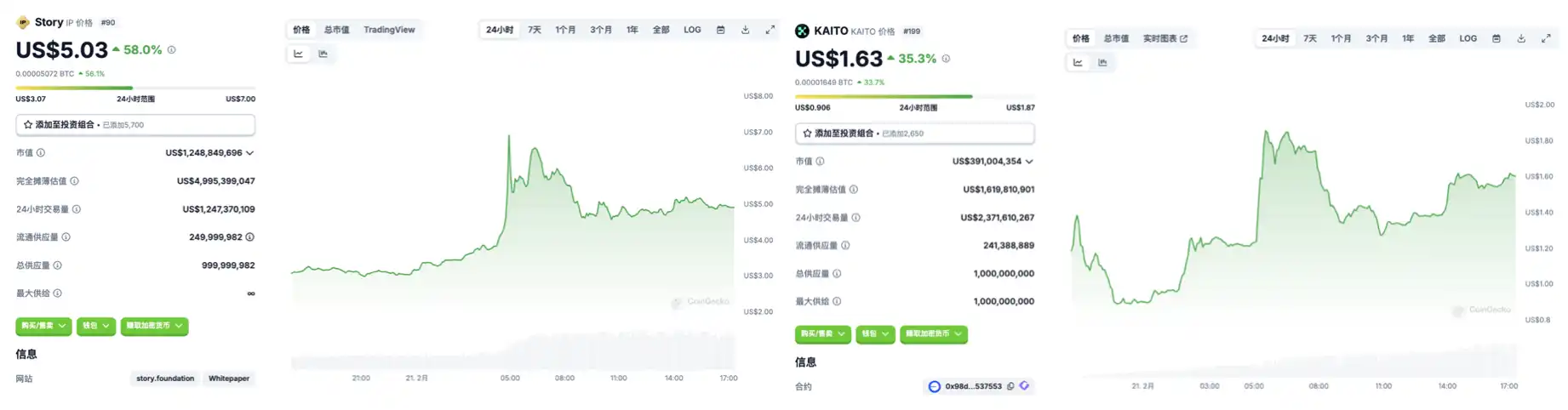
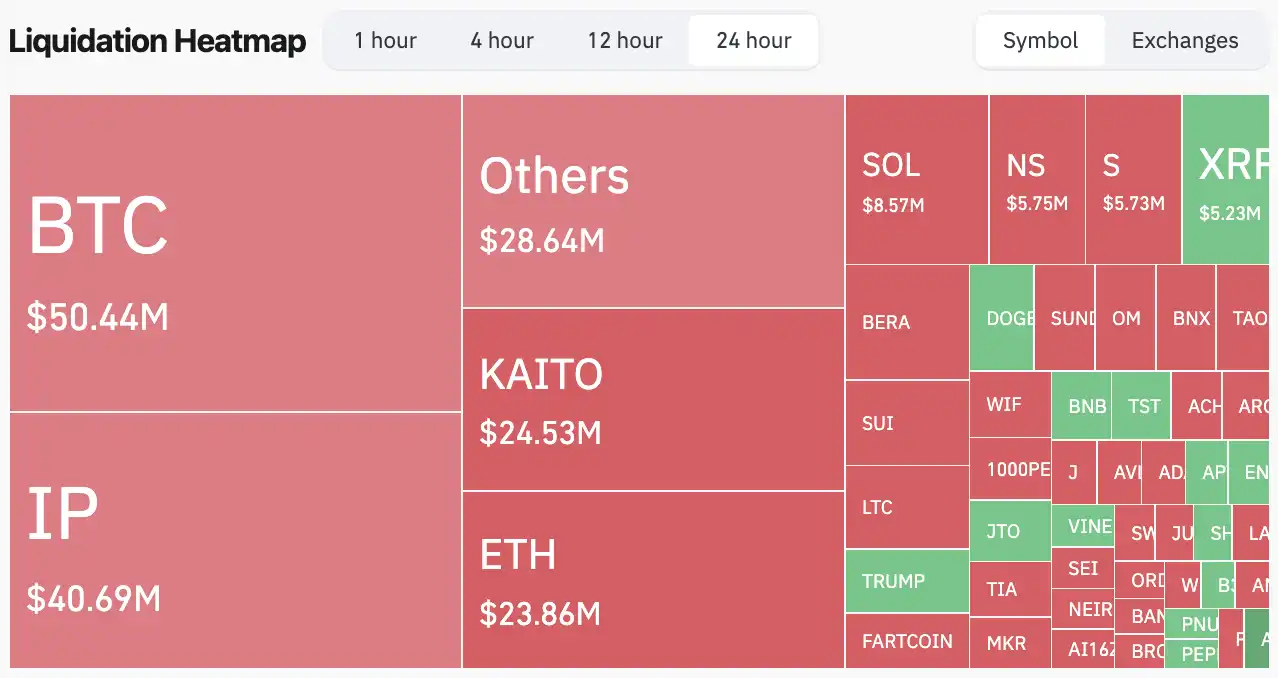
Market data shows that the IP contract price on the OKX platform reached $9 in the early hours of today, with a spot price of $8.96, up about 550% from the low on February 16. Coinglass data shows that the total liquidation in the IP contract trading on the network in the last 24 hours was $40.69 million, second only to BTC contract trading (liquidation of $50.44 million), with long liquidation of $10.38 million and short liquidation of $30.31 million.
Meanwhile, KAOTO's trading volume surpassed $2.5 billion, with a total network contract liquidation of $24.53 million, ranking third across the network in 24 hours, second only to BTC and IP, with long liquidation of $10.31 million and short liquidation of $14.22 million.
Why is there a liquidation frenzy?
Many investors exclaimed that this kind of market behavior is not common market behavior at all but more like the sophisticated manipulation of whales, market makers, or operators who believe that the cost of quickly driving up the price is far lower than consuming the positions of retail traders in liquidation.
In the past, when the price of a token rose, there would usually be a profound narrative, but the current situation is that fundamentals and price are barely related.
Some time ago, token burns by PENGU, or price buybacks by JUP did not cause a particularly significant reaction at the price level. Since "if you don't like it, you can short it" has become a consensus, the so-called "fundamentals" of new coins are hardly noticed by anyone. As long as the contract is launched, the whole network experiences a situation where negative rates are maxed out, and the bears rush in. "Profound narratives" are a thing of the past, and market trading behavior is now dominated by funds and contract leverage.
And when the mindset of retail investors is formed, the next step is harvesting. You can already see clues from the IP liquidation data: when everyone is on the "short" side, the whales only need to invest a relatively limited amount of money to drive up the coin price, allowing them to "consume" the liquidation positions of retail traders and profit from "contract liquidation."
Some in the community jokingly refer to it as "there are no retail investors who wake up at 4 a.m. and use $100 million to push the price to $9; this is the work of whales." For whales, rapidly pumping the price in the short term to benefit from the liquidation of short positions is often faster and more direct than slowly accumulating on the secondary market. Once those shorting retail investors are liquidated in a turn of events, whales can lock in profits at a high price. This back-and-forth movement of funds tilting towards whales makes the subsequent price manipulation easier.
The reason new coins can play this way is fundamentally because their liquidity and circulation are not as abundant as mainstream coins, allowing large funds to easily manipulate the market. If the hype is sufficient in the short term, whales are still willing to test the retail investors' loss tolerance.
Although many people love to summarize the market with "it won't rise if everyone is bullish," in the high-leverage, high-volatility ecosystem of new coin contracts, this rule is often amplified by the market's reflexivity. In short: as soon as the shorts become mainstream, whales often choose to liquidate them all. However, there is not a single way to liquidate the weak hands; market whales can both pump up the price and massively dump it when retail investors switch to "buying the dip" long positions. Therefore, simple "mindlessly chasing long" or "mindlessly longing" strategies may lead to being harvested.
With each round of the new coin myth, many people may harbor a sense of luck, thinking they are quick enough to avoid being harvested. However, most of the harvested weak hands initially thought they could take profits at the right time, but the outcome often leads to quicker liquidation triggers than imagined.
In this battle between retail investors and whales, in a market where everyone wants to short, whales, who nurture market groupthink, excel at harvesting during chaos, with reflexivity and capital leverage as their double-edged sword. To stay alert, the only thing one can rely on is perhaps a respect for risk and an understanding of market mechanisms. After all, the one who laughs last must have understood the logic and techniques behind the scenes, rather than blindly following the crowd. Whether the next price movement continues to skyrocket or plummet, rational and cautious behavior is always the best strategy.
You may also like

The bear market has arrived, and cryptocurrency ETF issuers are also getting involved

The richest man had a quarrel with his former boss

BTC Firm Above 70K! Saylor’s "Institutional Logic" vs. Moon’s "Retail Faith": Who is Really Harvesting the Market?
Bitcoin is holding firm above the $70,000 support level following a massive short squeeze that liquidated $427 million. As the "Four-Year Cycle" narrative shifts, the market is split: Michael Saylor’s cold, institutional "indiscriminate stacking" vs. Carl Moon’s high-energy retail "hopium." This article decodes these two polar-opposite strategies for the 2026 bull run and reveals how WEEX’s institutional-grade liquidity and AI trading tools empower every type of investor to convert market volatility into profit.

The Girl Who Created the SBTI Test: A Story of a Doomed Cyber Love, an E-Widow Ratfolk

B.AI Officially Launched: Building AI Agent Financial Bedrock Platform, Driving AGI Era Business Underlying Logic

B.AI Officially Launched: Breaking Down A2A Collaboration Barriers to Unlock the Smart Body Economy's Full Potential
We helped Xu Mingxing write a book called "<OK Life>".

Rare APY of 400%, is TradeXYZ handing out money to oil bulls?
a16z: Perpetual Contracts are Rewriting Global Trading Rules

Bitcoin Hits $73,000 Triggering $427M Short Liquidation | Carl Moon: $200,000 is the Target
April 9, 2026 (UTC+0), 22:17. Bitcoin (BTC) executed a high-velocity surge within minutes, heavy-hitting the $73,000 psychological barrier and touching a local high near $74,000. While the price has since retraced to consolidate above $72,000, this "instant ambush" successfully completed a $427M liquidation of short positions.

a16z partner: perpetual contracts are rewriting the global trading rules

Bitcoin ETF Inflows Just Turned Positive After 5 Months of Outflows: What Does That Mean for BTC Price Now?
The Hidden Risks Behind Bitcoin ETF Inflows in 2026: What Traders Should Know. The question now isn't whether inflows are happening. It's what they're telling you about the next phase and whether your portfolio is positioned for it.
Decoding 2026's Bitcoin ETF Data: How to Trade Alongside Institutional Smart Money in 2026
After months of sustained outflows, rolling 30-day net ETF inflows just crossed 30,000 BTC. That's not noise. Historically, when institutional capital rotates back in at this scale, it marks a regime shift — not just a bounce.
Auto Earn Bonus 2026: WEEX vs Binance vs Bybit vs OKX vs Kraken (Only 1 Pays Extra)
Auto Earn 2026: Binance? Bybit? No extra bonus. Only WEEX gives +0.5% + 300% APR referral. Limited-time. See exactly how much more you can earn.

Auto Earn 2026: WEEX Offers 0.5% Extra + 300% APR Bonus — More Than Binance & Bybit?
Most exchanges offer Auto Earn, but only WEEX adds an extra 0.5% bonus on balance growth + 300% APR referral rewards in 2026. Here’s how WEEX compares to Binance, Bybit, OKX, and Kraken — and why you might earn more with a simple toggle.

Seven Green Candles Meet Three White Soldiers | Rewire News Morning Brief

Gold Revisits $4800, Where Is the Top This Year?

Anthropic's Earth's Most Powerful AI So Strong It Made Wall Street Hold Emergency Meeting, But JPMorgan Was Missing Its "Antidote"
The bear market has arrived, and cryptocurrency ETF issuers are also getting involved
The richest man had a quarrel with his former boss
BTC Firm Above 70K! Saylor’s "Institutional Logic" vs. Moon’s "Retail Faith": Who is Really Harvesting the Market?
Bitcoin is holding firm above the $70,000 support level following a massive short squeeze that liquidated $427 million. As the "Four-Year Cycle" narrative shifts, the market is split: Michael Saylor’s cold, institutional "indiscriminate stacking" vs. Carl Moon’s high-energy retail "hopium." This article decodes these two polar-opposite strategies for the 2026 bull run and reveals how WEEX’s institutional-grade liquidity and AI trading tools empower every type of investor to convert market volatility into profit.


 App
App