
 Buy Crypto
- Markets
 Futures
- Spot
- Copy Trade
- Earn
- More
Evaluate Solana's new proposal SIMD-0228, what does it mean for SOL validators?

Original Author: David Grid, Partner at FinalityCap
Original Translation: zhouzhou, BlockBeats
Editor's Note: This article discusses the impact of Solana's SIMD-0228 proposal on validator profitability. It estimates the number of Solana validators and their profitability in different scenarios, including changes in inflation, fees, MEV, and other factors. The model also analyzes validator profitability and suggests that Solana could lose a significant number of validators if income decreases.
The following is the original content (reorganized for better readability):
The solana SIMD-0228 has sparked a lot of discussion, but I haven't seen much data on its impact, so I built a model.
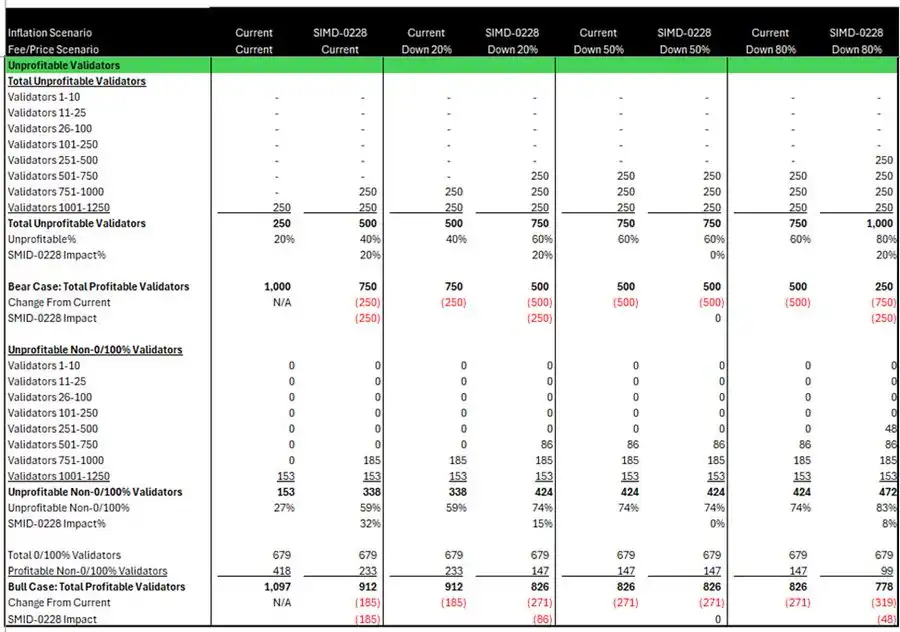
After the implementation of SIMD-0228, Solana could lose an additional 50 to 250 validators under different revenue adjustment scenarios.
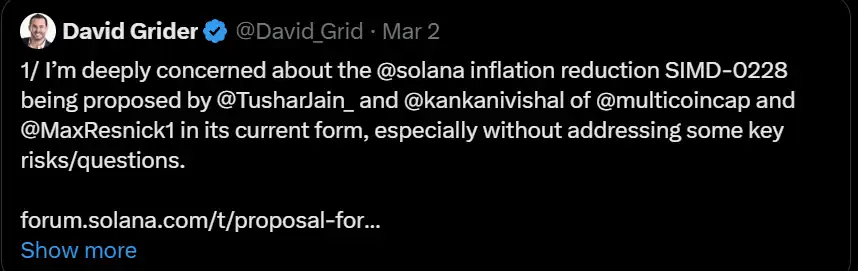
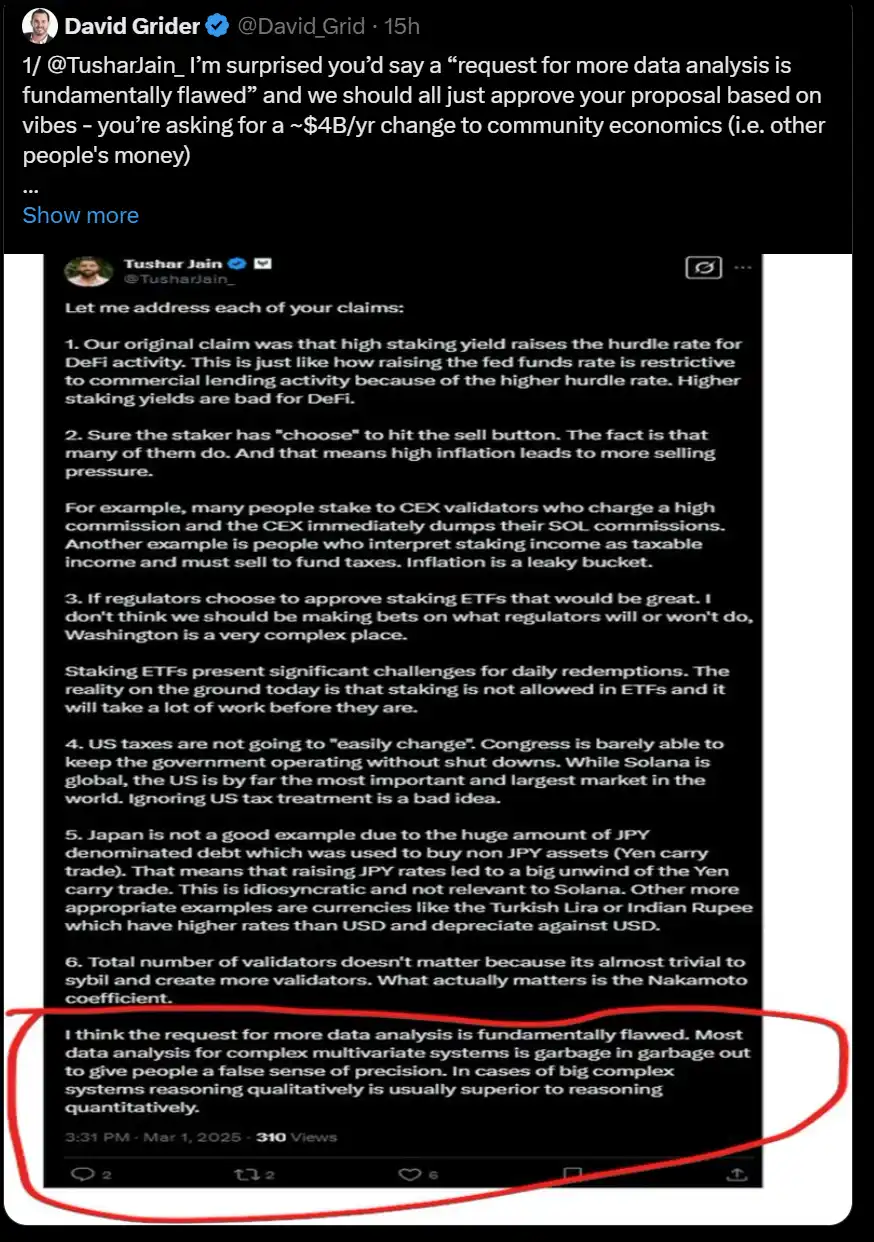
But first, why did I build this model? Because I believe the direction of this proposal is right, but I am very concerned that supporters pushing it forward may think that data is irrelevant.
Here is the link to the model. There is no single correct answer here, and I believe many aspects can be improved, and the assumptions can be further scrutinized. But this is a starting point, and I welcome community feedback.
What is the goal of this model?
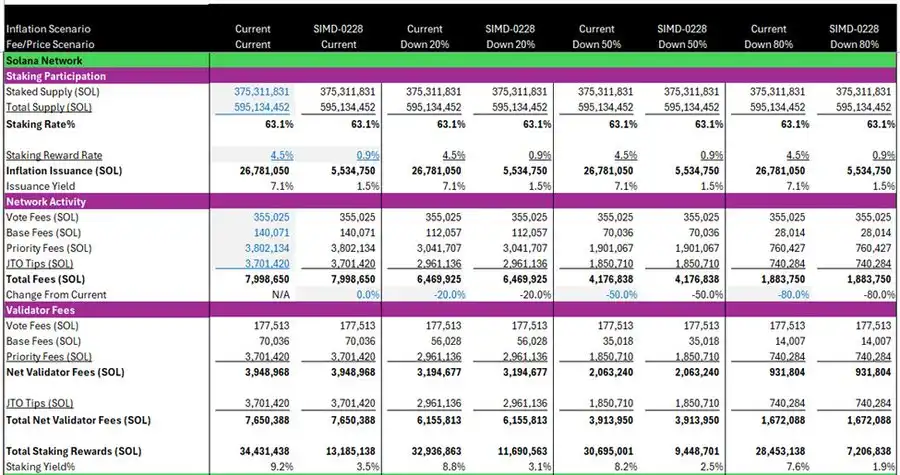
It aims to estimate the number of validators that can remain profitable in various Solana fee/price decline scenarios under the current and proposed SIMD-0228 inflation rates.
The model starts from the current staking and FDV supply, using the current staking reward rate and the reward rate provided by the SIMD-0228 calculator. Anyone can replicate this model and adjust the staking rate for stress testing.
Next, it analyzed the assumption of network fees. I used the 2024 actual fees provided by Blockworks as a starting point and adjusted it down by 20%, 50%, and 80% respectively (voting fees remained unchanged). The model then calculated the burned portion to derive the final validator fee.
The staking distribution data is from Solana Beach, and the model takes the average stake amount in each validator ranking range, assuming that the distribution remains unchanged in all scenarios. However, I believe that under SIMD-0228, staking may become more concentrated.
Then, the model uses the average stake share to estimate the typical validator's SOL fee and inflation reward within that range.
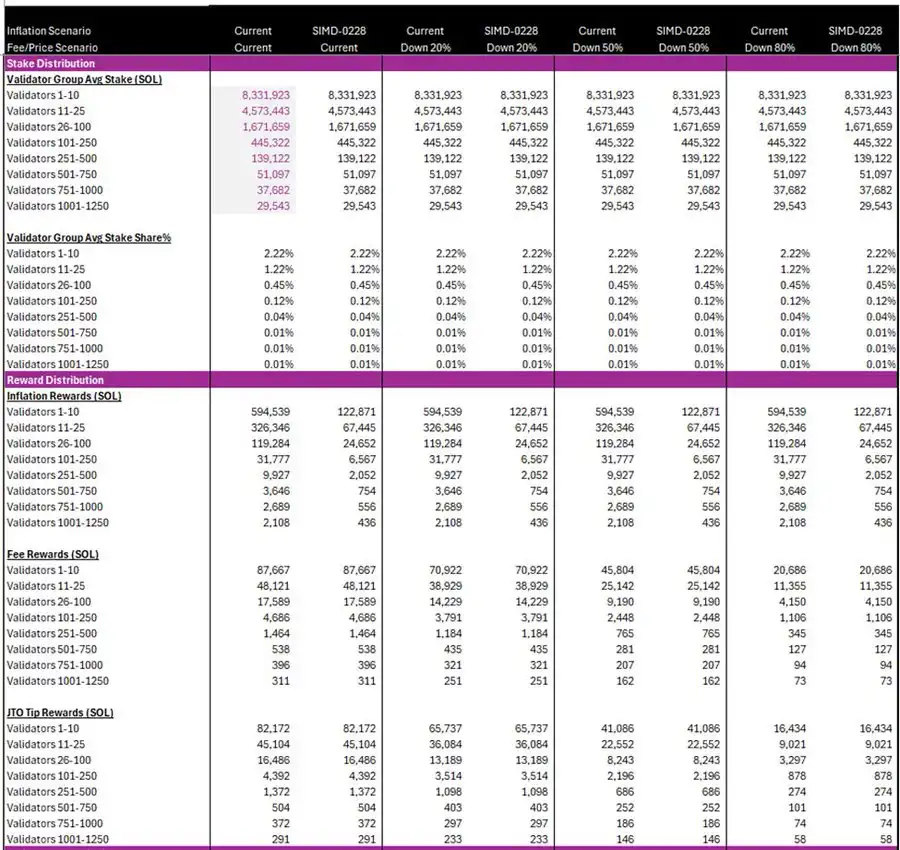
Subsequently, the model analyzed validators within each range with actual non-0% and non-100% commission rates (validators with 100% commission may be private validators) to estimate the optimistic scenario impact of SIMD-0228. It assumes that validators receive commissions from delegators through the following three aspects:
1. Inflation Reward: The model uses the actual average commission per validator group provided by Solana Beach (excluding validators with 0% or 100% commission).
2. Transaction Fees (Voting Fee, Base Fee, Priority Fee): The model assumes 100% goes to the validator.
3. Jito MEV Tips: The model assumes that validators receive 10% of MEV profits.
Are these data completely accurate? No. But they are based on discussions with validators. I highly welcome further community feedback.
One more thing to note: The reduction in the inflation rate by SIMD-0228 may indirectly affect fee allocation. After the inflation reduction, delegators may further compress validator fees and MEV profit shares to compensate for the revenue decrease. Therefore, I believe that validator profitability may have more downside risk than shown in the model.

The commission rate directly affects the SOL income that validator operators receive from various sources (inflation rewards, transaction fees, MEV).
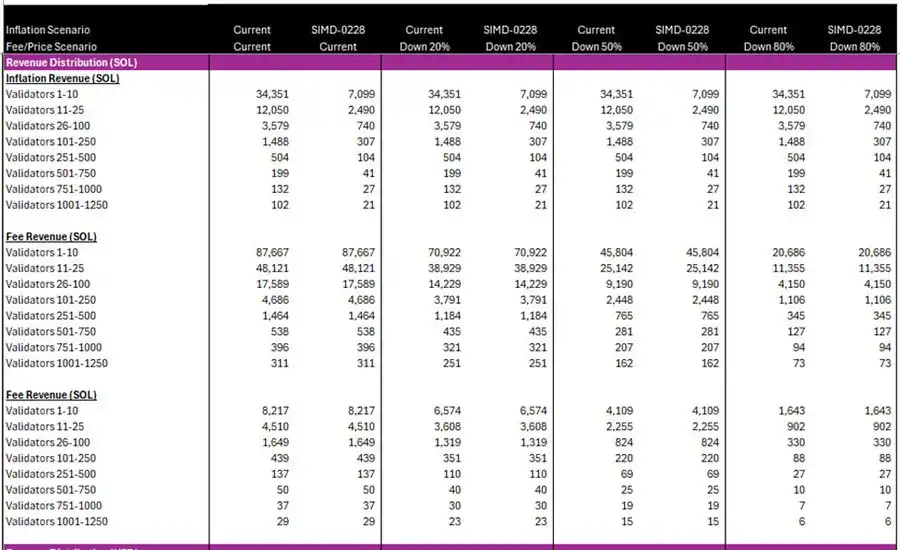
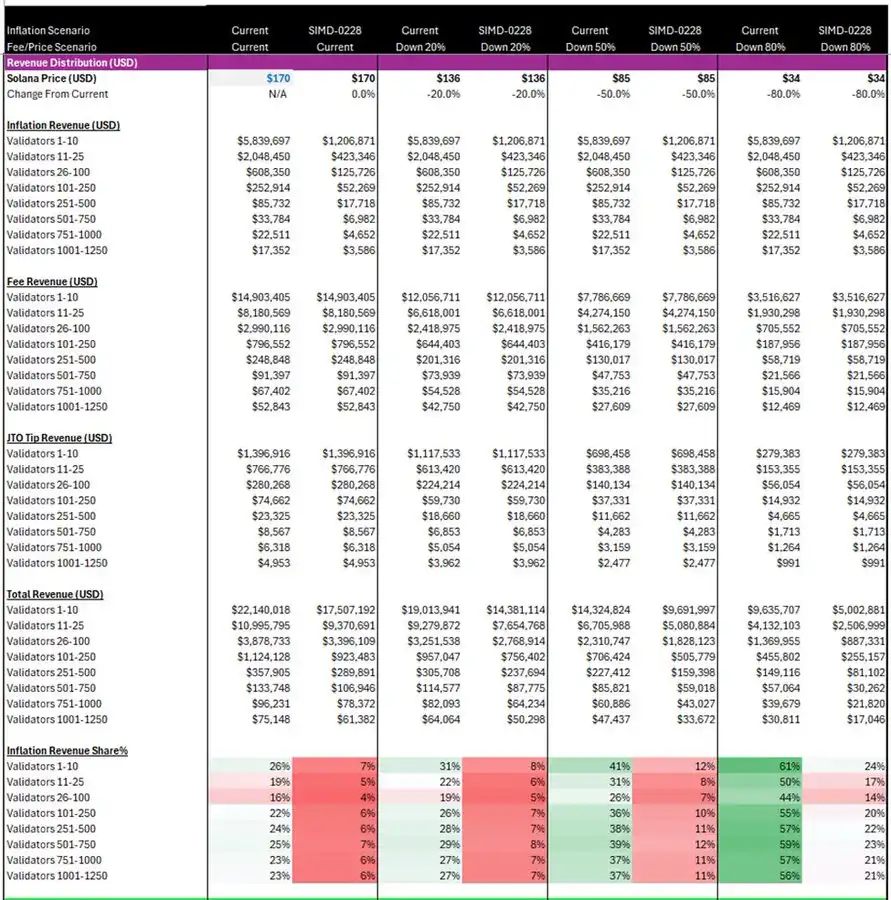
Next, the model takes various SOL price (USD) assumptions and, using the same fee scenario as before, calculates the USD value of the validator's income from various sources. Please note the data at the bottom, where the change in the percentage of inflation rewards in total income is compared between the current inflation curve and SIMD-0228. This illustrates how the importance of inflation is heightened under different scenarios.
Next, the model estimates the annual cost of running a Solana validator to be approximately $85,000.
The fixed cost comes from the validator's infrastructure, with them running two servers along with bandwidth, resulting in monthly costs between $1,500 and $2,000. The model also estimates the variable voting cost based on different SOL prices and current transaction fees.
Currently, the community is discussing adjusting the voting fee to help reduce costs for small validators. You can adjust different levels of the voting fee in the model to observe its impact.
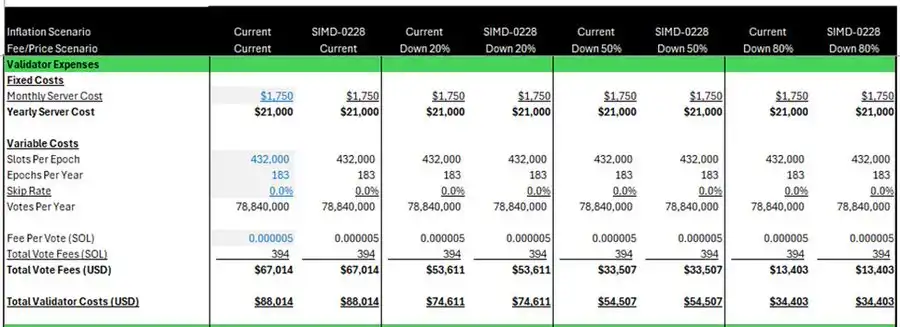
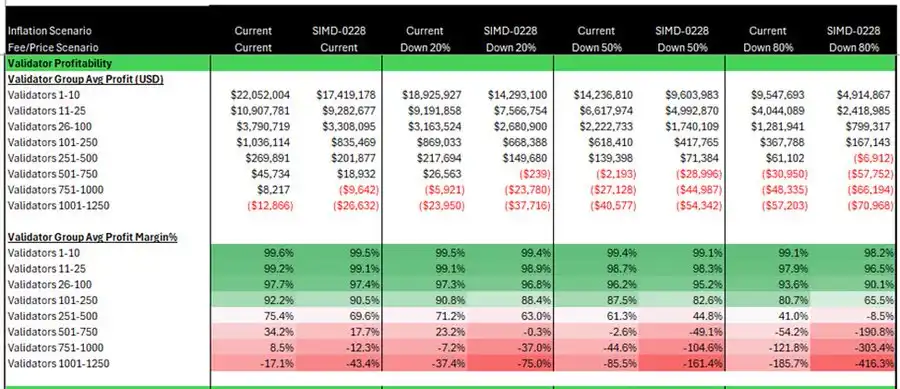
Then, the model derives the average validator profitability segmented by tier. What does the data tell us?
· The smallest 250 validators are still not profitable but remain online, which may be related to the Solana Foundation's delegation program.
· At the current price and fee levels, validators in the 751-1000 tier may no longer be profitable under SIMD-0228.
· If income decreases by 20%, under SIMD-0228, the Solana network could lose an additional 250 validators (validators in the 501-750 tier), who should have been profitable under other circumstances.
· Similarly, validators in the 501-750 tier may continue to remain profitable/online under the current model until their income drops by -50%.
· In the scenario where income drops by 80%, only the top 250 validator tier of Solana may remain profitable under SIMD-0228, while the top 500 validators may still be profitable if inflation remains unchanged.
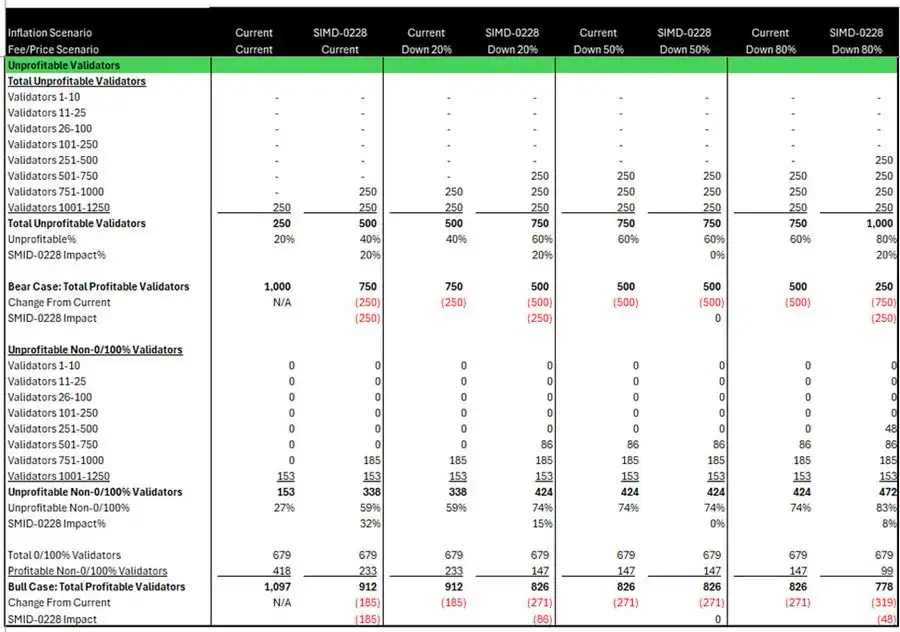
The model analyzed the network's potential validator count under optimistic and pessimistic scenarios by validating profitability level.
· The pessimistic scenario assumes all non-profitable validators leave the network.
· The optimistic scenario assumes only validators with non 0% and 100% commission leave the network.
How Many Validators Should Solana Have?
I don't know the answer. This question is left for the community to decide. I hope this model can help everyone think about SIMD-0228's impact through data rather than intuition.
What Is My Opinion on SIMD-0228?
Right now, I might be neutral. I was previously against it mainly because I felt that not enough analysis had been done to understand its impact. What could make me support it?
Lowering voting fees before implementing SIMD-0228
Adding an adjustment factor targeting not only the staking rate but also the validator count
You may also like

After two years, Hong Kong's first batch of stablecoin licenses finally issued: HSBC, Standard Chartered make the cut

The person who helped TAO rise by 90% has now single-handedly crashed the price again today

3-Minute Guide to Participating in the SpaceX IPO on Bitget

Top 5 Cryptos to Buy in 2026 Q1: A ChatGPT Deep Dive Analysis
Explore the top 5 cryptos to buy in Q1 2026 including BTC, ETH, SOL, TAO, and ONDO. See price outlooks, key narratives, and institutional catalysts shaping the next market move.

How to Earn $15,000 with Idle USDT Before Altcoin Season 2026
Wondering if altcoin season is coming in 2026? Get the latest market update, and learn how to turn your idle stablecoins waiting for entry into extra rewards up to 15,000 USDT.
Can You Win Joker Returns Without Large Trading Volume? 5 Mistakes New Players Make In WEEX Joker Returns Season 2
Can small traders win WEEX Joker Returns 2026 without huge volume? Yes—if you avoid these 5 costly mistakes. Learn how to maximize card draws, use Jokers wisely, and turn small deposits into 15,000 USDT rewards.

Altcoin Season 2026: 4 Stages to Profit (Before the Crowd FOMO In)
Altcoin Season 2026 is starting — discover the 4 key stages of capital rotation (from ETH to PEPE) and how to position before the peak. Learn which tokens will lead each phase and avoid missing the rally.

Will Alt season come in 2026? 5 Tips to Spot the Next 100x Crypto Opportunities
Will altcoin season arrive in 2026? Discover 5 rotation stages, early signals smart traders watch, and the key crypto sectors where the next 100x altcoin opportunities may emerge.

The bear market has arrived, and cryptocurrency ETF issuers are also getting involved

The richest man had a quarrel with his former boss

BTC Firm Above 70K! Saylor’s "Institutional Logic" vs. Moon’s "Retail Faith": Who is Really Harvesting the Market?
Bitcoin is holding firm above the $70,000 support level following a massive short squeeze that liquidated $427 million. As the "Four-Year Cycle" narrative shifts, the market is split: Michael Saylor’s cold, institutional "indiscriminate stacking" vs. Carl Moon’s high-energy retail "hopium." This article decodes these two polar-opposite strategies for the 2026 bull run and reveals how WEEX’s institutional-grade liquidity and AI trading tools empower every type of investor to convert market volatility into profit.

The Girl Who Created the SBTI Test: A Story of a Doomed Cyber Love, an E-Widow Ratfolk

B.AI Officially Launched: Building AI Agent Financial Bedrock Platform, Driving AGI Era Business Underlying Logic

B.AI Officially Launched: Breaking Down A2A Collaboration Barriers to Unlock the Smart Body Economy's Full Potential
We helped Xu Mingxing write a book called "<OK Life>".

Rare APY of 400%, is TradeXYZ handing out money to oil bulls?
a16z: Perpetual Contracts are Rewriting Global Trading Rules
Bitcoin Hits $73,000 Triggering $427M Short Liquidation | Carl Moon: $200,000 is the Target
April 9, 2026 (UTC+0), 22:17. Bitcoin (BTC) executed a high-velocity surge within minutes, heavy-hitting the $73,000 psychological barrier and touching a local high near $74,000. While the price has since retraced to consolidate above $72,000, this "instant ambush" successfully completed a $427M liquidation of short positions.
After two years, Hong Kong's first batch of stablecoin licenses finally issued: HSBC, Standard Chartered make the cut
The person who helped TAO rise by 90% has now single-handedly crashed the price again today
3-Minute Guide to Participating in the SpaceX IPO on Bitget
Top 5 Cryptos to Buy in 2026 Q1: A ChatGPT Deep Dive Analysis
Explore the top 5 cryptos to buy in Q1 2026 including BTC, ETH, SOL, TAO, and ONDO. See price outlooks, key narratives, and institutional catalysts shaping the next market move.
How to Earn $15,000 with Idle USDT Before Altcoin Season 2026
Wondering if altcoin season is coming in 2026? Get the latest market update, and learn how to turn your idle stablecoins waiting for entry into extra rewards up to 15,000 USDT.
Can You Win Joker Returns Without Large Trading Volume? 5 Mistakes New Players Make In WEEX Joker Returns Season 2
Can small traders win WEEX Joker Returns 2026 without huge volume? Yes—if you avoid these 5 costly mistakes. Learn how to maximize card draws, use Jokers wisely, and turn small deposits into 15,000 USDT rewards.


 App
App