
 Buy Crypto
- Markets
 Futures
- Spot
- Copy Trade
- Earn
- More
What Is Vibe Coding? How AI Is Changing Web3 & Crypto Development


In June 2025, an AI hackathon produced an unusual winner: a lawyer. The event — Anthropic’s Built with Opus 4.6: Claude Code Hackathon — gave participants just one week to build real AI applications. But when the results came in, several of the top builders weren’t engineers at all.
First place went to a lawyer. Third place to a cardiologist building between hospital shifts. Another finalist was a musician experimenting with AI-generated tools. None of them were professional developers. Yet within a week, they produced working software — interfaces, tools, and deployable prototypes.
The difference wasn’t their technical background. It was the tools. Instead of writing code line by line, participants relied on AI systems that could generate entire components — from UI layouts to backend logic — using natural-language instructions. A well-crafted prompt could produce what once required days of engineering work.
This emerging approach now has a name circulating across the tech world: vibe coding. And if the trend continues, it may quietly reshape who gets to build the next generation of Web3 applications.
What Is Vibe Coding?
The term “vibe coding” was popularized by AI researcher Andrej Karpathy to describe a new style of software development emerging in the age of AI.
For decades, building software required developers to translate ideas into precise programming syntax. Every database query, interface element, and system interaction had to be written manually. In simple terms, the traditional workflow looked like this: human → code → software.
Vibe coding flips that model. Instead of writing every line of code, builders describe what they want and AI generates the implementation. The workflow increasingly looks like human idea → prompt → AI → software.
Consider a simple instruction such as: “Build a crypto portfolio dashboard with wallet login and token analytics.” Modern AI coding tools can generate the interface layout, backend logic, and database structure required for the application. The result still requires human oversight and refinement, but it dramatically shortens the distance between an idea and a working prototype.
In practice, building software begins to resemble directing an intelligent collaborator rather than programming a machine.
Why Vibe Coding Matters for Web3 Development
For the crypto industry, this shift could have unusually large consequences.
Building a Web3 application has historically required navigating a dense layer of technical complexity. Developers must write smart contracts, integrate blockchain wallets, and manage decentralized infrastructure — all while ensuring the system is secure enough to handle real financial value.
On networks like Ethereum, builders often rely on specialized languages such as Solidity, where even small mistakes can lead to significant financial losses. As a result, many projects require extensive testing and professional security audits before launching. The outcome is a familiar constraint across the crypto ecosystem: far more people can imagine a Web3 idea than can actually build one.
AI-assisted development may begin to narrow that gap. When interfaces, dashboards, and backend systems can be generated through prompts, early experimentation becomes much easier. What once required a team and months of development can increasingly begin with a single builder testing an idea.
The path from concept to prototype, which once looked like this: idea → recruit engineers → months of development, is starting to look more like this: idea → prompt → prototype. And when experimentation becomes easier, the number of people willing to build tends to grow quickly.
How AI Coding Tools Enable Non-Technical Builders
As the tools of software creation evolve, the profile of who builds may begin to change as well.
For much of Web3’s history, launching an application required specialized engineering skills. But if AI systems can handle much of the underlying code generation, the barrier to entry shifts from technical execution to idea formation and problem definition.
This opens the door for a broader group of participants. Designers, traders, researchers, and domain experts — people who understand problems within the crypto ecosystem but lack formal programming training — may increasingly be able to turn their ideas into working prototypes.
That shift could matter in an industry driven by experimentation. Many of Web3’s most influential products began as small projects built by individuals or tiny teams. If the cost and complexity of early-stage development continue to fall, the number of people willing to test new concepts may grow significantly.
In that environment, the next meaningful Web3 innovation may not necessarily come from a traditional engineering team. It could just as easily begin with someone who simply had an idea — and the tools to build it.
How AI Is Lowering the Barrier to Web3 Development
Lowering the barrier to building software tends to produce one predictable result: more experimentation.
If creating a Web3 application no longer requires months of engineering work, more individuals will be willing to test ideas that previously would have remained theoretical. A trader might build a portfolio analytics tool. A researcher could prototype a decentralized data platform. A creator might launch a new type of on-chain community product.
The early internet saw similar waves of experimentation whenever creation tools became easier to use. In Web3, where innovation often emerges from small teams and rapid iteration, a growing pool of builders could accelerate the pace of new ideas.
Of course, easier building also brings more noise. Not every experiment will succeed, and some projects will inevitably be short-lived. But historically, periods of rapid experimentation are also when new categories of products tend to emerge.
How AI and Crypto Could Power the Next Generation of Web3 Apps
If AI tools increasingly handle the creation of software, another question naturally follows: how will these applications operate economically?
Software still needs mechanisms for payments, ownership, and value exchange. Traditional financial infrastructure often involves intermediaries, geographic limitations, and slower settlement. By contrast, blockchain networks such as Ethereum offer programmable infrastructure where transactions, incentives, and digital ownership can be managed directly through smart contracts.
This is where Web3 may play an unexpected role. AI can help generate applications quickly, but crypto networks can provide the economic layer that allows those applications to function globally.
In that sense, the relationship between the two technologies may be complementary. AI may increasingly build the software, while crypto provides the economic systems that allow those applications to function globally.
If that model takes hold, the future of Web3 may not be defined by who can write code — but by who has the best ideas to build.
What’s Next: More AI Experiments in Crypto
As vibe coding continues lowering the barrier to building software, crypto may soon see a wave of new experiments. Instead of months of engineering work, individuals can quickly prototype tools, strategies, and applications powered by AI.
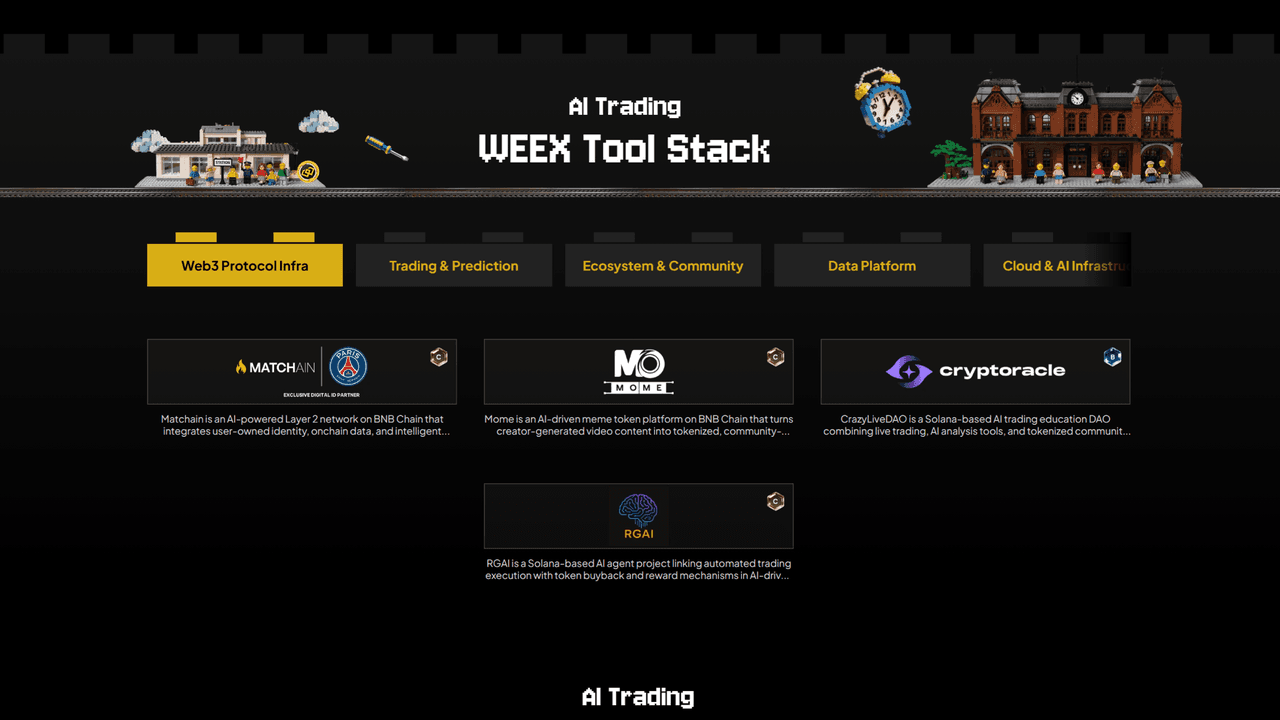
The WEEX AI Trading Hackathon has already explored this shift, bringing traders and builders together to design and test AI-driven trading systems directly in live crypto markets.
If vibe coding is making it easier than ever to build, the next wave of Web3 innovation may come from a much broader community of creators — not just engineers, but anyone with a strong idea. If you're ready to experiment, welcome to the second WEEX AI Trading Hackathon this May.
About WEEX
Founded in 2018, WEEX has developed into a global crypto exchange with over 6.2 million users across more than 150 countries. The platform emphasizes security, liquidity, and usability, providing over 1,200 spot trading pairs and offering up to 400x leverage in crypto futures trading. In addition to the traditional spot and derivatives markets, WEEX is expanding rapidly in the AI era — delivering real-time AI news, empowering users with AI trading tools, and exploring innovative trade-to-earn models that make intelligent trading more accessible to everyone. Its 1,000 BTC Protection Fund further strengthens asset safety and transparency, while features such as copy trading and advanced trading tools allow users to follow professional traders and experience a more efficient, intelligent trading journey.
Follow WEEX on social media
X: @WEEX_Official
Instagram: @WEEX Exchange
Tiktok: @weex_global
Youtube: @WEEX_Official
Discord: WEEX Community
Telegram: WeexGlobal Group
You may also like

The biggest bottleneck in DeFi development

CZ Memoir Released: Reveals a Large Amount of Industry Insider Information, Prompting Intense Rebuttal from Xu Mingxing

a16z: After securities are on the blockchain, why will intermediary institutions be replaced by code?

XRP Tokyo Is Here: What We Learn and What’s Next for XRP Price
Key Takeaways: Ripple’s 2025 XRP Tokyo event highlights a projected $33 trillion on-chain stablecoin volume by 2026. Significant…

Solana’s Future: Navigating the $285M Hack, Rug Pulls, and Milei Libra Scandal
Key Takeaways: Multiple Crises: Solana faces a $285 million hack, allegations of rug pulls, and the Milei Libra…

BTC USD Faces Tension: Markets React to Trump’s Dire Warning
Key Takeaways: Bitcoin’s price drops sharply below $70,000 amid geopolitical tensions, playing off Trump’s dramatic 8 PM ultimatum…
Bitcoin Price Surge: Ceasefire Sparks Optimism Hits $71K
Key Takeaways: After the US-Iran ceasefire announcement, Bitcoin surged beyond $71,000, marking its highest in a month. A…

Ethereum Price Forecast: Record $180 Billion Stablecoin Supply Marks Buyers’ Return
Key Takeaways: Ethereum’s stablecoin supply has surged to a record $180 billion, marking a 150% increase over the…

Emerging Evidence Links Argentina’s Milei to LIBRA Crypto Scandal
Key Takeaways: Evidence unveiled by Argentina’s federal prosecutors links President Javier Milei to the LIBRA token through call…

US Spot Bitcoin ETFs See Surge as BTC Nears $70K; LiquidChain and Layer-3 DeFi Rise
Key Takeaways: U.S. spot Bitcoin ETFs absorbed $471 million in a single day, moving BTC closer to the…

Bitcoin Price Prediction: Decoupling from Tech Stocks, Shaped by Geopolitics and AI Turmoil
Key Takeaways: Bitcoin is decoupling from tech stocks as geopolitical tensions and AI crises reshape the market, currently…

Chaos Labs Departure Leaves Aave Without Risk Management Amidst Governance Conflict
Key Takeaways: Aave, with a $50 billion TVL, is currently operating without a risk manager due to Chaos…

Grayscale Ethereum ETF Staking: A New Catalyst for $5,700?
Key Takeaways: Grayscale’s Ethereum Staking ETF introduces a yield-bearing structure that could significantly reshape investor sentiment. Ethereum’s price…

Polygon Crypto Enhances Finality Through the Giugliano Hardfork
Key Takeaways: Polygon’s Giugliano hardfork is operational on the mainnet, effectively reducing transaction finality by 2 seconds. The…

Senate’s Three-Week Deadline: Ripple XRP and the CLARITY Act’s Critical Moment
Key Takeaways: The Senate Banking Committee’s decision on the CLARITY Act in late April could define XRP’s future…
Solana Foundation Introduces STRIDE for DeFi Security
Key Takeaways: STRIDE is a structured security evaluation program for Solana’s DeFi ecosystem, managed by Asymmetric Research. It…
Trump Iran Doomsday Deadline Revisited: How Will Bitcoin and SPX Respond?
Key Takeaways: The geopolitical tension surrounding the Trump Iran deadline poses significant risks to Bitcoin prices and the…

XRP Crypto Slips to $1.31: Liquidity Challenges and Market Movement
Key Takeaways: XRP has fallen to $1.31, struggling after a rejection at the $1.35 level, showing potential liquidity…
The biggest bottleneck in DeFi development
CZ Memoir Released: Reveals a Large Amount of Industry Insider Information, Prompting Intense Rebuttal from Xu Mingxing
a16z: After securities are on the blockchain, why will intermediary institutions be replaced by code?
XRP Tokyo Is Here: What We Learn and What’s Next for XRP Price
Key Takeaways: Ripple’s 2025 XRP Tokyo event highlights a projected $33 trillion on-chain stablecoin volume by 2026. Significant…
Solana’s Future: Navigating the $285M Hack, Rug Pulls, and Milei Libra Scandal
Key Takeaways: Multiple Crises: Solana faces a $285 million hack, allegations of rug pulls, and the Milei Libra…
BTC USD Faces Tension: Markets React to Trump’s Dire Warning
Key Takeaways: Bitcoin’s price drops sharply below $70,000 amid geopolitical tensions, playing off Trump’s dramatic 8 PM ultimatum…


 App
App