
 Buy Crypto
- Markets
 Futures
- Spot
- Copy Trade
- Earn
- More
How to Build a Potential AI Agent Project in a Bear Market?

Original Title: The AI Agent Playbook for Builders
Original Author: Defi0xJeff, Founder of steak studio
Original Translation: zhouzhou, BlockBeats
Editor's Note: This article discusses the correct way to build a crypto AI agent, emphasizing that the agent should complement the core product by changing the user journey to enhance product value, rather than relying solely on the token. Entrepreneurs should focus on solving real-world problems, building a sustainable core product, and then using agents and tokens for promotion and monetization.
The following is the original content (slightly reorganized for easier comprehension):
The market has experienced multiple pullbacks, with liquidity gradually becoming scarcer. Recently launched successful new agents have a maximum market cap of around $10 million.
By "successful," I mean the product has achieved Product-Market Fit (PMF), provided value to actual users, and has started (or is about to start) generating revenue. This is very different from three to four months ago when agents with PMF could have market caps exceeding $1 billion, especially if they positioned themselves as agent+framework/launchpad tokens. For example, AVA as a 3D agent not only serves as an agent itself but also derives value from the launchpad and supported projects through its sensory layer.
Old Playbook: Agent as Framework
The previous approach was to launch an agent to showcase its capabilities, attract developers looking to build their own agents, and require these developers to hold/burn/pay agent tokens to access the framework. The issue was that the crypto community assigned too high a premium to framework tokens, and these "framework agents" often lacked differentiation. In many cases, they did not even have a product—they were just talking on Twitter, hoping for token price appreciation.
The first version of agents treated the conversational agent itself as a product, which is unique in the crypto space as we value community building more—similar to founder-led marketing (founders gaining attention through constant chatter). Having agents constantly chatter for your project to increase visibility seemed like a good idea—it worked well when first launched in November 2024, lasting a month. But now, with 420,690 agents constantly chattering, most agents seem immature, repetitive, and frankly annoying.
Playbook: Agent as a Business
Here is how you should think about launching an agent — launching an agent means you will be operating a startup while managing up to three products:
1. Core Product (Real Business)
Your core product should solve a real-world problem. It should not just be a conversational agent but a true product.
Example:
· Improve sports betting odds prediction models to help users win more in sports betting (e.g., crypto community AskBillyBets).
· Develop a crypto asset prediction model that enables better trading, minimizes impermanent loss, and maximizes liquidity provider returns (e.g., crypto communities Cod3xOrg, gizatechxyz, and Almanak).
· Aggregate insights from top alpha sources (such as Cookie, Kaito, Nansen, Messari, Aixbt, CG, Dexscreener, and Bubblemaps) into an AI agent research search engine to aid investment decisions (currently, no team is solving this problem — we need an AI agent like Perplexity).
The core product should be the top priority before any team launches a token. You need to ensure there is actual demand in the market and users are willing to pay for it. Otherwise, you will fall into the "crypto valley," the consequences of which may be more severe than traditional startups:
· High operational costs.
· Token-funded customer acquisition costs (CAC).
· Token price crash → Reputation collapse → No one cares about your project.
If your token crashes, it becomes a curse. Most people won't care about your project regardless of how strong your core product is or how much progress you've made.
Instead of relying on token incentives, focus on attracting customers through your product. Find a balance between growth and revenue-generating business models.
The playbook of the crypto community KaitoAI is a good case study:
· They built an enterprise product — a crypto search engine focused on social/emotion/narrative and charged users, projects, and the ecosystem, providing real value.
· They launched the Mindshare Dashboard, becoming the standard for tracking narratives and trends.
· They intensified their efforts by introducing the Yapper Leaderboard, allowing KOLs to spontaneously share it as a status symbol.
· They further rolled out NFT WL and KAITO airdrop, incentivizing Twitter engagement through actual rewards.
This approach is not easy to replicate, but the lesson is: first find PMF, generate revenue, get people excited before launching the token. Once you have attention (hype) and revenue, you can move to the next level.
Similarly, communication is crucial. Many projects have strong products but poor communication skills. If no one knows what you are doing, no one will care.
2. Token (Alignment Tool)
We have transitioned from "VC coins" to "fair launch," celebrating tokens with high circulation and low FDV. But fair launch is not entirely fair—every token strategy has its trade-offs.
If the token you launch has a high circulation and low FDV structure, you will not be able to raise funds from VCs and angels (because of undervaluation). However, you can use the token as a marketing tool to kickstart ideation sharing.
Many teams will launch two types of tokens:
· Protocol Token → Kickstarts Ideation Sharing.
· Ecosystem Token → Raises funding from VCs and angels at a higher valuation.
But this creates an expectation mismatch—communities expect airdrops, and when the ecosystem token is released, capital moves from the protocol token to the ecosystem token, leading to a collapse in the protocol token price. Managing the core product + protocol token + ecosystem token while ensuring value accrual for each token is very complex.
In an ideal world, there should be a token that accumulates all the value from the core product. Historically, projects that could generate revenue and funnel it back into the token (through buybacks or revenue distribution) have been able to survive long-term.
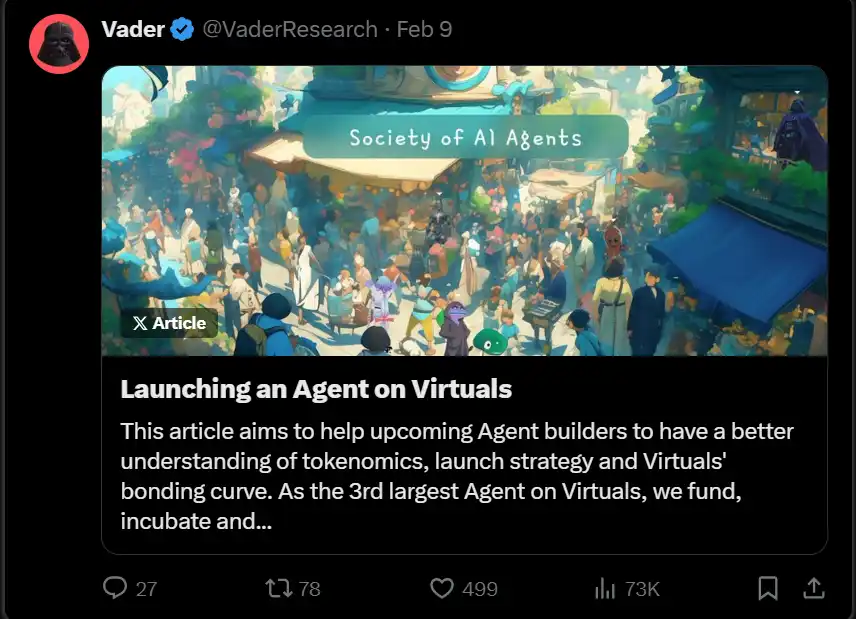
Tokens should complement the core product, not be a necessity. To delve deeper into protocol token strategy, please refer to the crypto community VaderResearch's analysis of the protocol token playbook for the crypto community at virtuals io.
3. Agent (Supplementary Product)
「Agent」 refers to conversational agents built using frameworks like ElizaOS, G.A.M.E, ARC, Pippin, etc. While these agents integrate on-chain/off-chain capabilities, they should be supplementary products to the core product.
Agents should enhance the value of the core product by altering the user's path:
Instead of having users actively seek out and use your product, let the agent bring the product to them.
This could mean:
· Showcasing the product directly on Twitter through text/video.
· Having the agent act as an AI companion, changing the user's interaction style (similar to ChatGPT's abstraction).
· Using the agent as the interface itself, executing tasks in the background.
Of course, there are exceptions. An example is the aixbt agent—it provides real-time social and sentiment analysis from Twitter, allowing users to access real-time Alpha signals ahead of others. Aixbt, by consistently providing Alpha, showcases the terminal's capability and has become the No. 1 KOL in CT. In this case, the agent itself is the product.
However, this model is extremely challenging to replicate. Most projects should focus on strengthening the core product first.
A successful product-first case study is cookiedotfun:
· Starting with a free AI agent dashboard to attract users.
· Transitioning to a freemium model by locking COOKIES to unlock advanced insights.
· Monetizing through providing API for projects and agents.
· Launching agentcookiefun to directly bring insights to Twitter.
Summary
In 2020-21, launching a token required mastering Solidity. But now platforms like pumpdotfun make it easy to tokenize anything.
This shift in mindset—people no longer focusing on building real products but directly launching tokens—is a "garbage in, garbage out" approach, leading capital to quickly move to the next "garbage." We need to change this.
To build sustainable projects, agent projects should be treated as startups. Instead of seeking funding between CT, VCs, and angel investors, it's better to build projects with long-term value—not for the next 6 months but for the next 6 years.
Innovation, solving real-world problems, building real businesses — not just creating the next speculative meme coin farm.
The future of the crypto AI agent depends on this.
You may also like

After two years, Hong Kong's first batch of stablecoin licenses finally issued: HSBC, Standard Chartered make the cut

The person who helped TAO rise by 90% has now single-handedly crashed the price again today

3-Minute Guide to Participating in the SpaceX IPO on Bitget

Top 5 Cryptos to Buy in 2026 Q1: A ChatGPT Deep Dive Analysis
Explore the top 5 cryptos to buy in Q1 2026 including BTC, ETH, SOL, TAO, and ONDO. See price outlooks, key narratives, and institutional catalysts shaping the next market move.

How to Earn $15,000 with Idle USDT Before Altcoin Season 2026
Wondering if altcoin season is coming in 2026? Get the latest market update, and learn how to turn your idle stablecoins waiting for entry into extra rewards up to 15,000 USDT.
Can You Win Joker Returns Without Large Trading Volume? 5 Mistakes New Players Make In WEEX Joker Returns Season 2
Can small traders win WEEX Joker Returns 2026 without huge volume? Yes—if you avoid these 5 costly mistakes. Learn how to maximize card draws, use Jokers wisely, and turn small deposits into 15,000 USDT rewards.

Altcoin Season 2026: 4 Stages to Profit (Before the Crowd FOMO In)
Altcoin Season 2026 is starting — discover the 4 key stages of capital rotation (from ETH to PEPE) and how to position before the peak. Learn which tokens will lead each phase and avoid missing the rally.

Will Alt season come in 2026? 5 Tips to Spot the Next 100x Crypto Opportunities
Will altcoin season arrive in 2026? Discover 5 rotation stages, early signals smart traders watch, and the key crypto sectors where the next 100x altcoin opportunities may emerge.

The bear market has arrived, and cryptocurrency ETF issuers are also getting involved

The richest man had a quarrel with his former boss
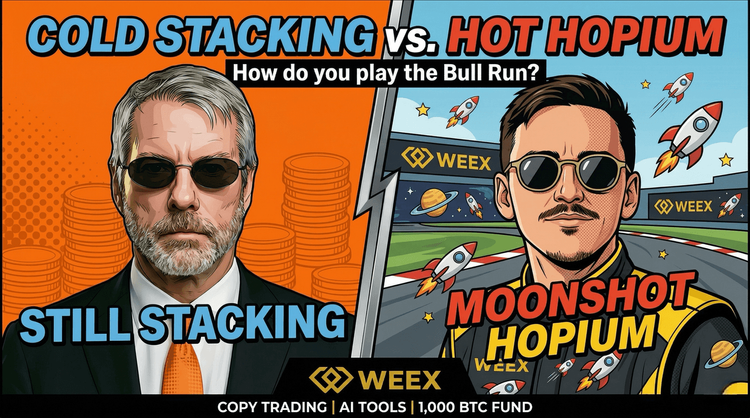
BTC Firm Above 70K! Saylor’s "Institutional Logic" vs. Moon’s "Retail Faith": Who is Really Harvesting the Market?
Bitcoin is holding firm above the $70,000 support level following a massive short squeeze that liquidated $427 million. As the "Four-Year Cycle" narrative shifts, the market is split: Michael Saylor’s cold, institutional "indiscriminate stacking" vs. Carl Moon’s high-energy retail "hopium." This article decodes these two polar-opposite strategies for the 2026 bull run and reveals how WEEX’s institutional-grade liquidity and AI trading tools empower every type of investor to convert market volatility into profit.

The Girl Who Created the SBTI Test: A Story of a Doomed Cyber Love, an E-Widow Ratfolk

B.AI Officially Launched: Building AI Agent Financial Bedrock Platform, Driving AGI Era Business Underlying Logic

B.AI Officially Launched: Breaking Down A2A Collaboration Barriers to Unlock the Smart Body Economy's Full Potential
We helped Xu Mingxing write a book called "<OK Life>".

Rare APY of 400%, is TradeXYZ handing out money to oil bulls?
a16z: Perpetual Contracts are Rewriting Global Trading Rules
Bitcoin Hits $73,000 Triggering $427M Short Liquidation | Carl Moon: $200,000 is the Target
April 9, 2026 (UTC+0), 22:17. Bitcoin (BTC) executed a high-velocity surge within minutes, heavy-hitting the $73,000 psychological barrier and touching a local high near $74,000. While the price has since retraced to consolidate above $72,000, this "instant ambush" successfully completed a $427M liquidation of short positions.
After two years, Hong Kong's first batch of stablecoin licenses finally issued: HSBC, Standard Chartered make the cut
The person who helped TAO rise by 90% has now single-handedly crashed the price again today
3-Minute Guide to Participating in the SpaceX IPO on Bitget
Top 5 Cryptos to Buy in 2026 Q1: A ChatGPT Deep Dive Analysis
Explore the top 5 cryptos to buy in Q1 2026 including BTC, ETH, SOL, TAO, and ONDO. See price outlooks, key narratives, and institutional catalysts shaping the next market move.
How to Earn $15,000 with Idle USDT Before Altcoin Season 2026
Wondering if altcoin season is coming in 2026? Get the latest market update, and learn how to turn your idle stablecoins waiting for entry into extra rewards up to 15,000 USDT.
Can You Win Joker Returns Without Large Trading Volume? 5 Mistakes New Players Make In WEEX Joker Returns Season 2
Can small traders win WEEX Joker Returns 2026 without huge volume? Yes—if you avoid these 5 costly mistakes. Learn how to maximize card draws, use Jokers wisely, and turn small deposits into 15,000 USDT rewards.


 App
App