
 Buy Crypto
- Markets
 Futures
- Spot
- Copy Trade
- Earn
- More
How to Use Your Time to Earn Money in the Crypto World?

Original Title: The Time-Money Illusion: Are You Making The Right Trade?
Original Author: Route 2 FI, Crypto Researcher
Original Translation: ChatGPT
Editor's Note: This article explores the balance between time and money, emphasizing that in the crypto field, the value of money does not increase linearly but varies with time and usage. The author, through personal experiences and reflections, presents strategies on achieving financial freedom and life satisfaction in the crypto space. The article highlights that while earning money is important, finding a balance and meaning in life is crucial. The author advises readers to pursue true freedom and happiness by optimizing their lifestyle, reducing unnecessary expenses, investing in long-term value, and personal growth. Lastly, the author reminds those chasing quick riches that true value lies in long-term investment and building a personal brand, not in short-term gambling.
The following is the original content (slightly rephrased for better readability and comprehension):
Everything involves trade-offs. Today I want to talk about a topic I often ponder: the balance between time and money.
You may recall the amusing debate about whether $1 million is enough for retirement. To me, even posing this question is absurd because in most parts of the world, the numbers discussed on Twitter are entirely unrealistic. I could even say that one-tenth of that amount would suffice for a good life in most places.
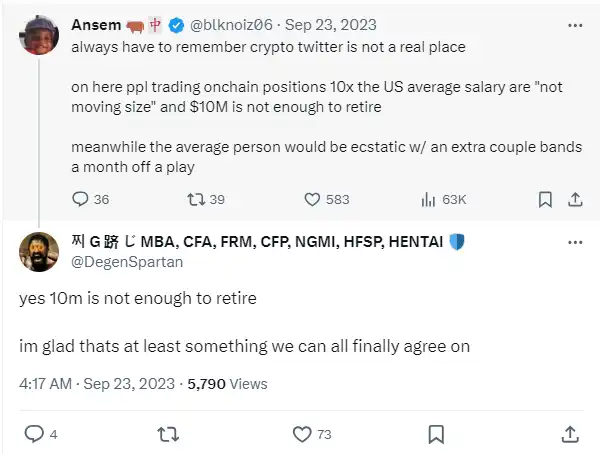
Money is a fascinating thing and not as straightforward as it seems at first glance. We go to work, and in return, we receive money as compensation. We use this money to buy things. However, the value of money will fluctuate with utility and time, depending on how you use it.
Whether you earn your first dollar or your first million dollars, the value of one dollar remains the same. It has the same purchasing power and the same value. Depending on when and how you spend that one dollar, the additional comfort or happiness it brings is often significantly different. After all, what we buy with money is merely a means to achieve the ultimate goal of happiness.
The happiness or utility brought by the first million dollars is not as much as the first dollar. In fact, to some extent, each additional dollar may bring a bit of unhappiness, manifested as added complexity, worry, and reliance on the next dollar.
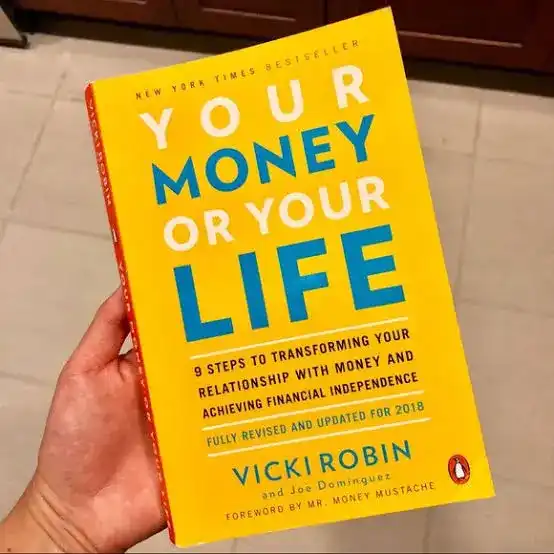
This concept was popularized in the book Your Money or Your Life. This book actually changed everything for me and ultimately led me into the world of Crypto Twitter.
You might have seen the image below before, but a repetition is always good as it provides a great example.
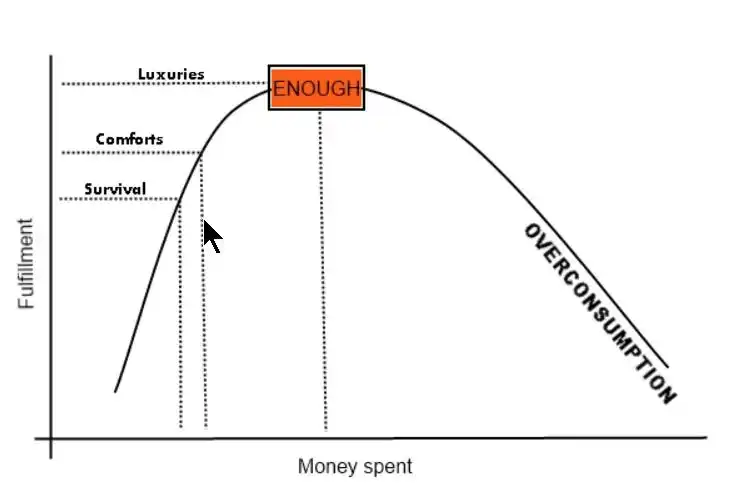
You can see that the more money you spend, the more happiness you gain, but after a certain point, the increase in happiness starts to plateau.
This point is different for everyone. The first few dollars you spend bring more happiness because it is speculated that you spend that money on things that bring more utility, which are more important to you.
At some point, the additional expense has almost no effect.
Money = Time (But Not in the Crypto Space)
Expanding on this idea, money is a representation of our time. Money is a store of value. We exchange our time and energy (our life force) for money, expecting that in the future, we can exchange it for other people's things or their energy.
For most of us, the relationship between time and money is more or less linear. After we finish our education, we exchange X time for Y money.
1X time = 1Y money.
It's not always the case, but usually, especially when we think in terms of working years. For some, there might be a slight curve on the graph, or the slope might change with promotions or job changes.
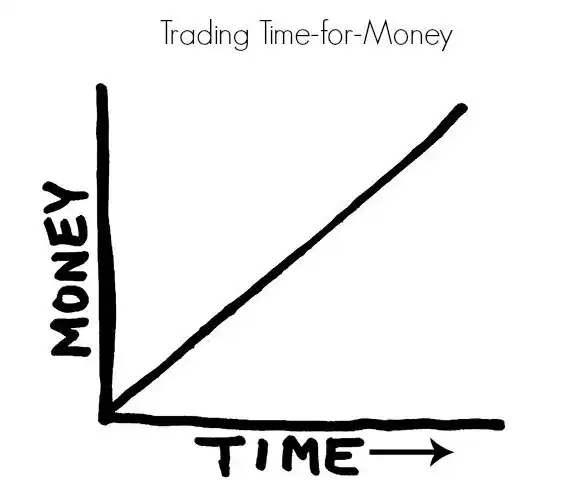
Most people are content with this.
Time = Money
But we, people of the crypto space, know that this is not necessarily true.
This was my understanding of money a few years ago when I decided to focus on achieving early financial independence and freedom. The longer we engage in this time = money exchange in life, the more unfavorable the exchange rate is for us.
Our time is limited. As time progresses, it becomes more and more valuable as we have less time left. Every day brings us closer to death. I know this sounds tragic, but it's a reality.
When you are on your deathbed, how much is your time worth?
How much money would you exchange for a few more days? Would you switch places with 93-year-old Warren Buffett? He has $100 billion but may not have that much time left.
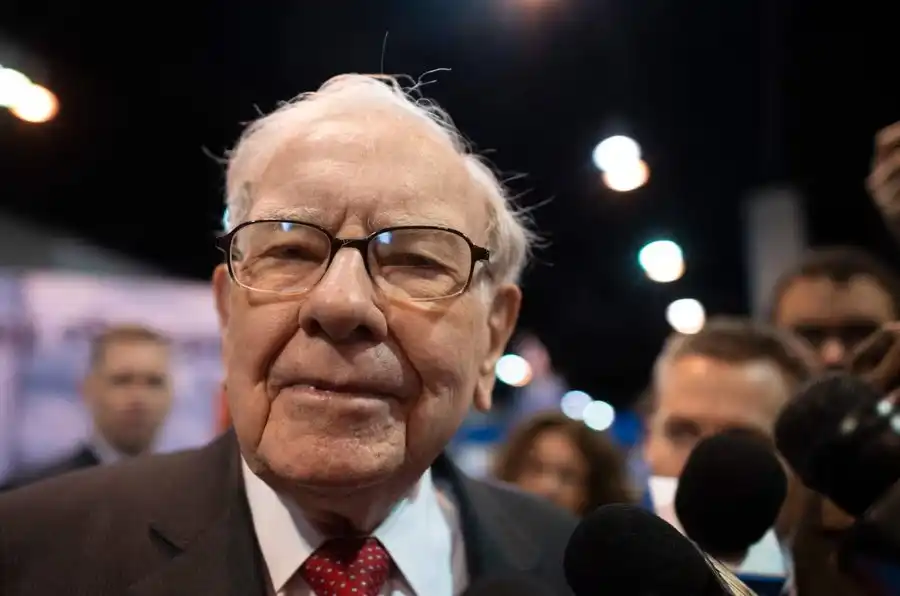
Will you work or spend time on other things?
I don't know about you, but in my life, I am at a crossroads, and I am starting to seriously consider exiting the crypto space after this bull market.
Ultimately, I opted for a semi-variant of this, and you can read more about it here:
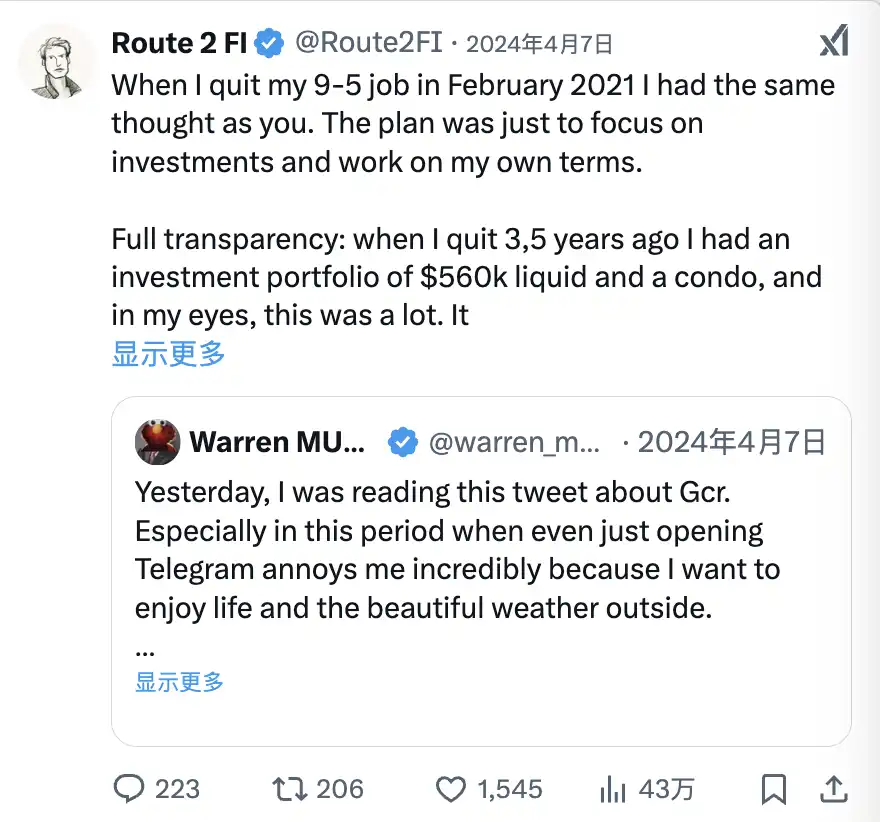
The time versus money part is certainly non-linear, but as the returns from each dollar diminish, it becomes less valuable to me. I am far from being as wealthy as the OGs of the crypto space, but I am content, and I believe that is what matters most.
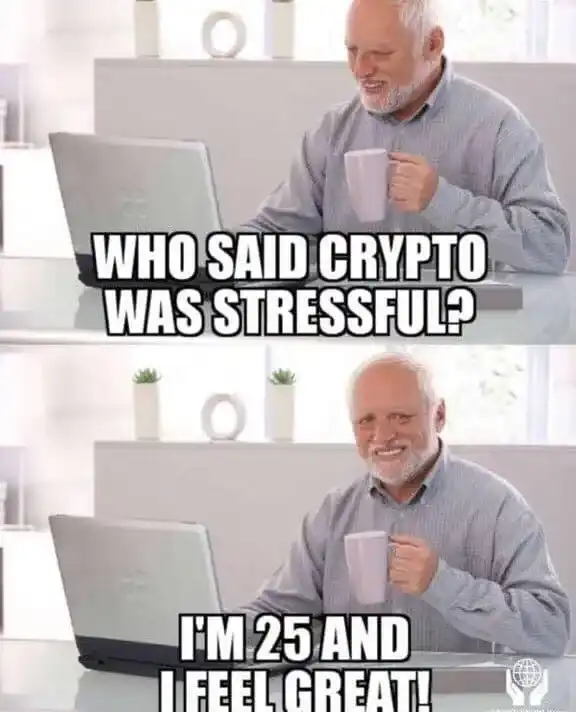
I don't want to end up like this. Perhaps I have to stop actively trading, only focusing on long-term investments (but look at the market, because in this industry, what is a truly long-term investment?)
Interestingly, when I look back, I used to put money in stock market index funds and checked the market only once a month (!).
Today, I might check 50 times a day.
The exchange of time for money essentially has no good or bad, it is a consequential choice.
From what I know, most people play this game and engage in this exchange for too long.
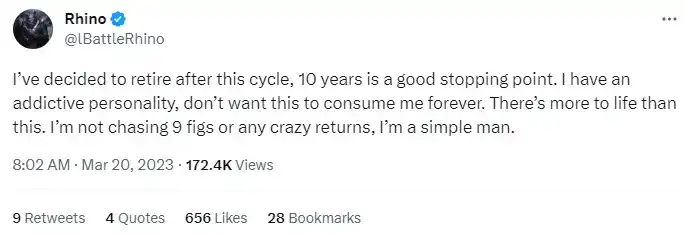
Some people really don't have much of a choice, but most of us do.
I still believe this should be the plan for most people:
I have developed a simple process, which is not new (although it may be new to you). It's not complicated.
Step 1: How much money do you need? Figure it out. I like to calculate it as monthly expenses x 12 months x 25.
Step 2: Reflect deeply on what brings you happiness in life and how much money you need to provide for these basic needs.
Step 3: Remove all expenses from your life that do not bring you joy.
Step 4: Use the money saved to buy your freedom.
Step 5: Use your freedom to do work you love or reduce work you hate.
Step 6: If you are still working, reassess and see if this exchange makes sense; if not, go back to Step 1 and repeat until satisfied.
Step 7: If you do not have enough money to complete Step 1, you need to find ways to earn more money.
If you are just starting to explore the crypto space, I recommend you read this guide.
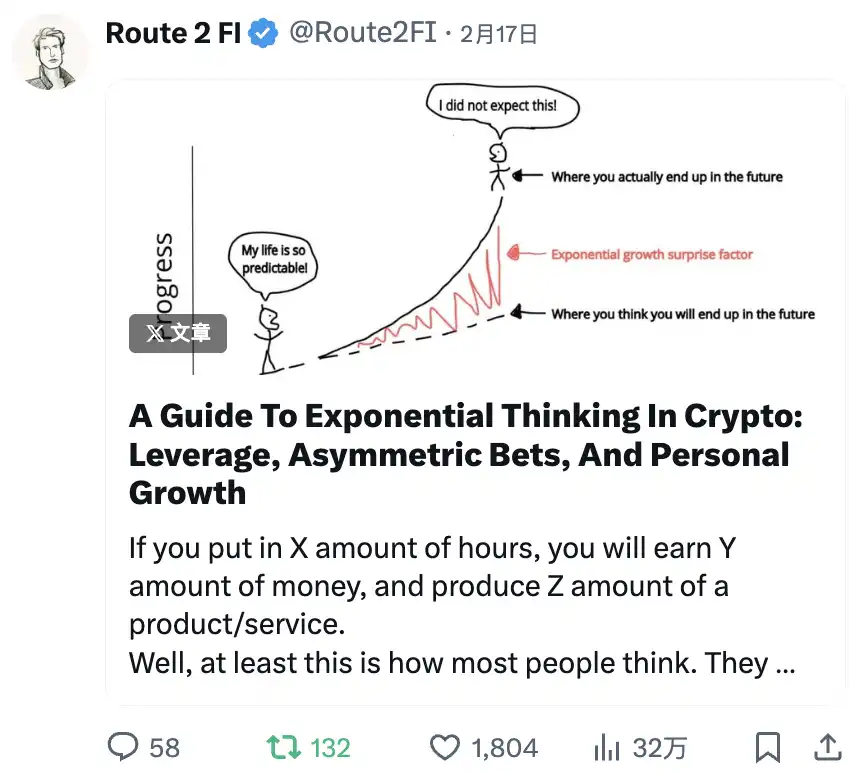
Forget a linear path; leverage your strengths for exponential growth and build a personal brand.
Take calculated risks in situations with asymmetric upside, where the potential upside is significantly greater than the downside risk, especially when young. Invest time in learning, build connections on platforms like Twitter, and seek internships to gain valuable experience in the crypto field.
Discover what you excel at, strive to become a master in your field, and find purpose in work that directly impacts your life.
The Impact of Money, Time, and Happiness on Crypto Enthusiasts
Don't misunderstand me; making money is a good thing. I am just talking about finding balance. I know I have crossed this limit several times and almost fell into depression because of it. You can read my reflections after the 2021 bull market here.
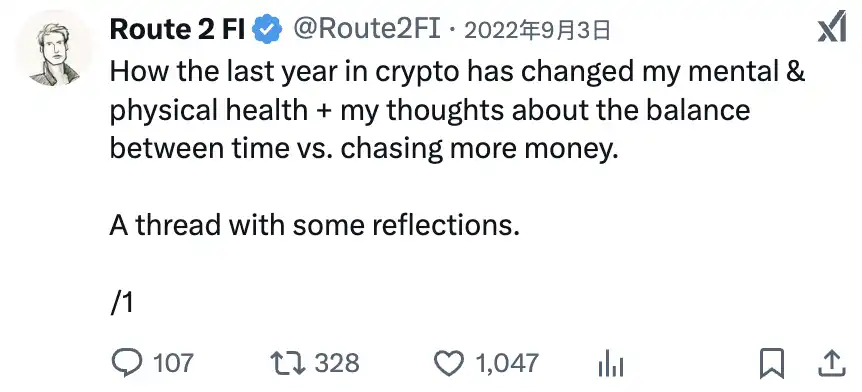
The above post is quite depressing, so if you are currently in a happy state, you may not want to read it.
Being in a bull market now, I feel like there is not enough time in a day. There are so many things I want to do but not enough time to do them all. This also stresses me out, especially when I find it hard to fall asleep holding large overnight positions.
I'm not sure if this is the life I want, I know I can limit my time, but in a 24/7 market, the fear of missing out on some movements makes it easier said than done.
Anyway, if I could be young again, I would optimize my life like this:
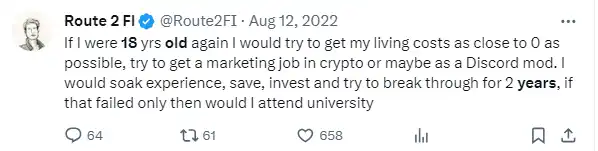
It's been 4 years since I quit my 9-5 job, but in a way, I just replaced the 9-5 with more crypto work.
I thought it was freedom, but it wasn't. Don't get me wrong, my current lifestyle is 100 times better than before, but I still want to optimize it a bit.
The last thing you want is to end up with a lot of money but no friends, an unhealthy lifestyle, and no expectations.
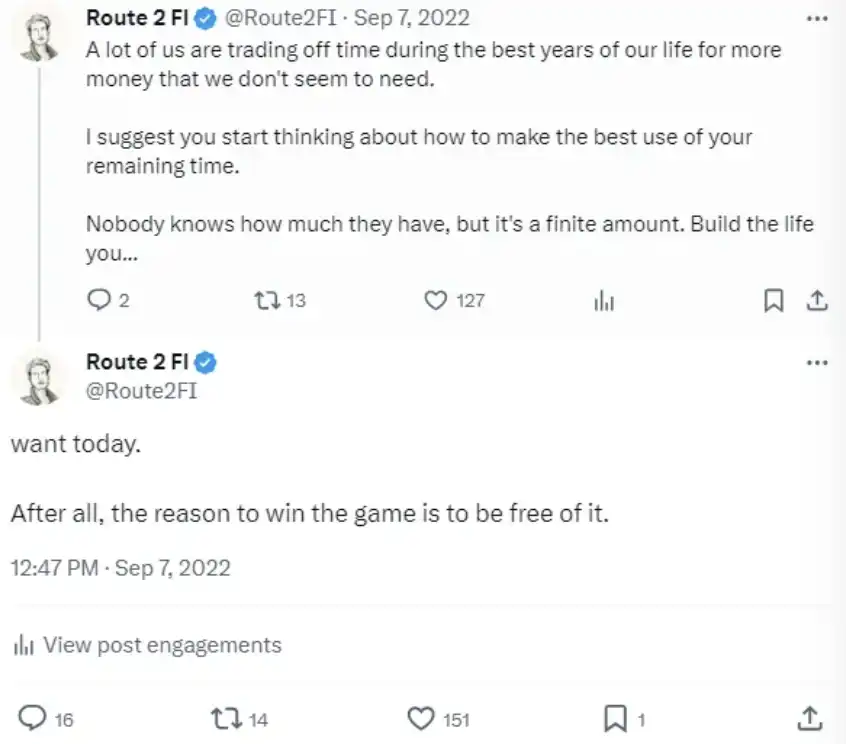
When you eventually find success in the crypto space, you'll realize it's not what you originally wanted.
You have the money, but you are still the same you.
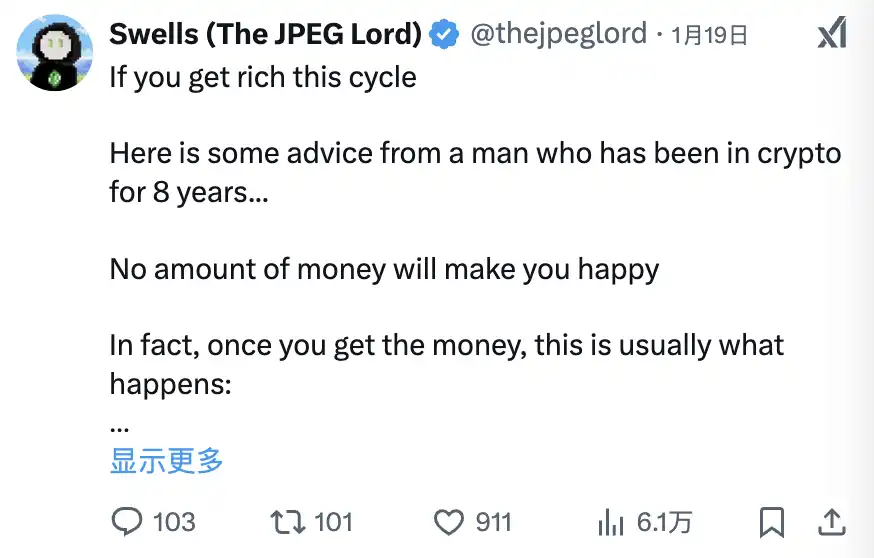
Make sure there are goals in your life besides monetary ones, or it's easy to fall into depression.
But that's another topic.
...
Oh, one more thing.
In the crypto space, growth is meaningless. Everything is about money. If you want to find meaning, growth, power, and true value, go connect with those playing the long-term game. Or simply create content and let them find you.
You may also like

Top 5 Cryptos to Buy in 2026 Q1: A ChatGPT Deep Dive Analysis
Explore the top 5 cryptos to buy in Q1 2026 including BTC, ETH, SOL, TAO, and ONDO. See price outlooks, key narratives, and institutional catalysts shaping the next market move.

How to Earn $15,000 with Idle USDT Before Altcoin Season 2026
Wondering if altcoin season is coming in 2026? Get the latest market update, and learn how to turn your idle stablecoins waiting for entry into extra rewards up to 15,000 USDT.
Can You Win Joker Returns Without Large Trading Volume? 5 Mistakes New Players Make In WEEX Joker Returns Season 2
Can small traders win WEEX Joker Returns 2026 without huge volume? Yes—if you avoid these 5 costly mistakes. Learn how to maximize card draws, use Jokers wisely, and turn small deposits into 15,000 USDT rewards.

Altcoin Season 2026: 4 Stages to Profit (Before the Crowd FOMO In)
Altcoin Season 2026 is starting — discover the 4 key stages of capital rotation (from ETH to PEPE) and how to position before the peak. Learn which tokens will lead each phase and avoid missing the rally.

Will Alt season come in 2026? 5 Tips to Spot the Next 100x Crypto Opportunities
Will altcoin season arrive in 2026? Discover 5 rotation stages, early signals smart traders watch, and the key crypto sectors where the next 100x altcoin opportunities may emerge.

The bear market has arrived, and cryptocurrency ETF issuers are also getting involved

The richest man had a quarrel with his former boss
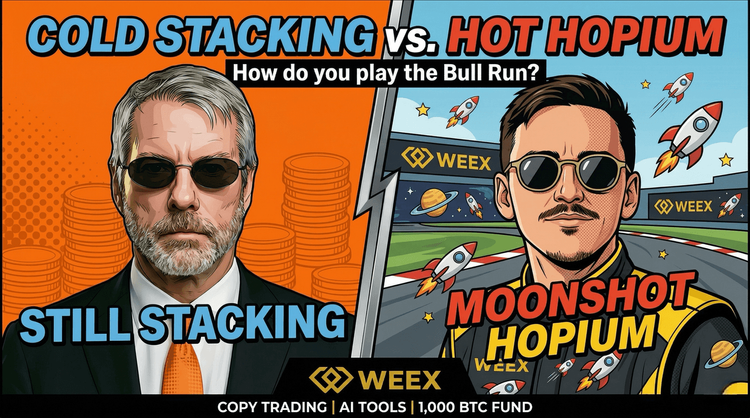
BTC Firm Above 70K! Saylor’s "Institutional Logic" vs. Moon’s "Retail Faith": Who is Really Harvesting the Market?
Bitcoin is holding firm above the $70,000 support level following a massive short squeeze that liquidated $427 million. As the "Four-Year Cycle" narrative shifts, the market is split: Michael Saylor’s cold, institutional "indiscriminate stacking" vs. Carl Moon’s high-energy retail "hopium." This article decodes these two polar-opposite strategies for the 2026 bull run and reveals how WEEX’s institutional-grade liquidity and AI trading tools empower every type of investor to convert market volatility into profit.

The Girl Who Created the SBTI Test: A Story of a Doomed Cyber Love, an E-Widow Ratfolk

B.AI Officially Launched: Building AI Agent Financial Bedrock Platform, Driving AGI Era Business Underlying Logic

B.AI Officially Launched: Breaking Down A2A Collaboration Barriers to Unlock the Smart Body Economy's Full Potential
We helped Xu Mingxing write a book called "<OK Life>".

Rare APY of 400%, is TradeXYZ handing out money to oil bulls?
a16z: Perpetual Contracts are Rewriting Global Trading Rules
Bitcoin Hits $73,000 Triggering $427M Short Liquidation | Carl Moon: $200,000 is the Target
April 9, 2026 (UTC+0), 22:17. Bitcoin (BTC) executed a high-velocity surge within minutes, heavy-hitting the $73,000 psychological barrier and touching a local high near $74,000. While the price has since retraced to consolidate above $72,000, this "instant ambush" successfully completed a $427M liquidation of short positions.

a16z partner: perpetual contracts are rewriting the global trading rules
Bitcoin ETF Inflows Just Turned Positive After 5 Months of Outflows: What Does That Mean for BTC Price Now?
The Hidden Risks Behind Bitcoin ETF Inflows in 2026: What Traders Should Know. The question now isn't whether inflows are happening. It's what they're telling you about the next phase and whether your portfolio is positioned for it.
Decoding 2026's Bitcoin ETF Data: How to Trade Alongside Institutional Smart Money in 2026
After months of sustained outflows, rolling 30-day net ETF inflows just crossed 30,000 BTC. That's not noise. Historically, when institutional capital rotates back in at this scale, it marks a regime shift — not just a bounce.
Top 5 Cryptos to Buy in 2026 Q1: A ChatGPT Deep Dive Analysis
Explore the top 5 cryptos to buy in Q1 2026 including BTC, ETH, SOL, TAO, and ONDO. See price outlooks, key narratives, and institutional catalysts shaping the next market move.
How to Earn $15,000 with Idle USDT Before Altcoin Season 2026
Wondering if altcoin season is coming in 2026? Get the latest market update, and learn how to turn your idle stablecoins waiting for entry into extra rewards up to 15,000 USDT.
Can You Win Joker Returns Without Large Trading Volume? 5 Mistakes New Players Make In WEEX Joker Returns Season 2
Can small traders win WEEX Joker Returns 2026 without huge volume? Yes—if you avoid these 5 costly mistakes. Learn how to maximize card draws, use Jokers wisely, and turn small deposits into 15,000 USDT rewards.
Altcoin Season 2026: 4 Stages to Profit (Before the Crowd FOMO In)
Altcoin Season 2026 is starting — discover the 4 key stages of capital rotation (from ETH to PEPE) and how to position before the peak. Learn which tokens will lead each phase and avoid missing the rally.
Will Alt season come in 2026? 5 Tips to Spot the Next 100x Crypto Opportunities
Will altcoin season arrive in 2026? Discover 5 rotation stages, early signals smart traders watch, and the key crypto sectors where the next 100x altcoin opportunities may emerge.


 App
App