
 Buy Crypto
- Markets
 Futures
- Spot
- Copy Trade
- Earn
- More
Huobi HTX Releases the "2026 Digital Asset Trend White Paper": Global Liquidity Restructuring, Defining a New Sovereign Era of "On-Chain Finance"

Recently, Huobi HTX officially released the 2026 Digital Asset Trends White Paper (hereinafter referred to as the "White Paper"). This white paper was jointly published with several industry institutions and media, including BlockBeats, ChainCatcher, Foresight News, HTX Learn, HTX Research, Odaily, PANews, Rootdate, and TechFlow. In the context of the current market being temporarily sluggish and industry sentiment becoming cautious, this lengthy report aims to re-examine the development path of digital assets from a structural perspective, providing the market with forward-looking judgments and a systematic framework to help investors establish long-term confidence and cognitive anchors during uncertain cycles.
The white paper conducts an in-depth analysis of the ten core trends in the digital asset market for 2026 and points out that digital assets are completing their historic establishment as an asset class, having completely moved away from a singular "price cycle-driven" model and officially entering a new era driven by "structural trends." They are gradually transitioning from a high-volatility innovation field to a core component of the global asset allocation system. In this wave of global liquidity restructuring, Huobi HTX is focusing on "stability, transparency, institutionalization, and AI empowerment" as its core strategy, aiming to become a trusted trading and asset service infrastructure for long-term capital, anchoring the direction of the new era of on-chain finance.
New Macroeconomic Landscape: From "Digital Gold" Positioning to New Highs in Stablecoin Scale
The white paper predicts that by 2026, global monetary policy will enter a "rebalancing" phase, with the interest rate differentials between the Federal Reserve and emerging markets no longer moving in sync. In this complex macro environment, BTC will solidify its positioning as "digital gold." Core assets like Bitcoin are no longer marginal "innovation experiments," but rather structural assets deeply embedded in global asset allocation models, forming a hedging combination with U.S. Treasuries and gold, with pricing power further shifting towards medium to long-term capital. At the same time, ETH is expected to become the core carrier of yield assets. Ethereum, with its mature staking and DeFi infrastructure, has established its position as "on-chain government bonds," becoming a cash flow-driven growth asset.
In terms of liquidity, the scale of stablecoins will reach new highs. The function of stablecoins has expanded from merely a medium of exchange to the infrastructure for global cross-border payments and settlements. Huobi HTX states: "In 2026, the market will no longer ask 'Do digital assets have value?' but rather 'What is the allocation ratio?'" As the scale of stablecoins surpasses $300 billion, an "on-chain settlement system" based on the U.S. dollar has taken shape. Huobi HTX, through deepening liquidity depth, has become a frontline position for global macro funds sensing market temperature.
Institutional Wave and Asset On-Chain: Acceleration of RWA and Explosion of Derivatives
In 2026, the way institutions enter the market will undergo a qualitative change. The proportion of institutions will continue to rise, while retail volatility will slow down. The white paper summarizes three main paths for institutional participation: direct asset allocation, yield enhancement (through staking, RWA to obtain stable cash flow), and infrastructure participation (deeply laying out equity in exchanges and custodial institutions). The entry of long-term capital makes market behavior more rational, with volatility gradually converging. At the same time, the scale of RWA (Real World Assets) will grow rapidly. The tokenization of U.S. Treasuries and fixed-income assets has introduced stable sources of income on-chain. According to the white paper, the global RWA scale has surpassed $340 billion, with U.S. Treasuries, gold, and even commodities like electricity and soybeans being digitally mapped through blockchain.
With the increase in institutional participants, on-chain derivatives trading is expected to explode. Perpetual contracts and options products are gradually moving on-chain, with pricing mechanisms becoming more mature. In response to this trend, Huobi HTX has comprehensively upgraded its institutional service capabilities, building a "compliance bridge" to the on-chain world for professional capital through complete API interfaces, customized risk control support, and deep integration with top global custodial institutions, helping users lock in structural premiums amid macro volatility.
Infrastructure Upgrade and the Rise of the Agent Economy: Dual Drive of zkEVM and AI Agent
In 2026, digital asset infrastructure is undergoing a dual-track transformation, pushing the industry into a new phase of "10G L1" and "automated execution":
At the infrastructure level, Ethereum has solved 80% of the proof bottlenecks through zkEVM protocol-level integration, entering the "10G L1" era, integrating all ecological liquidity with extreme performance and security, completely ending the narrative of "Ethereum killers." In this context, modular blockchains will become the mainstream architecture. As underlying protocols are commoditized, value is shifting from the protocol layer to "fat applications," with customized L2 and the AI Agent economy driven by super dApps becoming the core of the ecosystem.
At the same time, AI Agents will become the main entities for on-chain execution. AI agents are replacing humans as the core executors of trading, yield management, and risk control. As of March 2026, the economic output generated by AI Agents (aGDP) has reached hundreds of millions of dollars. Trading models are shifting from "manual operation" to "intention-driven," leading to the rise of the agent economy.
Huobi HTX is keeping pace with technological frontiers by launching HTX AI Skills. Users only need to input natural language, and AI can complete market interpretation, strategy generation, and assisted execution. This "intention-driven" new trading paradigm significantly lowers the threshold, allowing ordinary investors to enjoy professional-grade, intelligent on-chain financial services.
Embracing 2026, Huobi HTX's Strategic Foundation is Transparent Competition and Regulatory Certainty
In an era of structural differentiation, competition among platforms has shifted from a battle for traffic to a "trust competition." Transparent competition will become the core difference for exchanges. Huobi HTX emphasizes in the white paper that transparency is no longer an added bonus but a survival baseline. Huobi HTX has taken the lead in the industry to implement "Proof of Reserves (PoR) normalization," achieving clarity and verifiability of asset structures through technological means. At the same time, as regulations gradually clarify, gray areas will further shrink. In the increasingly clear global regulatory environment of 2026, Huobi HTX, operating in compliance, is demonstrating strong resilience against risks.
Huobi HTX promises global users: safety and transparency are the foundation of the platform's development. In the future, Huobi HTX will focus on three main lines for strategic layout: continuously upgrading institutional service capabilities, integrating on-chain assets and yield products, and promoting global compliance layout.
As stated at the end of the white paper: the digital asset market is shifting from "broad-based increases" to "survival of the fittest," marking an era for professionals and long-termists. In 2026, Huobi HTX proposes four strategic keywords: "stability, transparency, institutionalization, and AI empowerment," aiming not only to be a matchmaker for trading but also a builder of on-chain financial infrastructure. In the grand narrative of liquidity restructuring, Huobi HTX is willing to work with global participants to usher in the next golden decade of digital assets.
About Huobi HTX
Huobi HTX was established in 2013 and has developed over 12 years from a cryptocurrency exchange into a comprehensive blockchain business ecosystem, covering digital asset trading, financial derivatives, research, investment, incubation, and other businesses.
As a leading global Web3 portal, Huobi HTX adheres to a development strategy of global expansion, ecological prosperity, wealth effect, and safety compliance, providing comprehensive, safe, and reliable value and services for virtual currency enthusiasts worldwide.
For more information about Huobi HTX, please visit https://www.htx.com/ or HTX Square, and follow X, Telegram, and Discord. For further inquiries, please contact glo-media@htx-inc.com.
You may also like
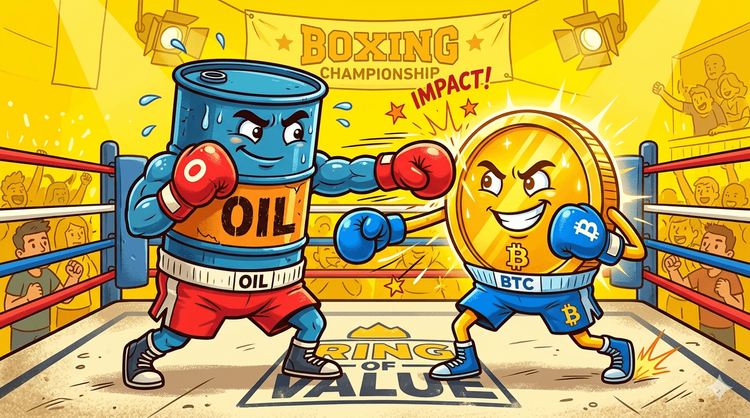
How the US-Iran War Could Affect Oil and Bitcoin Prices (Latest Analysis)
The outbreak of the US-Iran war on February 28, 2026, has provided an unprecedented real-time laboratory for understanding how geopolitical oil shocks interact with an increasingly institutionalized cryptocurrency market. This article examines the relationship between crude oil prices and Bitcoin throughout the conflict, analyzing price movements, correlation patterns, and the underlying transmission mechanisms.

OpenAI Wants to Write Its Own Rules|Rewire News Brief

Chaos Labs Exits, Who Will Pick Up Aave's Risk?
Stealthy Financial War? Iran Collects Strait Transit Fees in Stablecoin

OpenAlice: One Person, That's a Jane Street | Project Overview

The Small-Town Youth Labeling Big AI Models

Morning Report | Strategy increased its holdings by 4,871 BTC last week; Toss plans to develop its own blockchain and issue a native cryptocurrency; OpenAI's CFO privately questioned the timing of the IPO in 2026

Research: Stablecoins have a trading volume of 35 trillion a year, how much of it is real payment?

Galaxy Research: AI agents are giving rise to new species on the blockchain, how zero-human companies activate the financial flywheel

Data Research: How big is the liquidity gap between Hyperliquid and CME crude oil?

WEEX P2P now supports GHS, ETB & ZAR—Merchant Recruitment Now Open
To make crypto deposits easier, WEEX has officially launched its P2P trading platform and continues to expand fiat support. We're excited to announce that the Ghana Cedi (GHS), Ethiopian Birr (ETB) and South African Rand (ZAR) are now available on WEEX P2P!
Why Are GPU Prices Skyrocketing Out of Control?

How to Master Claude Cowork Completely?

70-Page Confidential Letter Alleges First Charge of 'Lying,' Altman Tells Board 'I Can't Change My Personality'
Is Altcoin Season Starting in 2026? What Traders Should Watch Now
Altcoin season signals are becoming clearer in 2026 as capital rotation across crypto markets accelerates. Here’s what traders should watch and how strategy-based participation is evolving in the current market cycle.
Bitcoin ETF Inflows in 2026: Impact on BTC Price and Crypto Market Trends
Bitcoin ETF inflows are reshaping BTC price trends and crypto market liquidity in 2026. See how institutional capital is influencing volatility, trading behavior, and portfolio allocation strategies across crypto markets.
Visa's Stablecoin Strategy: Cards, Settlement, and the Future

Stock Market Split
How the US-Iran War Could Affect Oil and Bitcoin Prices (Latest Analysis)
The outbreak of the US-Iran war on February 28, 2026, has provided an unprecedented real-time laboratory for understanding how geopolitical oil shocks interact with an increasingly institutionalized cryptocurrency market. This article examines the relationship between crude oil prices and Bitcoin throughout the conflict, analyzing price movements, correlation patterns, and the underlying transmission mechanisms.


 App
App