
 Buy Crypto
- Markets
 Futures
- Spot
- Copy Trade
- Earn
- More
Lumoz Introduces On-Chain AI Agent with TEE+ZK Dual Proof Architecture

Source: Lumoz
Background
With the development of Web3, decentralized AI Agents have become a critical application. These agents can autonomously operate without centralized servers, process user data, and interact with blockchain smart contracts. However, the openness and trustlessness of Web3 present security challenges. AI Agents show potential in Web3, such as managing private keys, executing automated trades, and supporting DAO operations. However, their lack of trustworthiness and accountability deviates from core principles like decentralization and transparency, limiting their widespread adoption and hindering future development.
Current Status
Currently, most AI agents operate in untrusted environments, facing numerous security and transparency challenges. These agents often handle users' sensitive data and perform critical tasks, but their operating environments lack necessary safeguards, leading to potential risks such as data leaks, tampering with execution logic, or unverifiable computation results. Common assumed issues include:
· The agent's initialization process has not been tampered with
· Data provided by external APIs is secure and reliable
· Private keys are properly managed and cannot be leaked
· User input is not tampered with during transmission
Introducing TEE to Enhance Security
By default, all worker nodes are considered untrusted. Malicious workers may attempt the following improper behaviors:
· Eavesdropping on users' sensitive data;
· Providing incorrect computation results or not executing tasks at all;
· Degrading service quality, such as by reducing computing power or disrupting network connections.
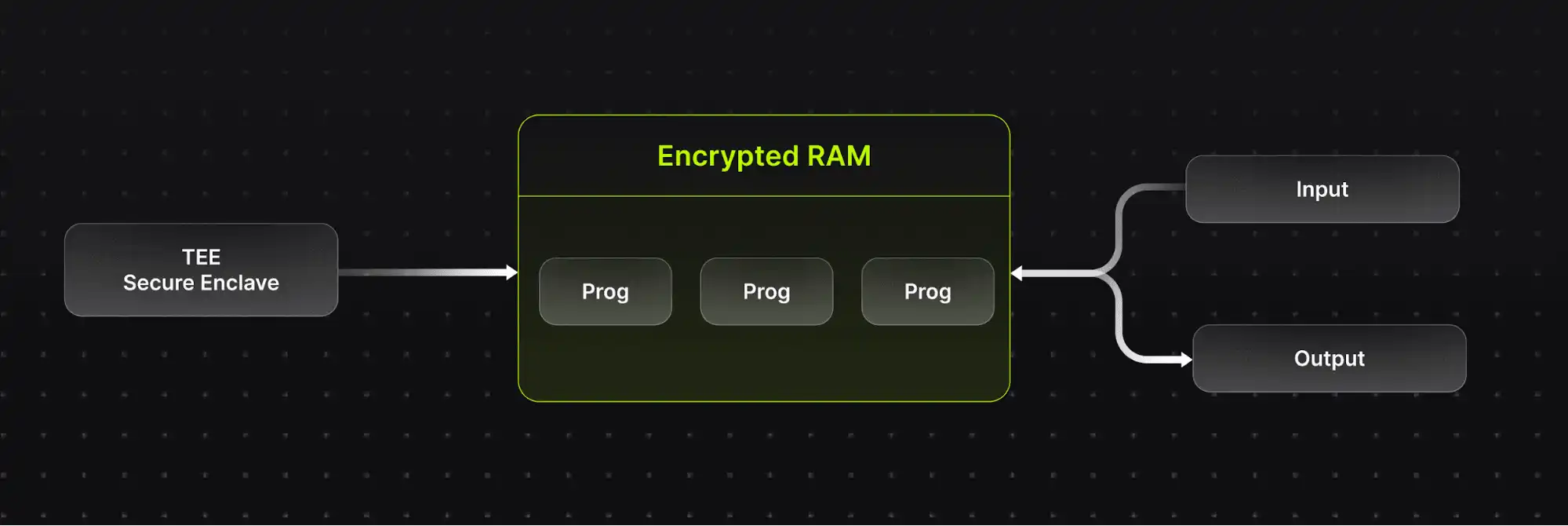
To ensure the system's trustlessness, Lumoz relies on a Secure Enclave (a trusted execution environment, similar to Intel SGX) and an innovative key management mechanism. The Secure Enclave provides robust hardware security features to the system, primarily including the following:
· Data Confidentiality: All in-memory data is encrypted;
· Secure Execution: Even if an attacker controls the operating system or physical device, the correctness of the execution process cannot be compromised;
· Remote Attestation: Users can verify remotely to ensure that the hardware and software are running within a secure area.
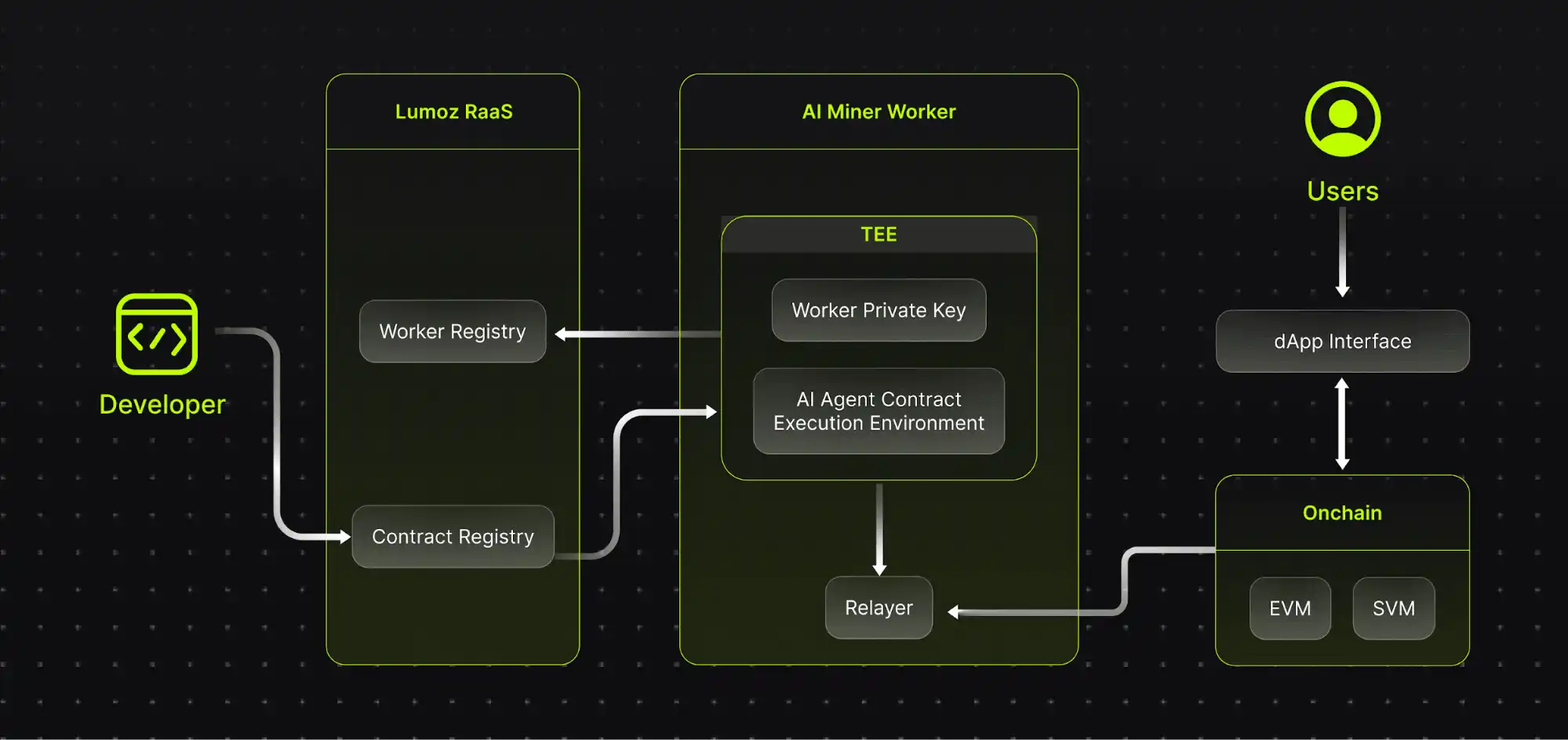
Lumoz TEE Working Principle
Lumoz aims to be the core processing platform for AI computation, taking on a critical role in supporting scalable blockchain infrastructure. By integrating Trusted Execution Environment (TEE) technology, Lumoz can ensure the security and transparency of its computation process. This innovative combination merges the decentralization advantage of blockchain with the robust security of TEE, enabling Lumoz to not only provide a decentralized cloud computing network but also to efficiently execute various computing tasks in a trust-minimized environment.
Benefits of Introducing TEE
· Hardware-Level Security: Hardware secure areas ensure privacy, confidentiality, and data integrity.
· Minimal Computation Overhead: Applications running on TEE operate nearly at the same speed as applications running in a regular CPU environment.
· Low Verification Cost: Gas consumption for verifying TEE proofs is minimal, requiring only ECDSA verification.
TEE Implementation Effects
· Data Tamper-Resistance: Ensuring that user request/response data is not altered by intermediaries is crucial. This requires a secure communication channel and strong encryption mechanisms.
· Secure Execution Environment: Both hardware and software must be protected from attacks. This involves using TEE to provide an isolated environment for secure computation.
· Open-Source and Reproducible Version: The entire software stack, from the operating system to the application code, must be reproducible. This allows auditors to verify the integrity of the system.
Verifiable Execution Results: The results of AI computation must be verifiable to ensure that the output is trustworthy and has not been tampered with.
TEE (Intel SGX) Framework
TEE Server-Side Security Check
When the service starts, it will generate a signing key in the TEE.
1. You can obtain CPU and GPU proofs to verify if the service is running inside a secure VM in TEE mode.
2. This proof includes the public key of the signing key to demonstrate that the key was generated in the TEE.
3. All inference results include a signature with the signing key.
4. You can use the public key to verify that all inference results were generated in the TEE.
TEE and ZK-SNARKs
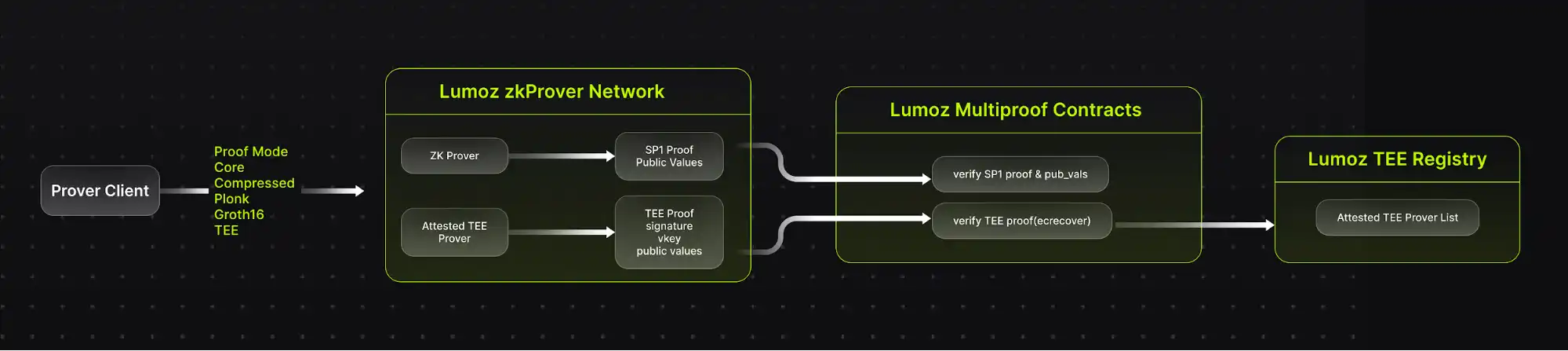
We cannot guarantee that any single encryption system is 100% secure. At the same time, current Zero-Knowledge (ZK) solutions are theoretically secure, but still cannot guarantee error-free operation of the entire system, especially from an engineering perspective. Due to the complexity of ZK implementations, this remains challenging. This is where a multi-proof system comes into play. To hedge against errors in ZK implementations, a hardware-based Trusted Execution Environment (TEE) can serve as a second-factor authenticator, providing dual security for ZK projects like AI Agents.
Core Architecture Design
Decentralized Root of Trust (DROT)
Decentralized Root of Trust (DROT) is a core element of the Trusted Execution Environment (TEE) trust chain. Ultimately, user validation relies on remote proofs signed by the CPU, which in turn depend on a set of hardware-stored keys for generation. The hardware components responsible for managing these root keys, verifying firmware and applications, and issuing remote proofs are collectively referred to as DROT.
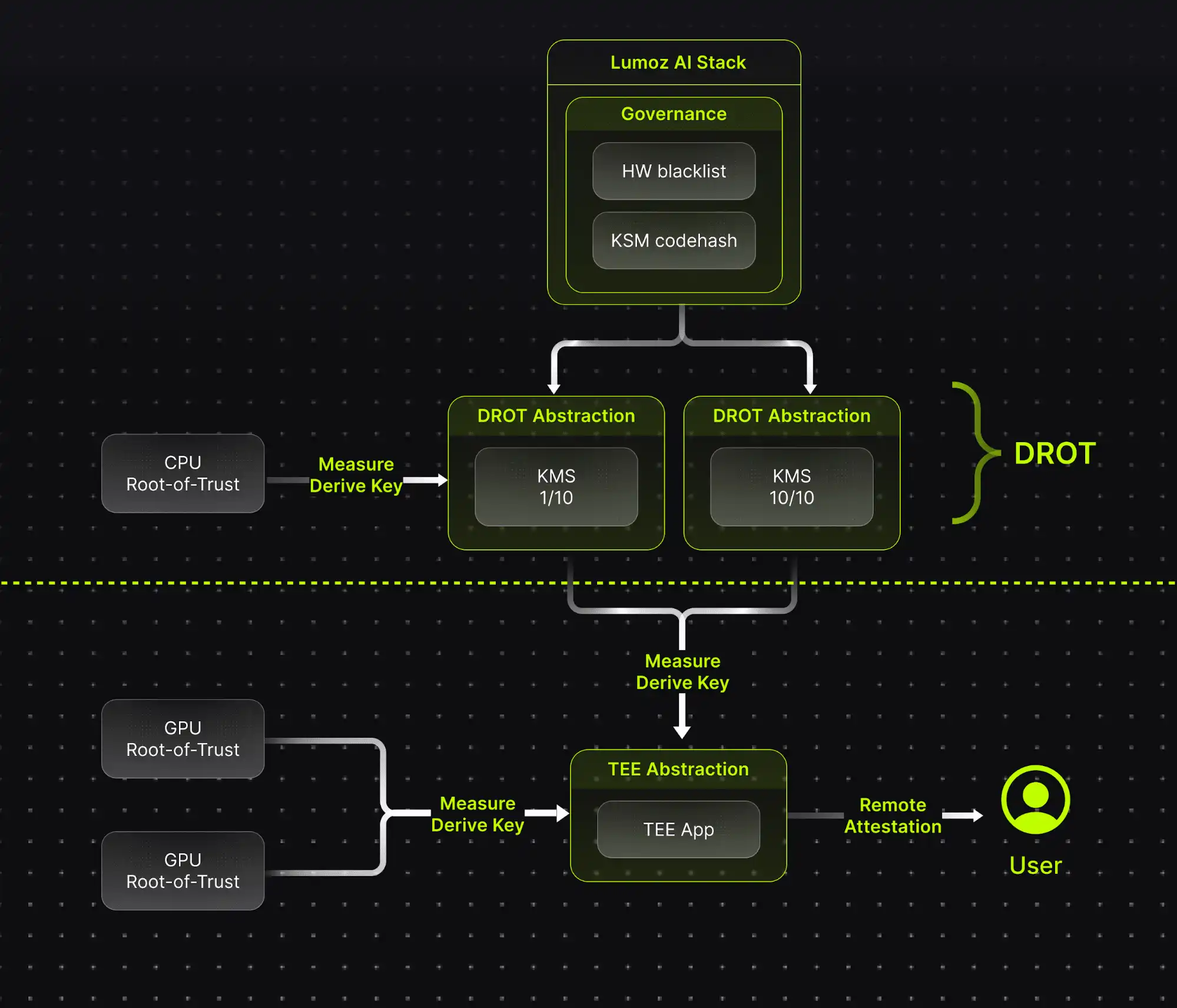
Key Management Protocol
In the overall solution design, key management follows the principle of least privilege, meaning that the secret known to each entity in the system is strictly limited to the secrets required to perform its tasks.
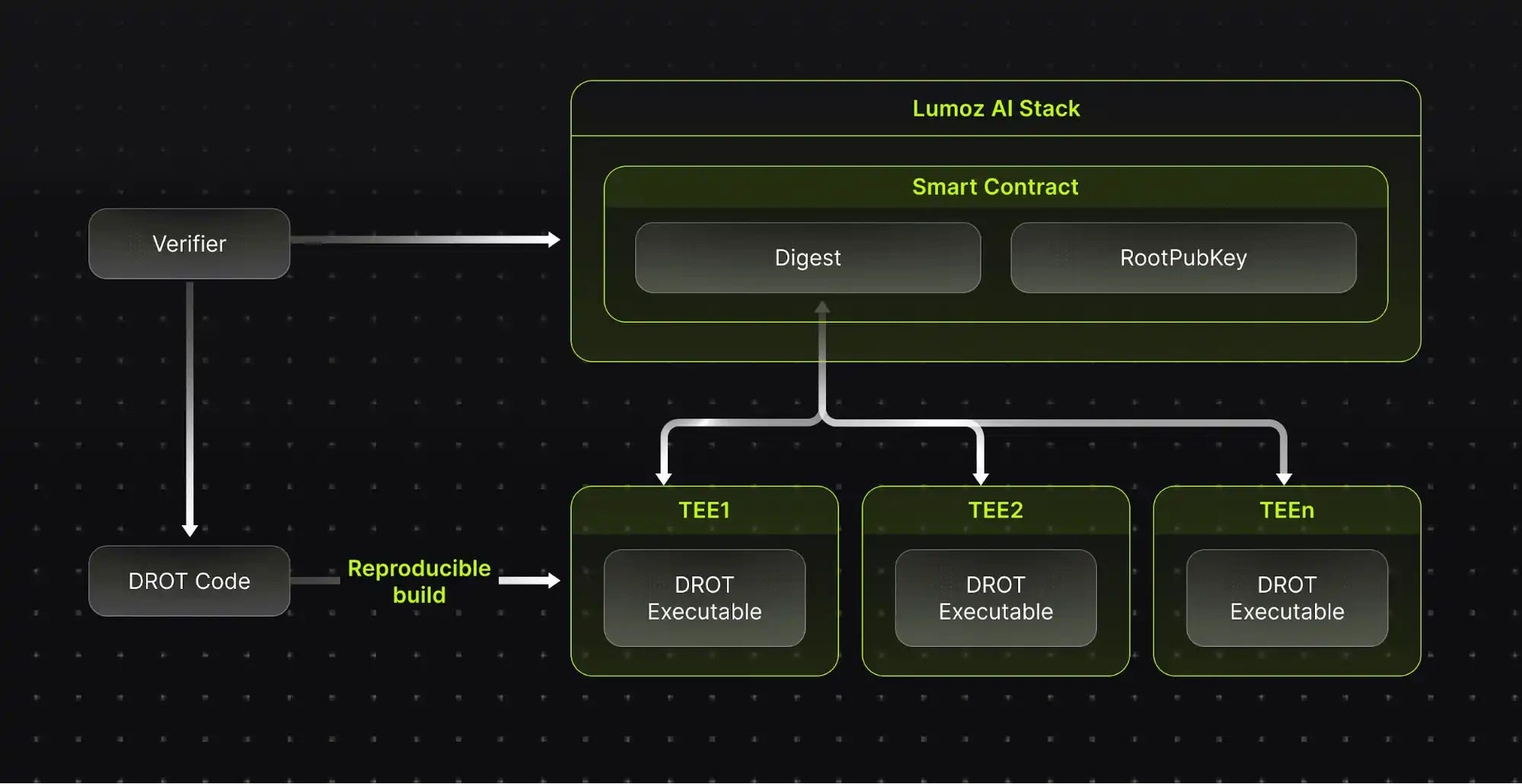
TEE Domain Certificate
The certificate management module in the design of the solution, which acts as a reverse proxy for the application running in the network. It is worth noting that as part of the overall solution, it runs in a TEE and is also managed by smart contracts.
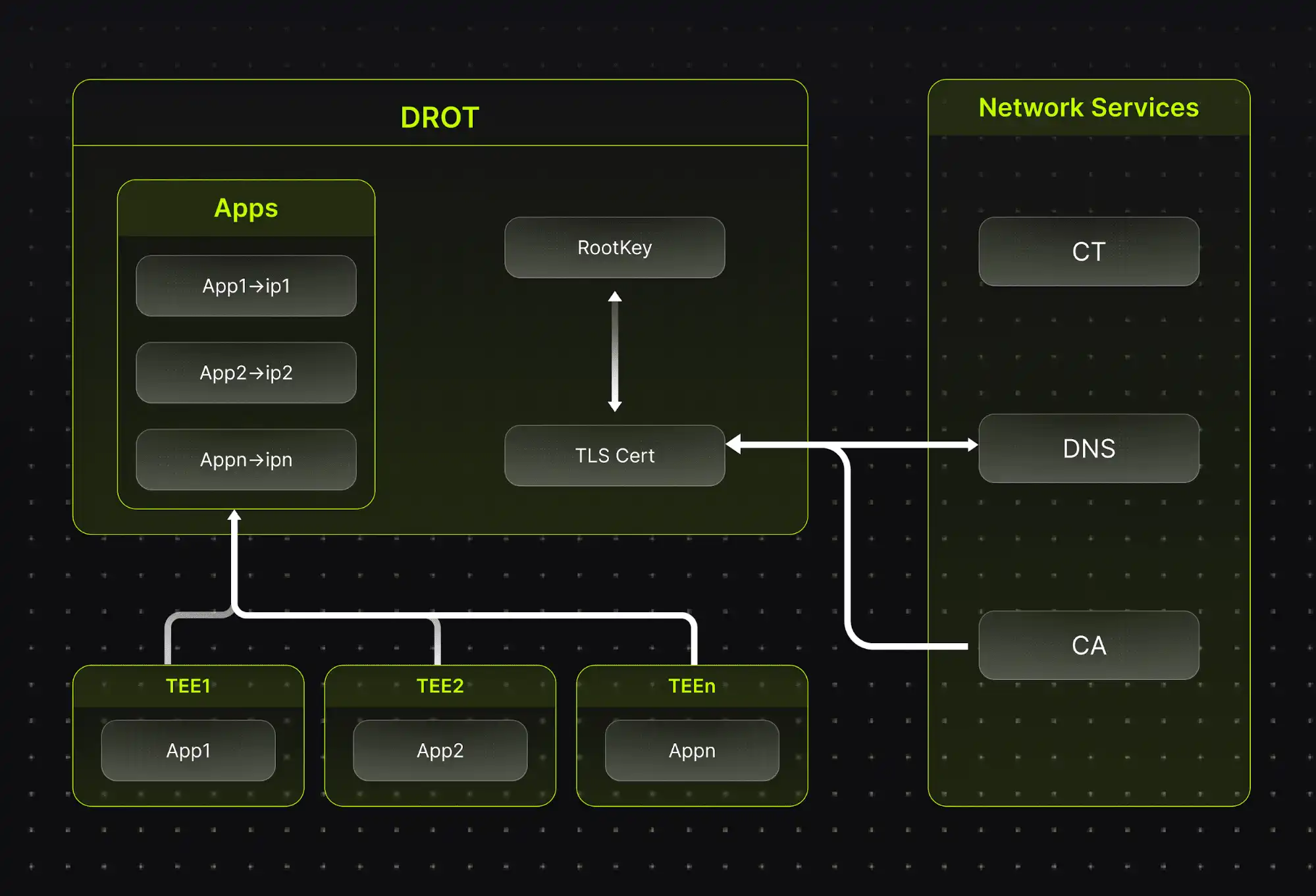
Summary
In the TEE and ZK multiproof architecture provided by Lumoz, the innovative solution combines the Trusted Execution Environment (TEE) and Zero-Knowledge Proof (ZK) to enhance the security, privacy, and verifiability of most AI Agents in untrusted environments. By combining the hardware isolation capability of TEE with the cryptographic verification features of ZK, it effectively addresses the issues of data protection and execution transparency, while also aligning with the core principles of decentralization and transparency in Web3. This technical architecture not only enhances the trustworthiness and usability of AI Agents but, with ongoing technological optimization and standardization, will unlock greater potential for AI Agents in various application scenarios.
For further developments, please follow the Lumoz website and social media.
This article is contributed content and does not represent the views of BlockBeats
You may also like

Ray Dalio's new article: The world is entering a war cycle

IOSG: When Fintech Meets Crypto Native: The Next Decade of Digital Finance

They knew in advance that Trump would tweet about a ceasefire, entered with $20k, and exited with $400k.

The biggest bottleneck in DeFi development

CZ Memoir Released: Reveals a Large Amount of Industry Insider Information, Prompting Intense Rebuttal from Xu Mingxing

a16z: After securities are on the blockchain, why will intermediary institutions be replaced by code?

XRP Tokyo Is Here: What We Learn and What’s Next for XRP Price
Key Takeaways: Ripple’s 2025 XRP Tokyo event highlights a projected $33 trillion on-chain stablecoin volume by 2026. Significant…

Solana’s Future: Navigating the $285M Hack, Rug Pulls, and Milei Libra Scandal
Key Takeaways: Multiple Crises: Solana faces a $285 million hack, allegations of rug pulls, and the Milei Libra…

BTC USD Faces Tension: Markets React to Trump’s Dire Warning
Key Takeaways: Bitcoin’s price drops sharply below $70,000 amid geopolitical tensions, playing off Trump’s dramatic 8 PM ultimatum…
Bitcoin Price Surge: Ceasefire Sparks Optimism Hits $71K
Key Takeaways: After the US-Iran ceasefire announcement, Bitcoin surged beyond $71,000, marking its highest in a month. A…

Ethereum Price Forecast: Record $180 Billion Stablecoin Supply Marks Buyers’ Return
Key Takeaways: Ethereum’s stablecoin supply has surged to a record $180 billion, marking a 150% increase over the…

Emerging Evidence Links Argentina’s Milei to LIBRA Crypto Scandal
Key Takeaways: Evidence unveiled by Argentina’s federal prosecutors links President Javier Milei to the LIBRA token through call…

US Spot Bitcoin ETFs See Surge as BTC Nears $70K; LiquidChain and Layer-3 DeFi Rise
Key Takeaways: U.S. spot Bitcoin ETFs absorbed $471 million in a single day, moving BTC closer to the…

Bitcoin Price Prediction: Decoupling from Tech Stocks, Shaped by Geopolitics and AI Turmoil
Key Takeaways: Bitcoin is decoupling from tech stocks as geopolitical tensions and AI crises reshape the market, currently…

Chaos Labs Departure Leaves Aave Without Risk Management Amidst Governance Conflict
Key Takeaways: Aave, with a $50 billion TVL, is currently operating without a risk manager due to Chaos…
Grayscale Ethereum ETF Staking: A New Catalyst for $5,700?
Key Takeaways: Grayscale’s Ethereum Staking ETF introduces a yield-bearing structure that could significantly reshape investor sentiment. Ethereum’s price…

Polygon Crypto Enhances Finality Through the Giugliano Hardfork
Key Takeaways: Polygon’s Giugliano hardfork is operational on the mainnet, effectively reducing transaction finality by 2 seconds. The…

Senate’s Three-Week Deadline: Ripple XRP and the CLARITY Act’s Critical Moment
Key Takeaways: The Senate Banking Committee’s decision on the CLARITY Act in late April could define XRP’s future…


 App
App