
 Buy Crypto
- Markets
 Futures
- Spot
- Copy Trade
- Earn
- More
Pump.fun Flips the Table? Self-Custody AMM Pool Breaks Free from Raydium's Restraints

Original Title: "Pump.fun Building Its Own AMM Pool? Revealing the Heart of Raiding Raydium's Profits"
Original Source: DeepTech TechFlow
“For to everyone who has, more will be given, and he will have an abundance; but from him who does not have, even what he has will be taken away.” --- Matthew
On-chain, the Matthew effect of the strong getting stronger has never stopped.
For example, Pump.fun has quietly started to target Raydium's profits: today, it stealthily launched its own AMM pool, attempting to siphon off the liquidity revenue that originally belonged to Raydium.
Currently, this custom AMM (http://amm.pump.fun) page appears very simple, where you can swap any token just like other DeFi products.
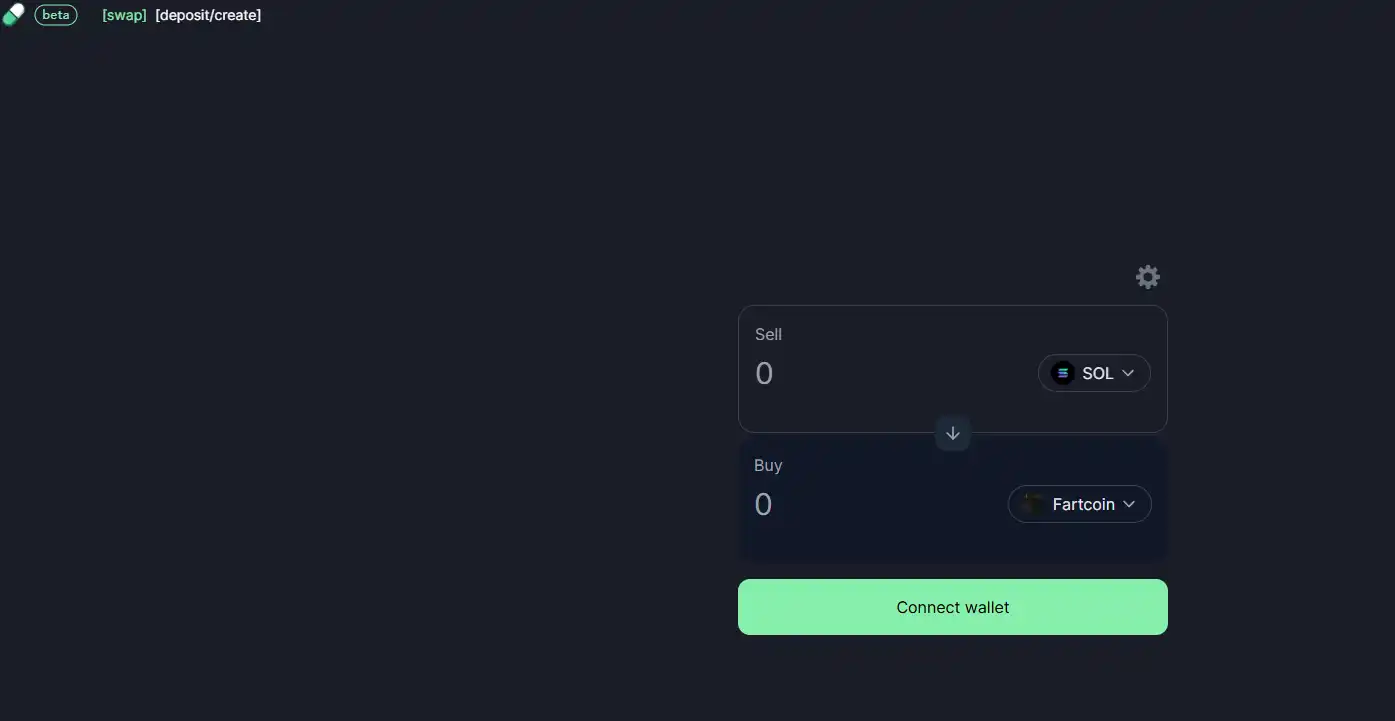
However, the intention behind this product may not be straightforward.
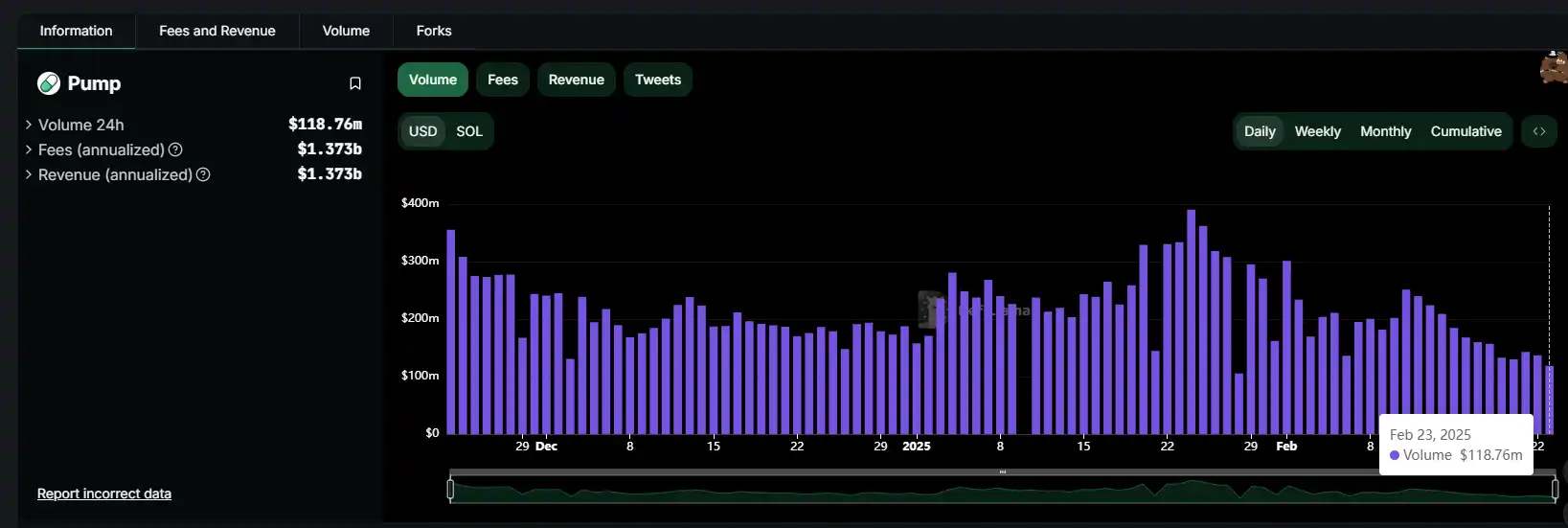
Everyone knows that Pump.fun has attracted a large number of Degens with its unique on-chain/off-chain mechanism and memecoin culture.
Users' trades first match within Pump.fun's on-chain pool, relying on the platform's liquidity to complete the transaction; once the on-chain pool is filled, trades are routed to the off-chain pool, which actually relies on Raydium's liquidity pool.
In this model, Pump.fun has always been a "flow provider" for Raydium, but is also constrained by Raydium's rules. Whenever trades flow to the off-chain pool, Pump.fun needs to pay a portion of the trading fees, and this profit ultimately flows to Raydium's liquidity providers (LPs).
Raydium itself is one of the most important AMM platforms in the Solana ecosystem, and a key infrastructure for DeFi users to access liquidity. It also provides liquidity pool services for many projects on Solana, with its TVL (Total Value Locked) consistently ranking at the top of Solana.
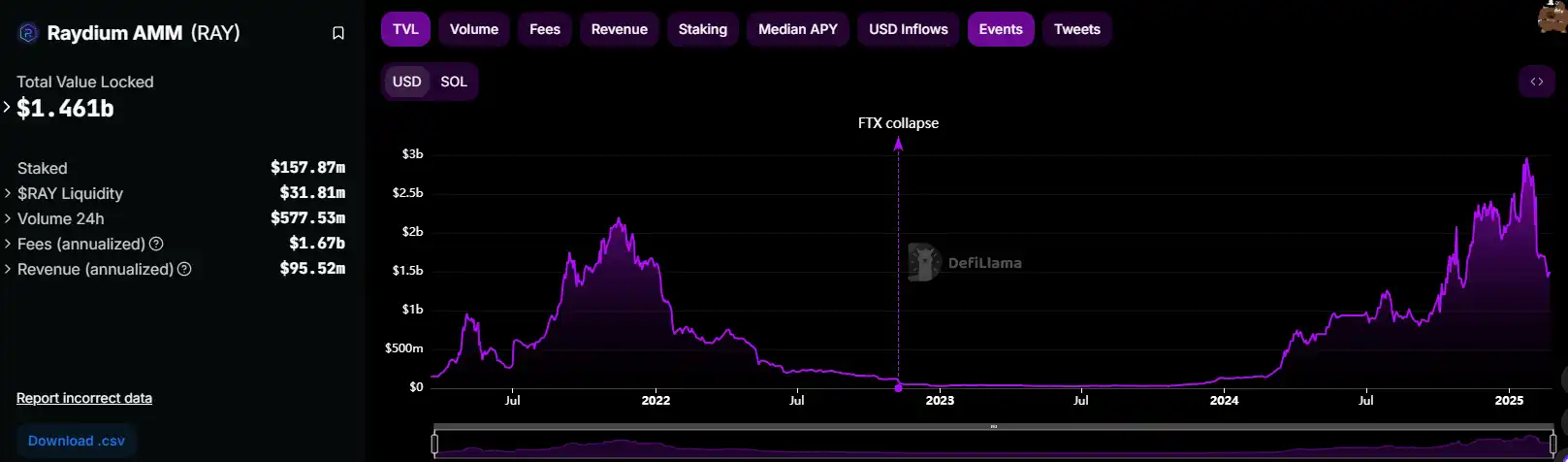
As the "liquidity hub" of Solana, Raydium holds a pivotal position in the ecosystem. However, Pump.fun's new move is challenging this status quo:
Pump.fun is no longer satisfied with being a mere "liquidity provider" for Raydium, but is attempting to become the liquidity "controller."
The Business Behind Building An AMM Pool
By building its own AMM, Pump.fun can transfer liquidity from Raydium to its own platform, thereby fully controlling the distribution of trading fees.
If Pump.fun's strategy succeeds, Raydium will not only lose a portion of its liquidity source but also face impact on its revenue model and ecosystem status.
So, how does the math work out for this situation?
1. Raydium's Revenue Model: Pump.fun's "Hidden Cost"
Under the current model, Pump.fun's off-chain trades rely on Raydium's liquidity pool, and each trade incurs a certain fee, with these fees ultimately flowing into Raydium's ecosystem.
Raydium's Standard Fee: A transaction fee of 0.25% is charged per trade, where:
· 0.22% is allocated to Raydium's liquidity providers (LPs).
· 0.03% is used for $RAY buyback and ecosystem support.
Pump.fun's Trading Volume: Assuming Pump.fun's daily trading volume is $100 million, of which 5% (approximately $5 million) is routed to Raydium's off-chain.
Pump.fun's Hidden Cost: Calculated at 0.25% fee, Pump.fun needs to pay Raydium $12,500 per day, approximately $4.5625 million annually.
For a rapidly growing platform, while this fee has decreased compared to before, it still represents a reliance on an external platform.
2. Potential Benefits of Building an AMM
By building its own AMM, Pump.fun can transfer the off-chain liquidity from Raydium to its own platform, thereby having full control over the allocation of transaction fees. So, how much potential benefit can this strategic move bring?
· New Revenue Model: Assuming Pump.fun's self-built AMM fee structure is the same as Raydium's (0.25%), but all fees are owned by the platform:
The daily off-chain trading volume remains at $5 million.
Calculating based on a 0.25% fee, Pump.fun can directly earn $12,500 in daily revenue.
The annual cumulative revenue is approximately $4,562,500.
· Net Earnings After LP Costs: If Pump.fun's AMM does not rely on external LP but is provided by the platform itself, this income will be entirely owned by the platform, without the need to distribute it to other liquidity providers.
3. Besides Money, What Else Does Pump.fun Value?
Building an AMM not only brings a direct increase in revenue but also significantly enhances Pump.fun's control over the ecosystem, laying the foundation for future development.
In the current model, Pump.fun's off-chain transactions rely on Raydium's liquidity pool, which means Raydium controls the user trading experience and liquidity stability.
After building its own AMM, Pump.fun will have full control over the liquidity pool rules and fee distribution, thus enhancing control over users.
By controlling liquidity, Pump.fun can further introduce more DeFi products (such as perpetual contracts, lending protocols, etc.) to build a closed-loop ecosystem.
For example, Pump.fun can facilitate the issuance and trading of memecoins through its AMM pool, providing more gameplay for its community.
Related Token Price Changes
Following Pump.fun's announcement of its self-built AMM, Raydium's token $RAY experienced a swift decline, with a current daily decline of 20%.
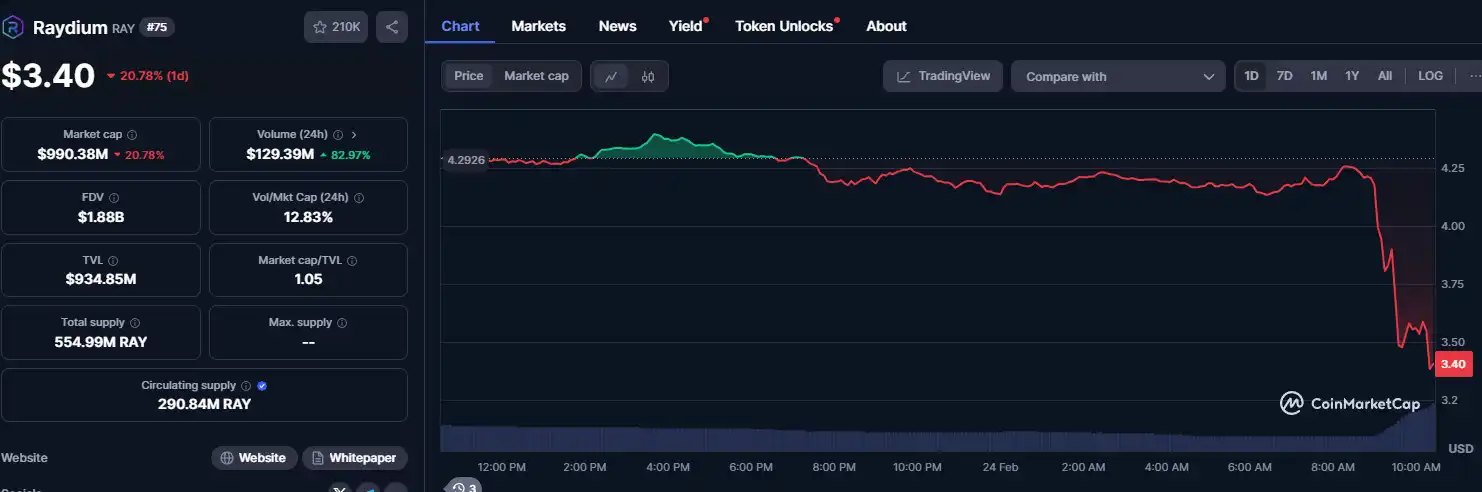
This phenomenon may reflect the market's concerns about its future revenue and position.
Pump.fun's strategy may pose a long-term threat to Raydium, especially in terms of liquidity migration and fee income.
On the flip side, following Pump.fun's self-built AMM pool launch, the price of a MEME test token Crack quickly surged, with a peak market cap reaching $4 million.
CA: CitRGsrgU7NjaXsxdMFc7sfsxtSnPdtkhHJqbPvhpump
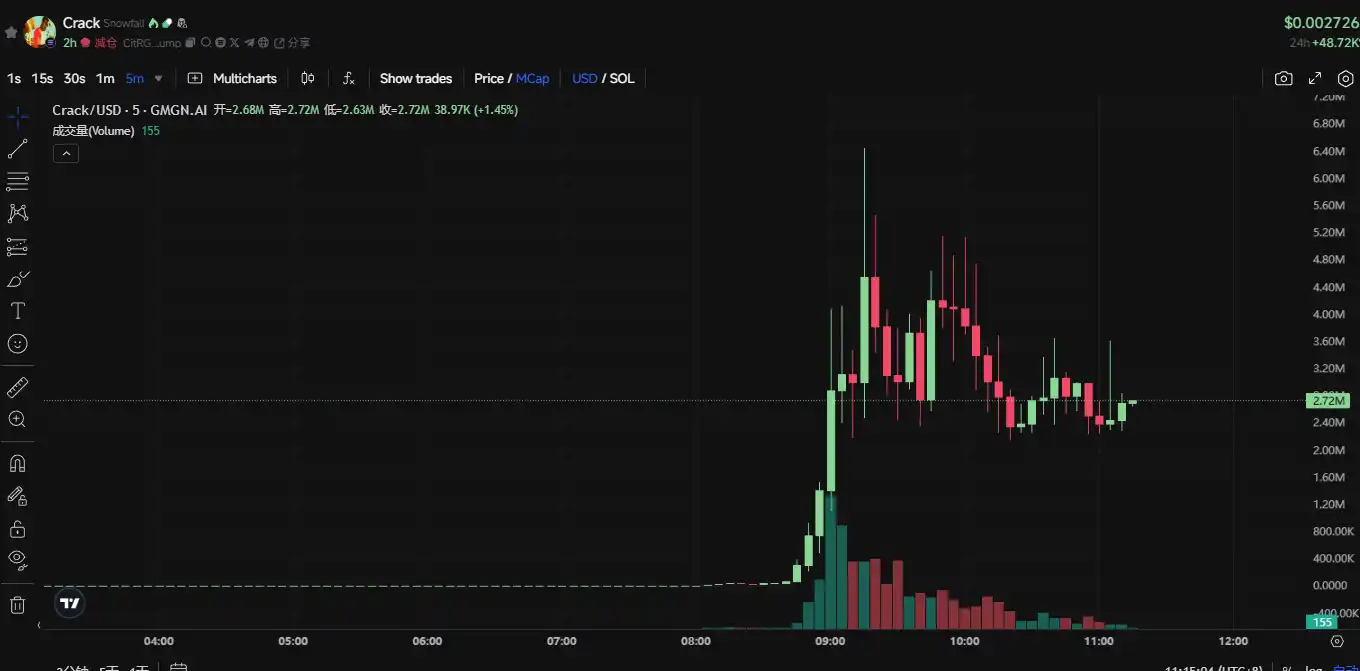
In a few market hotspots, the test tokens of AMM pools may continue to soar for a while.
Revealing the Heart of the Challenge
Post self-built AMM, if operations run smoothly, Pump.fun will have full control over off-chain liquidity, significantly boosting revenue.
By integrating on-chain and off-chain liquidity, Pump.fun can build a fully self-consistent on-chain Meme DeFi ecosystem.
From capturing attention flow to seizing capital destinations, Pump.fun is evidently transitioning from "relying on external liquidity" to "owning liquidity."
Once an innovative platform gains a larger user base, it naturally has the opportunity to disrupt traditional DeFi's position and the on-chain ecosystem layout through strategic adjustments.
However, whether Pump.fun can truly shake Raydium's position in the future will depend on its liquidity strategy, user growth balance, and most importantly, whether the bull market is still here.
Timing and luck.
Not only are the “leeks” engaging in PVP, but also projects are engaging in fierce competition against each other.
You may also like

Top 5 Cryptos to Buy in 2026 Q1: A ChatGPT Deep Dive Analysis
Explore the top 5 cryptos to buy in Q1 2026 including BTC, ETH, SOL, TAO, and ONDO. See price outlooks, key narratives, and institutional catalysts shaping the next market move.

How to Earn $15,000 with Idle USDT Before Altcoin Season 2026
Wondering if altcoin season is coming in 2026? Get the latest market update, and learn how to turn your idle stablecoins waiting for entry into extra rewards up to 15,000 USDT.
Can You Win Joker Returns Without Large Trading Volume? 5 Mistakes New Players Make In WEEX Joker Returns Season 2
Can small traders win WEEX Joker Returns 2026 without huge volume? Yes—if you avoid these 5 costly mistakes. Learn how to maximize card draws, use Jokers wisely, and turn small deposits into 15,000 USDT rewards.

Altcoin Season 2026: 4 Stages to Profit (Before the Crowd FOMO In)
Altcoin Season 2026 is starting — discover the 4 key stages of capital rotation (from ETH to PEPE) and how to position before the peak. Learn which tokens will lead each phase and avoid missing the rally.

Will Alt season come in 2026? 5 Tips to Spot the Next 100x Crypto Opportunities
Will altcoin season arrive in 2026? Discover 5 rotation stages, early signals smart traders watch, and the key crypto sectors where the next 100x altcoin opportunities may emerge.

The bear market has arrived, and cryptocurrency ETF issuers are also getting involved

The richest man had a quarrel with his former boss

BTC Firm Above 70K! Saylor’s "Institutional Logic" vs. Moon’s "Retail Faith": Who is Really Harvesting the Market?
Bitcoin is holding firm above the $70,000 support level following a massive short squeeze that liquidated $427 million. As the "Four-Year Cycle" narrative shifts, the market is split: Michael Saylor’s cold, institutional "indiscriminate stacking" vs. Carl Moon’s high-energy retail "hopium." This article decodes these two polar-opposite strategies for the 2026 bull run and reveals how WEEX’s institutional-grade liquidity and AI trading tools empower every type of investor to convert market volatility into profit.

The Girl Who Created the SBTI Test: A Story of a Doomed Cyber Love, an E-Widow Ratfolk

B.AI Officially Launched: Building AI Agent Financial Bedrock Platform, Driving AGI Era Business Underlying Logic

B.AI Officially Launched: Breaking Down A2A Collaboration Barriers to Unlock the Smart Body Economy's Full Potential
We helped Xu Mingxing write a book called "<OK Life>".

Rare APY of 400%, is TradeXYZ handing out money to oil bulls?
a16z: Perpetual Contracts are Rewriting Global Trading Rules
Bitcoin Hits $73,000 Triggering $427M Short Liquidation | Carl Moon: $200,000 is the Target
April 9, 2026 (UTC+0), 22:17. Bitcoin (BTC) executed a high-velocity surge within minutes, heavy-hitting the $73,000 psychological barrier and touching a local high near $74,000. While the price has since retraced to consolidate above $72,000, this "instant ambush" successfully completed a $427M liquidation of short positions.

a16z partner: perpetual contracts are rewriting the global trading rules
Bitcoin ETF Inflows Just Turned Positive After 5 Months of Outflows: What Does That Mean for BTC Price Now?
The Hidden Risks Behind Bitcoin ETF Inflows in 2026: What Traders Should Know. The question now isn't whether inflows are happening. It's what they're telling you about the next phase and whether your portfolio is positioned for it.
Decoding 2026's Bitcoin ETF Data: How to Trade Alongside Institutional Smart Money in 2026
After months of sustained outflows, rolling 30-day net ETF inflows just crossed 30,000 BTC. That's not noise. Historically, when institutional capital rotates back in at this scale, it marks a regime shift — not just a bounce.
Top 5 Cryptos to Buy in 2026 Q1: A ChatGPT Deep Dive Analysis
Explore the top 5 cryptos to buy in Q1 2026 including BTC, ETH, SOL, TAO, and ONDO. See price outlooks, key narratives, and institutional catalysts shaping the next market move.
How to Earn $15,000 with Idle USDT Before Altcoin Season 2026
Wondering if altcoin season is coming in 2026? Get the latest market update, and learn how to turn your idle stablecoins waiting for entry into extra rewards up to 15,000 USDT.
Can You Win Joker Returns Without Large Trading Volume? 5 Mistakes New Players Make In WEEX Joker Returns Season 2
Can small traders win WEEX Joker Returns 2026 without huge volume? Yes—if you avoid these 5 costly mistakes. Learn how to maximize card draws, use Jokers wisely, and turn small deposits into 15,000 USDT rewards.
Altcoin Season 2026: 4 Stages to Profit (Before the Crowd FOMO In)
Altcoin Season 2026 is starting — discover the 4 key stages of capital rotation (from ETH to PEPE) and how to position before the peak. Learn which tokens will lead each phase and avoid missing the rally.
Will Alt season come in 2026? 5 Tips to Spot the Next 100x Crypto Opportunities
Will altcoin season arrive in 2026? Discover 5 rotation stages, early signals smart traders watch, and the key crypto sectors where the next 100x altcoin opportunities may emerge.


 App
App