
 Buy Crypto
- Markets
 Futures
- Spot
- Copy Trade
- Earn
- More
SEC Announces "PoW Mining Does Not Constitute Securities Issuance" Action, Miners Welcome Regulatory Spring

Original Article Title: "SEC Announces 'PoW Mining Not Considered Securities,' Miners Do Not Need to Register, Welcoming a Major Regulatory Victory"
Original Article Author: Natalia Wu, BlockTempo
The U.S. Securities and Exchange Commission (SEC) announced regulatory guidance on Proof of Work (PoW) mining activities on the 20th, and for the first time concluded that "PoW mining activities do not constitute a securities offering," thus exempting them from federal securities law regulation, and mining participants do not need to register with the SEC.
This decision provides clear regulatory clarity for PoW miners and mining pools, alleviating their concerns about compliance with U.S. securities laws.
SEC Confirms PoW Mining Exempt from Securities Law Regulation
The SEC views PoW mining as an "administrative or transactional activity" rather than an investment contract. Miners validate transactions and secure the blockchain network by providing computational resources, earning newly minted cryptocurrency (referred to as "Covered Crypto Assets") as a reward. This process does not rely on third-party management or entrepreneurial efforts, which is a key criterion in the Howey test (used to determine whether an asset is a security).
The SEC considers "protocol mining" as the process of validating transactions and maintaining network security on a PoW blockchain. These networks are decentralized, permissionless systems, and miners add new blocks to the blockchain by solving complex cryptographic puzzles. Miners can participate without owning the network's native cryptocurrency, further distinguishing mining from securities issuance.
The SEC stated that its declaration covers only "protocol mining" activities involving:
• Miners mining cryptographic assets on a PoW network: The SEC emphasizes that these rewards come from the miners' own efforts, not third-party management, making them administrative tasks rather than securities transactions.
• The roles of mining pools and pool operators participating in the protocol mining process, including their roles in earning and distributing rewards. The SEC believes that miners' earnings in the pool are related to their computational contributions, not the pool operator's efforts, so these activities are also exempt from securities law regulation.
Cryptocurrency Mining Industry Regulatory Victory
This clarification is a significant victory for the PoW mining community. The SEC's confirmation that mining is not subject to securities regulation means that miners and pool operators can continue their operations without registering or complying with additional legal requirements. This decision may enhance confidence in the mining industry, especially in the context of ongoing regulatory scrutiny of mining due to energy consumption and environmental impact concerns.
It is worth noting that, after the Trump administration, the SEC has ushered in a crypto-friendly new leadership team and has been committed to providing a clearer regulatory stance. The SEC first defined the classification of digital assets at the end of February, categorizing Bitcoin as a digital commodity and determining that meme coins are not securities, with investors bearing the risk.
PoW Coins Experience Overall Decline in the Past 24 Hours
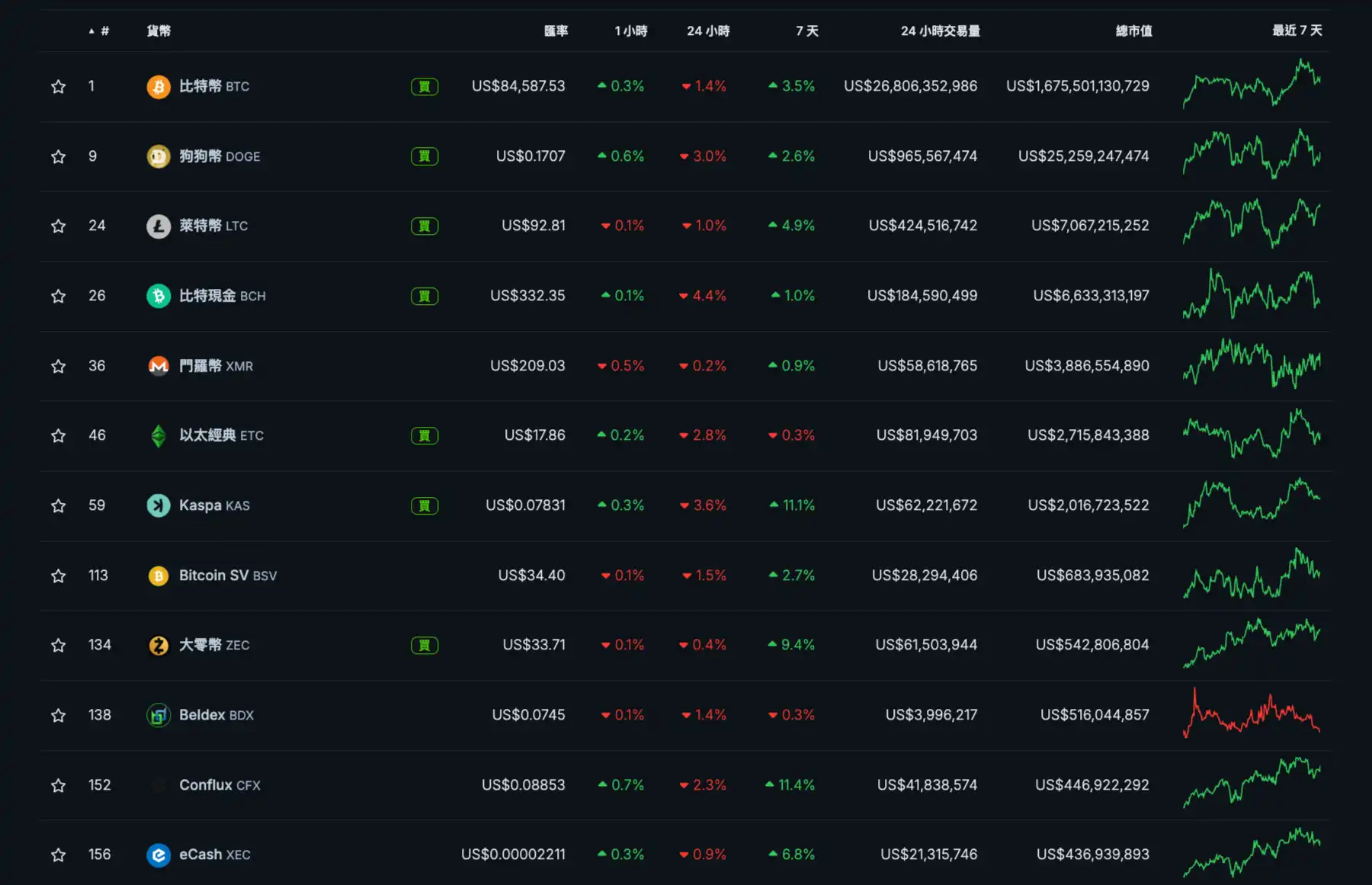
However, following the SEC's announcement, the prices of PoW tokens did not show a significant increase. In the past 24 hours, they followed the overall cryptocurrency market trend and experienced a general decline.
Due to the lack of highlights and substantial positive news in Trump's speech at the digital asset summit, as well as the escalating tariff war raising risk aversion sentiment, Bitcoin plummeted from $86,529 last night to a low of $83,642, a 3.3% drop, and has since slightly rebounded to $84,528, representing a 1.5% decline in the past 24 hours.
You may also like

The 17-Year Mystery Will Be Solved, Who is Satoshi Nakamoto?

5 Minutes to Make AI Your Second Brain

Uniswap is trapped in an innovation dilemma

What is the key to competition in crypto banking?

The flow of stablecoins and the spillover effects in the foreign exchange market

After two years, Hong Kong's first batch of stablecoin licenses finally issued: HSBC, Standard Chartered make the cut
The person who helped TAO rise by 90% has now single-handedly crashed the price again today

3-Minute Guide to Participating in the SpaceX IPO on Bitget

Top 5 Cryptos to Buy in 2026 Q1: A ChatGPT Deep Dive Analysis
Explore the top 5 cryptos to buy in Q1 2026 including BTC, ETH, SOL, TAO, and ONDO. See price outlooks, key narratives, and institutional catalysts shaping the next market move.

How to Earn $15,000 with Idle USDT Before Altcoin Season 2026
Wondering if altcoin season is coming in 2026? Get the latest market update, and learn how to turn your idle stablecoins waiting for entry into extra rewards up to 15,000 USDT.
Can You Win Joker Returns Without Large Trading Volume? 5 Mistakes New Players Make In WEEX Joker Returns Season 2
Can small traders win WEEX Joker Returns 2026 without huge volume? Yes—if you avoid these 5 costly mistakes. Learn how to maximize card draws, use Jokers wisely, and turn small deposits into 15,000 USDT rewards.

Altcoin Season 2026: 4 Stages to Profit (Before the Crowd FOMO In)
Altcoin Season 2026 is starting — discover the 4 key stages of capital rotation (from ETH to PEPE) and how to position before the peak. Learn which tokens will lead each phase and avoid missing the rally.

Will Alt season come in 2026? 5 Tips to Spot the Next 100x Crypto Opportunities
Will altcoin season arrive in 2026? Discover 5 rotation stages, early signals smart traders watch, and the key crypto sectors where the next 100x altcoin opportunities may emerge.

The bear market has arrived, and cryptocurrency ETF issuers are also getting involved

The richest man had a quarrel with his former boss

BTC Firm Above 70K! Saylor’s "Institutional Logic" vs. Moon’s "Retail Faith": Who is Really Harvesting the Market?
Bitcoin is holding firm above the $70,000 support level following a massive short squeeze that liquidated $427 million. As the "Four-Year Cycle" narrative shifts, the market is split: Michael Saylor’s cold, institutional "indiscriminate stacking" vs. Carl Moon’s high-energy retail "hopium." This article decodes these two polar-opposite strategies for the 2026 bull run and reveals how WEEX’s institutional-grade liquidity and AI trading tools empower every type of investor to convert market volatility into profit.

The Girl Who Created the SBTI Test: A Story of a Doomed Cyber Love, an E-Widow Ratfolk



 App
App