
 Buy Crypto
- Markets
 Futures
- Spot
- Copy Trade
- Earn
- More
Solana Stake Reward Adjustment Proposal, What Impact on SOL Price?

Original Author: David Grider, Partner at FinalityCap
Translation: zhouzhou, BlockBeats
Editor's Note: This article discusses a proposal regarding the adjustment of Solana staking rewards. The proposal's arguments have encountered issues, particularly concerning the impact of high staking rewards on DeFi yields and the effect of inflation on selling pressure. David counters by suggesting that the relationship between staking rewards, network security, and market demand is closely intertwined, and that staking rewards should be determined by the market.
The following is the original content (slightly reorganized for readability):
I am very concerned about the inflation reduction proposal SIMD-0228 put forth for Solana, especially the current version proposed by TusharJain and kankanivishal from multicoincap, as well as MaxResnick1, particularly without addressing some critical risks and issues.
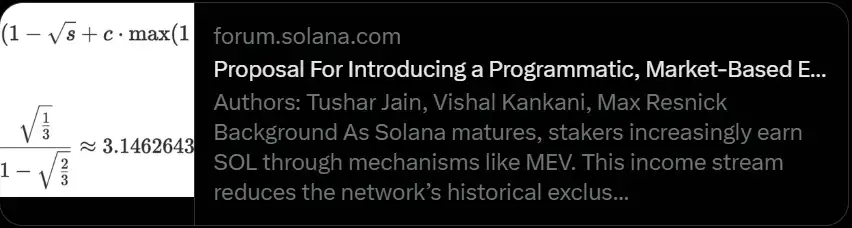
After listening to the latest Solana Validator Community Call, I believe that the arguments made for implementing this change have significant flaws.

Here is a summary of the arguments presented, which I will refute in detail in upcoming tweets:
1: High staking rewards are detrimental to DeFi yields
2: Inflation increases selling pressure and should be compared to network fees
3: High staking rewards reduce ETF demand
4: Staking rewards do not offer U.S. tax optimization as capital gains do
5: Higher staking rewards do not lead to a higher price
6: The staking formula will optimize the staking ratio, thus addressing security concerns (in my view, this is a critical security risk and a flawed approach)
Argument 1: A high staking rate is detrimental to DeFi yields.
Refutation 1: SOL staking is Solana's risk-free rate. Just as a higher risk-free rate on government bonds leads to an increase in rates on the credit curve, higher staking rewards will drive up DeFi rates and profits.
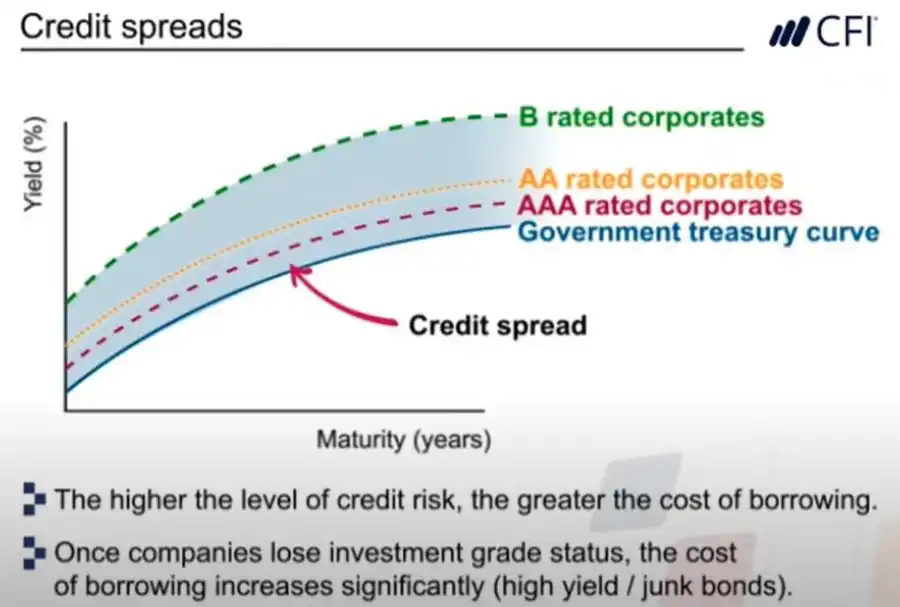
Point 2: Inflation has increased selling pressure, which should be compared to fees.
Rebuttal 2: This is not valid, just like unlocking does not necessarily bring selling pressure, whether to sell depends on the holder's choice. Validators can choose to restake their staking rewards. The impact of inflation on liquidity is smaller compared to other supply factors. Instead of comparing selling pressure to fees, it is better to compare it to fund flows. One can look at the Solana ETP fund flows as a measurable metric, but demand from funds and individuals is larger and more significant.
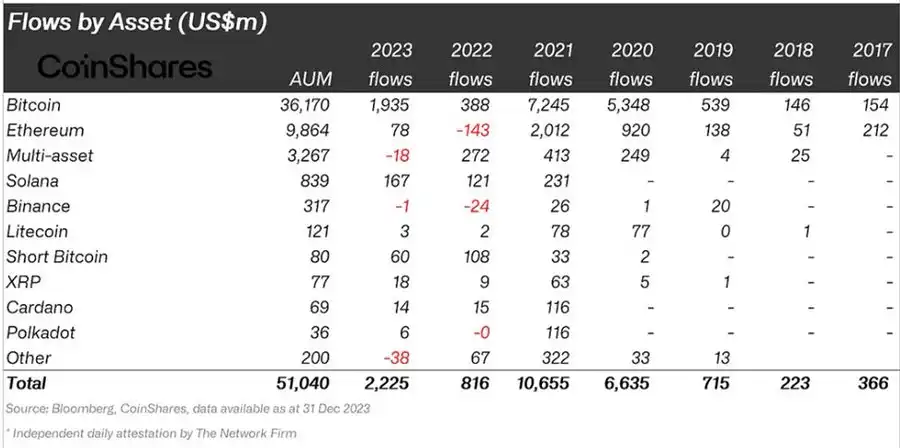
Point 3: High staking rewards have reduced the demand for ETFs.
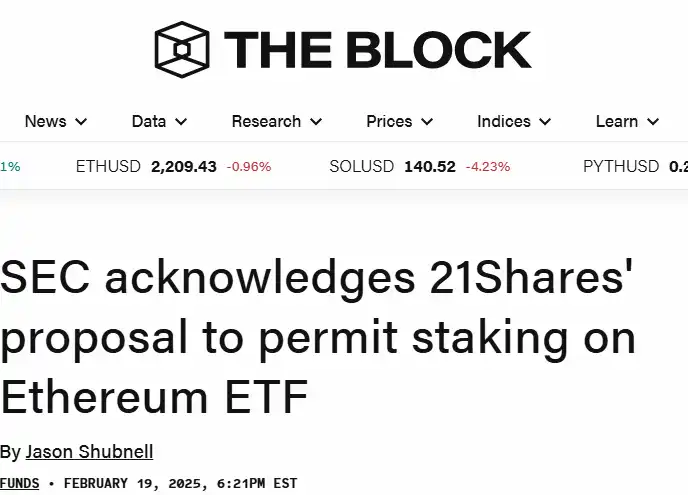
Rebuttal 3: Just because someone has used this point to explain the softness in ETH ETF demand does not mean it applies to Solana as well. Look at many of Europe's SOL ETPs; they take the entire staking yield and do not charge fees, attracting significant inflows of funds (as mentioned above). Moreover, US ETFs are also nearing approval for staking, so in the long run, this point does not hold.
Point 4: Staking rewards are not as tax-optimized as capital gains.
Rebuttal 4: Solana is a globally decentralized network; we should not optimize solely for US tax policies as tax policies can change at any time. This is similar to how equity investors would overlook the impact of tax changes on stock valuation.
Point 5: Higher staking rewards will not lead to a higher price.
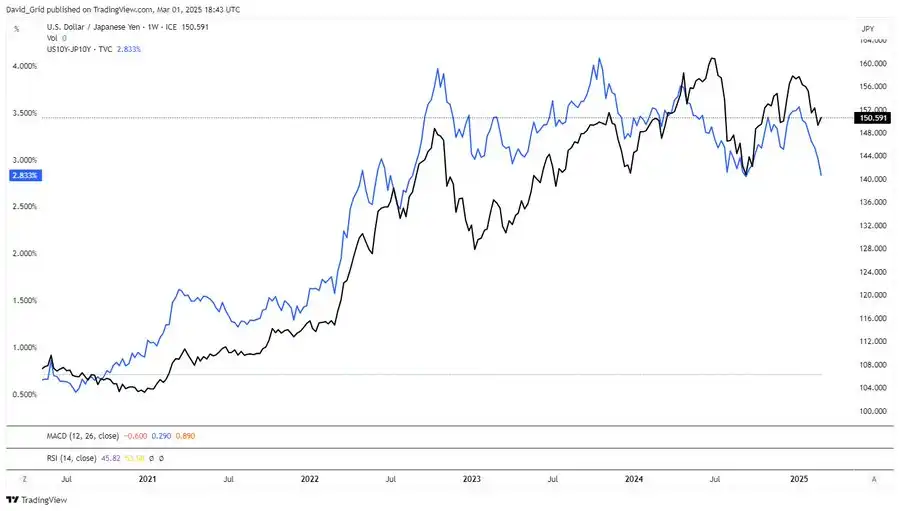
Rebuttal 5: Real-world evidence proves this point invalid. Just look at how traditional currencies are priced. The valuation of one currency against another is usually based on the interest rate differential. Higher rates typically lead to a stronger currency. Here is a chart showing the USD/JPY against the US 10-year Treasury and Japanese 10-year Government Bond yield differentials as an example.
Point 6: The staking formula will optimize the staking ratio, thus addressing security concerns.
Rebuttal 6: It also needs to optimize the number of validators and staking distribution. Running Solana validators is costly, and the number of validators has been decreasing.

Rebuttal 6 (Continued): An analysis that must be conducted in order to move forward safely with this proposal, but what I have not seen yet is:
Simulating how many of the currently active small validators would become unprofitable and drop out under the new proposal. This needs to be analyzed under different network activity and SOL price assumptions, especially in a bear market scenario considering a 80% drop in both MEV and base fees, as well as prices. Then, looking at the current Solana validator list, see how many current validators would become unprofitable and drop out under these scenarios.
We can discuss how many validators Solana needs. It may not need to artificially inflate to 100,000 like ETH, but we also do not want Solana to become a Cosmos chain with only 100 validators.
Additionally, because proponents have brought up the argument of U.S. tax implications to drive this proposal, we are also not sure what the SEC's decentralization test standards are, so it might be desirable to keep the validator count above 1,000 to keep SOL as a commodity.
In conclusion, unless someone has at least done this analysis, this proposal should not go through.
The proposal indeed raises the right question: how much inflation is needed? But before making a change, there are other questions we need to answer. I do agree that this number could be lower and should be more dynamic. Just as a company does not need to pay a fixed amount to suppliers or provide a fixed return to financiers, the market should determine this number, so I support this direction. We just need to slow down, do more work to understand its impact.
This could actually be a high-level approach to addressing this risk.
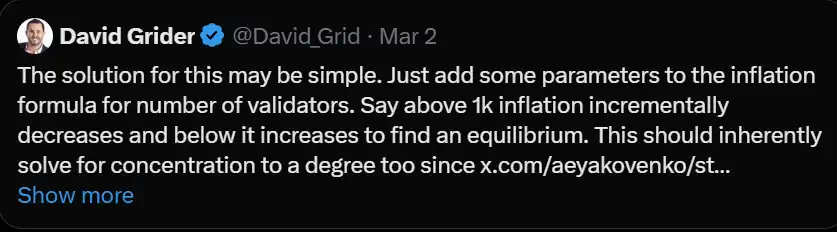
My sincere suggestion is, we should not assume and generalize its impact. Data analysis should be done, displaying all assumptions and data.
You may also like

The 17-Year Mystery Will Be Solved, Who is Satoshi Nakamoto?

5 Minutes to Make AI Your Second Brain

Uniswap is trapped in an innovation dilemma

What is the key to competition in crypto banking?

The flow of stablecoins and the spillover effects in the foreign exchange market

After two years, Hong Kong's first batch of stablecoin licenses finally issued: HSBC, Standard Chartered make the cut
The person who helped TAO rise by 90% has now single-handedly crashed the price again today

3-Minute Guide to Participating in the SpaceX IPO on Bitget

Top 5 Cryptos to Buy in 2026 Q1: A ChatGPT Deep Dive Analysis
Explore the top 5 cryptos to buy in Q1 2026 including BTC, ETH, SOL, TAO, and ONDO. See price outlooks, key narratives, and institutional catalysts shaping the next market move.

How to Earn $15,000 with Idle USDT Before Altcoin Season 2026
Wondering if altcoin season is coming in 2026? Get the latest market update, and learn how to turn your idle stablecoins waiting for entry into extra rewards up to 15,000 USDT.
Can You Win Joker Returns Without Large Trading Volume? 5 Mistakes New Players Make In WEEX Joker Returns Season 2
Can small traders win WEEX Joker Returns 2026 without huge volume? Yes—if you avoid these 5 costly mistakes. Learn how to maximize card draws, use Jokers wisely, and turn small deposits into 15,000 USDT rewards.

Altcoin Season 2026: 4 Stages to Profit (Before the Crowd FOMO In)
Altcoin Season 2026 is starting — discover the 4 key stages of capital rotation (from ETH to PEPE) and how to position before the peak. Learn which tokens will lead each phase and avoid missing the rally.

Will Alt season come in 2026? 5 Tips to Spot the Next 100x Crypto Opportunities
Will altcoin season arrive in 2026? Discover 5 rotation stages, early signals smart traders watch, and the key crypto sectors where the next 100x altcoin opportunities may emerge.

The bear market has arrived, and cryptocurrency ETF issuers are also getting involved

The richest man had a quarrel with his former boss

BTC Firm Above 70K! Saylor’s "Institutional Logic" vs. Moon’s "Retail Faith": Who is Really Harvesting the Market?
Bitcoin is holding firm above the $70,000 support level following a massive short squeeze that liquidated $427 million. As the "Four-Year Cycle" narrative shifts, the market is split: Michael Saylor’s cold, institutional "indiscriminate stacking" vs. Carl Moon’s high-energy retail "hopium." This article decodes these two polar-opposite strategies for the 2026 bull run and reveals how WEEX’s institutional-grade liquidity and AI trading tools empower every type of investor to convert market volatility into profit.

The Girl Who Created the SBTI Test: A Story of a Doomed Cyber Love, an E-Widow Ratfolk



 App
App