
 Buy Crypto
- Markets
 Futures
- Spot
- Copy Trade
- Earn
- More
Tether has issued a "new stablecoin" - what are the differences between USDT 2.0 and USDT?

Today, Tether announced the first deployment of its new token USDT0 on Kraken's Ethereum Layer 2 network Ink, aiming to leverage LayerZero's Omnichain Fungible Token Standard to develop a cross-chain liquidity layer, simplify USDT's cross-chain transfers, and provide a seamless user and developer experience.
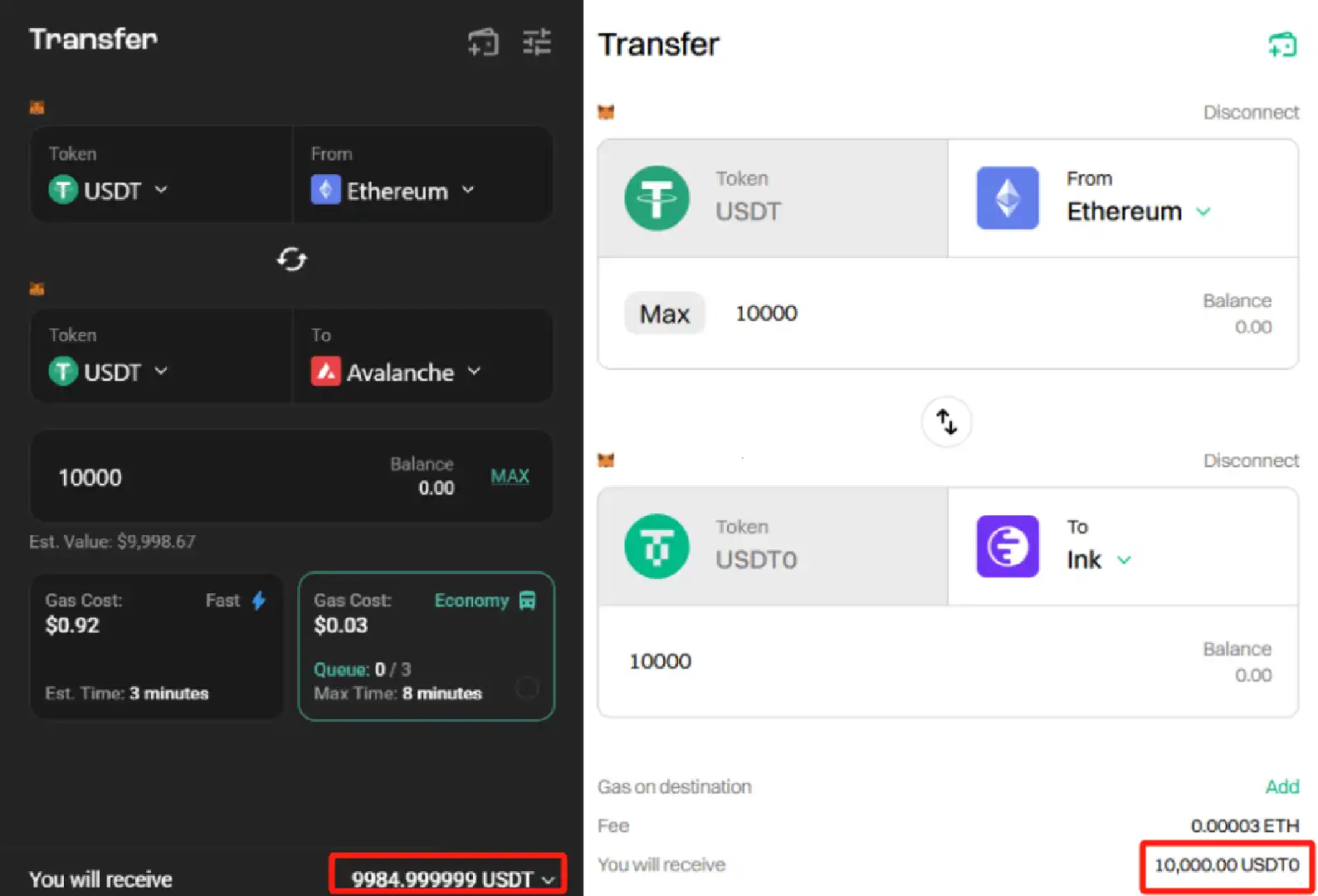
As a stablecoin previously launched by Tether, USDT has become the world's largest single stable asset. However, stablecoin liquidity is currently fragmented, with USDT on different chains unable to freely move across chains, and high cross-chain costs have always deterred ordinary investors. The introduction of USDT0 aims to address this issue. On the one hand, through collaboration with LayerZero, it significantly enhances the security of cross-chain transactions. On the other hand, it achieves zero-friction cross-chain transfers (as shown in the example below), expanding the business scope of USDT and enhancing its practicality on the blockchain.
Tether's CEO Paolo Ardoino stated: "USDT0 has brought a much-needed solution to enable the seamless circulation of USDT across different ecosystems. By enhancing interoperability and reducing barriers, it aligns with Tether's overall vision, optimizing user experience. It is truly exciting to see such innovation emerge and effectively meet market demands."
Significantly Reducing Cross-Chain Costs
USDT has always had interoperability, but in a fragmented way. Each blockchain has its own USDT, and to transfer USDT between different chains, one must rely on solutions like cross-chain bridges, i.e., burning USDT on one chain and minting it on another.
With USDT0, the situation is different: now USDT has become a single, liquid asset across various blockchains, no longer fragmented. More precisely, the same token can smoothly move between different networks.
For users, USDT0 eliminates the fragmentation issue, meaning higher capital efficiency. Below is an example of transferring 10,000 USDT from Ethereum to Avalanche (left) and now using USDT0 empowered by LayerZero (right). As seen, with USDT0, users receive exactly what they transfer cross-chain, significantly reducing expensive transaction fee losses.
Expansion Plan
Ink: The Gateway to Institutional Liquidity
USDT0 will first be launched on Ink, an L2 blockchain introduced by Kraken, one of the world's largest and most trusted cryptocurrency exchanges. Utilizing the world's largest stablecoin, USDT0 has built a seamless channel for institutional liquidity between entities.
Andrew Koller, the founder of Ink, stated: "Both USDT0 and Ink are committed to ensuring that users and developers have maximum control over their assets and can seamlessly access various opportunities. USDT0 has chosen Ink as its launch chain, which will set a new standard for the flow of stablecoin liquidity across all chains in the future."
Furthermore, USDT0 has integrated with Kraken, allowing users to deposit and withdraw USDT0 on Ink. There are plans for more integrations within the Kraken tech stack, which will set standards for USDT0's interoperability and pave the way for a world-class experience for USDT users.
Initial Partnerships and Expansion: Berachain and MegaETH
Following Ink, the initial partners for USDT expansion through USDT0 include Berachain and MegaETH, with more related announcements to be released in the coming weeks.
Berachain is a layer-one (L1) blockchain fully compatible with the Ethereum Virtual Machine (EVM), built on an innovative Proof of Liquidity (PoL) consensus mechanism. This mechanism rewards users who actively contribute resources to the network with the network's native governance token, $BGT. The integration of USDT0 on Berachain will launch on the Boyco platform, which aims to directly funnel funds into core applications on Berachain. Boyco consists of 11 decentralized applications and 15 asset issuers (including USDT0) and serves as an ideal channel for yield-seeking reserves on Berachain. The Boyco treasury has already attracted over $1.5 billion in deposits, and with the launch of official projects and the addition of high-value assets like USDT0, this number is expected to grow significantly.
MegaETH is the first real-time blockchain capable of processing 100,000 transactions per second with a sub-10-millisecond block time, while inheriting Ethereum's security. MegaETH looks forward to leveraging USDT0 in a wide range of DeFi applications and payment products. Combining real-time applications with Tether's distribution capabilities will accelerate the adoption of the next wave of cryptocurrencies.
Overall, USDT is the world's largest stablecoin and the most sought-after on-chain asset by users and the blockchain itself. USDT0 is a scalability solution for USDT that addresses the issue of high cross-chain transaction costs, making USDT and even the entire cryptocurrency ecosystem more user-friendly.
You may also like

Ray Dalio's new article: The world is entering a war cycle

IOSG: When Fintech Meets Crypto Native: The Next Decade of Digital Finance

They knew in advance that Trump would tweet about a ceasefire, entered with $20k, and exited with $400k.

The biggest bottleneck in DeFi development

CZ Memoir Released: Reveals a Large Amount of Industry Insider Information, Prompting Intense Rebuttal from Xu Mingxing

a16z: After securities are on the blockchain, why will intermediary institutions be replaced by code?

XRP Tokyo Is Here: What We Learn and What’s Next for XRP Price
Key Takeaways: Ripple’s 2025 XRP Tokyo event highlights a projected $33 trillion on-chain stablecoin volume by 2026. Significant…

Solana’s Future: Navigating the $285M Hack, Rug Pulls, and Milei Libra Scandal
Key Takeaways: Multiple Crises: Solana faces a $285 million hack, allegations of rug pulls, and the Milei Libra…

BTC USD Faces Tension: Markets React to Trump’s Dire Warning
Key Takeaways: Bitcoin’s price drops sharply below $70,000 amid geopolitical tensions, playing off Trump’s dramatic 8 PM ultimatum…
Bitcoin Price Surge: Ceasefire Sparks Optimism Hits $71K
Key Takeaways: After the US-Iran ceasefire announcement, Bitcoin surged beyond $71,000, marking its highest in a month. A…

Ethereum Price Forecast: Record $180 Billion Stablecoin Supply Marks Buyers’ Return
Key Takeaways: Ethereum’s stablecoin supply has surged to a record $180 billion, marking a 150% increase over the…

Emerging Evidence Links Argentina’s Milei to LIBRA Crypto Scandal
Key Takeaways: Evidence unveiled by Argentina’s federal prosecutors links President Javier Milei to the LIBRA token through call…

US Spot Bitcoin ETFs See Surge as BTC Nears $70K; LiquidChain and Layer-3 DeFi Rise
Key Takeaways: U.S. spot Bitcoin ETFs absorbed $471 million in a single day, moving BTC closer to the…

Bitcoin Price Prediction: Decoupling from Tech Stocks, Shaped by Geopolitics and AI Turmoil
Key Takeaways: Bitcoin is decoupling from tech stocks as geopolitical tensions and AI crises reshape the market, currently…

Chaos Labs Departure Leaves Aave Without Risk Management Amidst Governance Conflict
Key Takeaways: Aave, with a $50 billion TVL, is currently operating without a risk manager due to Chaos…
Grayscale Ethereum ETF Staking: A New Catalyst for $5,700?
Key Takeaways: Grayscale’s Ethereum Staking ETF introduces a yield-bearing structure that could significantly reshape investor sentiment. Ethereum’s price…

Polygon Crypto Enhances Finality Through the Giugliano Hardfork
Key Takeaways: Polygon’s Giugliano hardfork is operational on the mainnet, effectively reducing transaction finality by 2 seconds. The…

Senate’s Three-Week Deadline: Ripple XRP and the CLARITY Act’s Critical Moment
Key Takeaways: The Senate Banking Committee’s decision on the CLARITY Act in late April could define XRP’s future…


 App
App