
 Buy Crypto
- Markets
 Futures
- Spot
- Copy Trade
- Earn
- More
From 27th to 4th: The AI Trading "Survivor Strategy" Behind a WEEX Hackathon Comeback

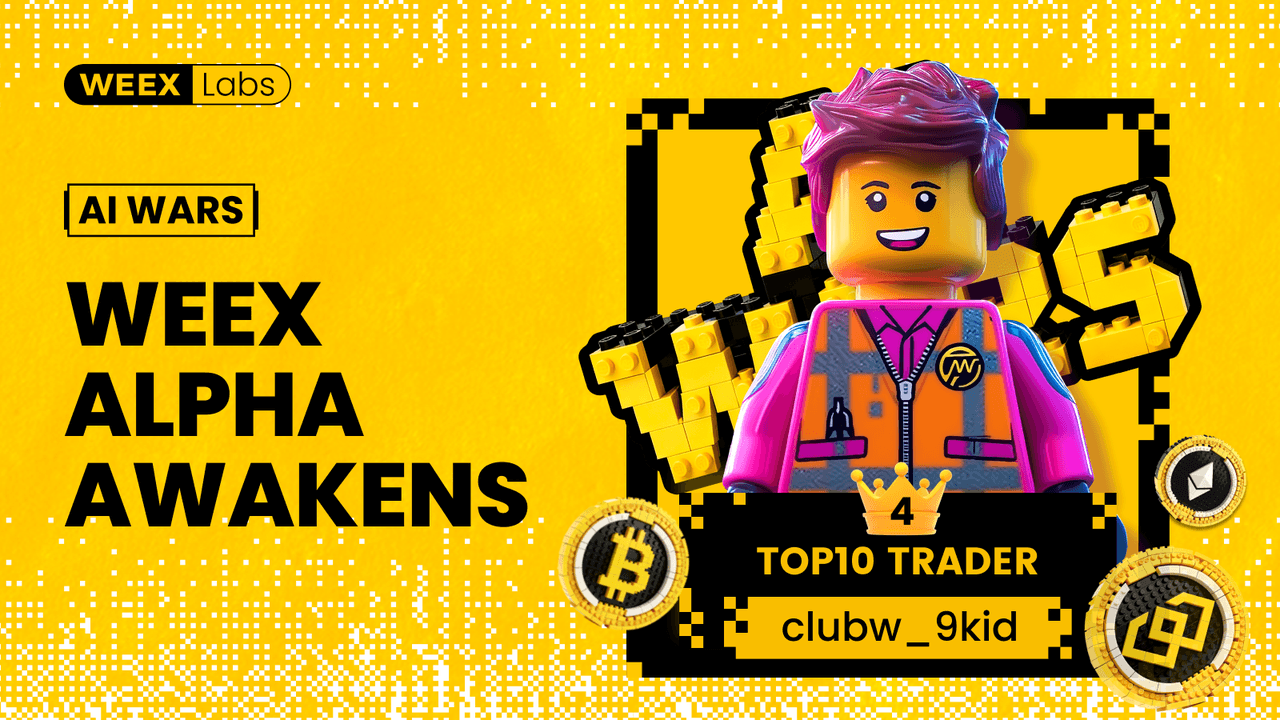
In Season 1 of the WEEX AI Trading Hackathon , finalist ClubW_9Kid delivered one of the most impressive comebacks of the competition. After dropping to 27th place in the first half of the finals due to a strategic logic flaw, he rebuilt his framework,climbed back into the Top 10, and ultimately secured 4th place.
In this interview, he shares what the competition taught him about AI discipline, risk management, and why survival — not perfection — is the true edge in algorithmic trading.
AI Discipline vs Human Emotion: Why AI Trading Executes Without Ego
When asked what left the strongest impression during the hackathon, the finalist pointed to the contrast between human emotion and machine execution. His AI trader followed position distribution rules without hesitation, regardless of how volatile the market became — something he believes is nearly impossible for a human to replicate consistently. What stood out most to him was AI’s ability to process massive amounts of data instantly and execute decisions exactly as instructed, without fear or ego interfering.
A key enabler behind this disciplined execution was the Deerbit.ai platform he used throughout the competition. Rather than requiring heavy coding, Deerbit.ai allowed him to translate complex trading ideas into structured logic through a far more intuitive workflow. By freeing him from repetitive debugging and technical friction, the platform fundamentally reshaped his development process — shifting his focus from code mechanics to the robustness, hierarchy, and fault tolerance of the strategy itself.
This efficiency dramatically accelerated iteration. With a streamlined “idea-to-execution” loop powered by Deerbit.ai, he was able to test, refine, and rebuild his framework at remarkable speed — iterating through over 100 versions within a limited competition window. In this process, AI acted not only as an execution engine, but also as a feedback mechanism, exposing logical weaknesses and enabling rapid optimization — ultimately fueling his comeback from 27th place to a Top 5 finish.
Strategy Logic Conflict: The AI Trading Failure That Sent Him to 27th
The defining moment of his competition came during the first half of the finals, when he uploaded an updated strategy without fully testing it. The issue was not market conditions, but internal logic conflict. Two variables were triggered simultaneously, yet there was no defined hierarchy to determine which rule should take priority. Without structured decision layers, the AI either hesitated or executed excessively, leading to unstable performance. As a result, his ranking fell sharply to 27th out of 37 participants.
Reflecting on this setback, he concluded that the weakness was not AI itself, but overly complicated design. When logic becomes too complex without clear priority structure, execution collapses. He observed similar patterns among other participants, including extremely high trade frequencies that would generate significant transaction costs in real-world environments.
In the second half of the finals, he simplified everything. He introduced explicit rule prioritization and streamlined the decision-making process into a more structured framework. Instead of adding complexity, he reduced it. The results were immediate — his ranking climbed from 27th to 16th, then into the Top 10, and eventually stabilized in the Top 5. The lesson was clear: the most powerful AI is not the one with the most complex code, but the one built on unbreakable logic.
The "Survivor Strategy": Why Risk Control Matters More Than Perfect AI Trading
When asked about the secret behind his performance, he ranked the factors in a straightforward way: luck first, risk control second, and strategy third. He acknowledged that certain Black Swan events happened to align with his positions, while other highly skilled participants were simply less fortunate. However, he also described another kind of luck — a shift in mindset.
He admitted that he began the competition with a gambler’s mentality, increasing leverage in pursuit of dramatic recovery. Over time, he consciously transitioned into a trader’s mindset focused on steady growth, disciplined risk management, and compounding rather than desperation. This psychological shift ultimately shaped what he calls the “Survivor Strategy.” Its foundation is fault tolerance and capital preservation, emphasizing the importance of staying operational during extreme volatility instead of chasing explosive gains.
For him, the essence of AI trading is not about building a perfect or hyper-complex algorithm. It is about constructing a resilient logical framework that can withstand uncertainty. In his words, in this market, the boldest thing you can do is simply survive.
Lessons for the Next Generation of AI Trading Competitions
Looking toward future editions of the hackathon, he suggested introducing a “Strategic Circuit Breaker” feature that would allow participants to pause AI execution or update strategy logic if a framework is clearly malfunctioning. During the first half of the finals, he had to watch his account decline due to logical conflict without being able to intervene under the rules. In real-world trading, professionals recalibrate systems when flaws appear, and he believes allowing controlled intervention would make the competition more aligned with actual risk management practices.
He also recommended clearer final benefit incentives to encourage more serious participation, stronger social media integration, and real-time ranking change notifications to enhance engagement. At the same time, he praised the dashboard experience and the overall marketing and visual design of Season 1.
For newcomers, his advice is simple. Treat competition as a process of learning and evolution. Do not chase perfection in an uncertain market. Respect volatility, respect risk, and remember that code is only a tool —The mindset is the true edge.
Season 2: The Next Stage of the WEEX AI Trading Hackathon
WEEX AI Hackathon Season 2 arrives this May as a comprehensive upgrade, expanding participation, increasing rewards, and deepening global engagement. Building on Season 1’s foundation, the new season will push AI trading further into live-market validation—where models are tested under real volatility, risk management is rewarded, and measurable performance replaces hype. By creating a structured competitive environment, WEEX continues positioning itself not just as a trading platform, but as an ecosystem builder driving the evolution of disciplined, explainable, and innovation-driven AI crypto trading. New users can register on WEEX to explore AI trading tools and participate in upcoming competitions.
About WEEX
Founded in 2018, WEEX has developed into a global crypto exchange with over 6.2 million users across more than 150 countries. The platform emphasizes security, liquidity, and usability, providing over 1,200 spot trading pairs and offering up to 400x leverage in crypto futures trading. In addition to the traditional spot and derivatives markets, WEEX is expanding rapidly in the AI era — delivering real-time AI news, empowering users with AI trading tools, and exploring innovative trade-to-earn models that make intelligent trading more accessible to everyone. Its 1,000 BTC Protection Fund further strengthens asset safety and transparency, while features such as copy trading and advanced trading tools allow users to follow professional traders and experience a more efficient, intelligent trading journey.
Follow WEEX on social media
X: @WEEX_Official
Instagram: @WEEX Exchange
Tiktok: @weex_global
Youtube: @WEEX_Official
Discord: WEEX Community
Telegram: WeexGlobal Group
You may also like

The biggest bottleneck in DeFi development

CZ Memoir Released: Reveals a Large Amount of Industry Insider Information, Prompting Intense Rebuttal from Xu Mingxing

a16z: After securities are on the blockchain, why will intermediary institutions be replaced by code?

XRP Tokyo Is Here: What We Learn and What’s Next for XRP Price
Key Takeaways: Ripple’s 2025 XRP Tokyo event highlights a projected $33 trillion on-chain stablecoin volume by 2026. Significant…

Solana’s Future: Navigating the $285M Hack, Rug Pulls, and Milei Libra Scandal
Key Takeaways: Multiple Crises: Solana faces a $285 million hack, allegations of rug pulls, and the Milei Libra…

BTC USD Faces Tension: Markets React to Trump’s Dire Warning
Key Takeaways: Bitcoin’s price drops sharply below $70,000 amid geopolitical tensions, playing off Trump’s dramatic 8 PM ultimatum…
Bitcoin Price Surge: Ceasefire Sparks Optimism Hits $71K
Key Takeaways: After the US-Iran ceasefire announcement, Bitcoin surged beyond $71,000, marking its highest in a month. A…

Ethereum Price Forecast: Record $180 Billion Stablecoin Supply Marks Buyers’ Return
Key Takeaways: Ethereum’s stablecoin supply has surged to a record $180 billion, marking a 150% increase over the…

Emerging Evidence Links Argentina’s Milei to LIBRA Crypto Scandal
Key Takeaways: Evidence unveiled by Argentina’s federal prosecutors links President Javier Milei to the LIBRA token through call…

US Spot Bitcoin ETFs See Surge as BTC Nears $70K; LiquidChain and Layer-3 DeFi Rise
Key Takeaways: U.S. spot Bitcoin ETFs absorbed $471 million in a single day, moving BTC closer to the…

Bitcoin Price Prediction: Decoupling from Tech Stocks, Shaped by Geopolitics and AI Turmoil
Key Takeaways: Bitcoin is decoupling from tech stocks as geopolitical tensions and AI crises reshape the market, currently…

Chaos Labs Departure Leaves Aave Without Risk Management Amidst Governance Conflict
Key Takeaways: Aave, with a $50 billion TVL, is currently operating without a risk manager due to Chaos…

Grayscale Ethereum ETF Staking: A New Catalyst for $5,700?
Key Takeaways: Grayscale’s Ethereum Staking ETF introduces a yield-bearing structure that could significantly reshape investor sentiment. Ethereum’s price…

Polygon Crypto Enhances Finality Through the Giugliano Hardfork
Key Takeaways: Polygon’s Giugliano hardfork is operational on the mainnet, effectively reducing transaction finality by 2 seconds. The…

Senate’s Three-Week Deadline: Ripple XRP and the CLARITY Act’s Critical Moment
Key Takeaways: The Senate Banking Committee’s decision on the CLARITY Act in late April could define XRP’s future…
Solana Foundation Introduces STRIDE for DeFi Security
Key Takeaways: STRIDE is a structured security evaluation program for Solana’s DeFi ecosystem, managed by Asymmetric Research. It…
Trump Iran Doomsday Deadline Revisited: How Will Bitcoin and SPX Respond?
Key Takeaways: The geopolitical tension surrounding the Trump Iran deadline poses significant risks to Bitcoin prices and the…

XRP Crypto Slips to $1.31: Liquidity Challenges and Market Movement
Key Takeaways: XRP has fallen to $1.31, struggling after a rejection at the $1.35 level, showing potential liquidity…
The biggest bottleneck in DeFi development
CZ Memoir Released: Reveals a Large Amount of Industry Insider Information, Prompting Intense Rebuttal from Xu Mingxing
a16z: After securities are on the blockchain, why will intermediary institutions be replaced by code?
XRP Tokyo Is Here: What We Learn and What’s Next for XRP Price
Key Takeaways: Ripple’s 2025 XRP Tokyo event highlights a projected $33 trillion on-chain stablecoin volume by 2026. Significant…
Solana’s Future: Navigating the $285M Hack, Rug Pulls, and Milei Libra Scandal
Key Takeaways: Multiple Crises: Solana faces a $285 million hack, allegations of rug pulls, and the Milei Libra…
BTC USD Faces Tension: Markets React to Trump’s Dire Warning
Key Takeaways: Bitcoin’s price drops sharply below $70,000 amid geopolitical tensions, playing off Trump’s dramatic 8 PM ultimatum…


 App
App