
 Buy Crypto
- Markets
 Futures
- Spot
- Copy Trade
- Earn
- More
Underestimated Veteran Public Chain: ETF Application Drives HBAR to Rise Again

Original Article Title: "Applying for a Spot ETF, Monthly Growth Exceeds 104%, What is HBAR?"
Original Article Author: Golem, Odaily Planet Daily
Today, the L1 blockchain Hedera's native token, HBAR, has broken through 0.38 USDT, reaching a high of 0.39 USDT, with a 24-hour increase of over 40%. In the past month, the price has surged over 104%, returning to November 2021 levels.
The Hedera blockchain was launched as early as 2019. On November 13th this year, the crypto investment firm Canary Capital submitted an HBAR ETF application to the US SEC. Compared to the widespread attention and discussion sparked by ETF applications for SOL, XRP, and LTC, the heat around HBAR has always been less intense, with many crypto newcomers in this bull market round not even having heard of the project.
So, where does the Hedera blockchain come from? What are the other reasons behind the explosive rise in HBAR price? Odaily Planet Daily will briefly introduce and analyze Hedera in this article.
Hedera Introduction
Hedera is a decentralized open-source proof-of-stake public blockchain, with its underlying technology utilizing a leaderless, asynchronous Byzantine Fault Tolerant (ABFT) Hashgraph consensus algorithm. According to its official website data, Hedera blockchain finality only takes 2.9 seconds, with an average transaction cost of $0.0001, and the network has low energy consumption, with an average energy consumption per transaction as low as 0.000003 kWh, whereas Solana's energy consumption is 170 times that amount.
Developers can use the Hedera blockchain for real asset tokenization, building DeFi and NFT ecosystems, creating decentralized identities, and using native consensus timestamps to create low-cost, scalable, and publicly verifiable data logs — recording payment events, supply chain origins, IoT sensor data, etc.
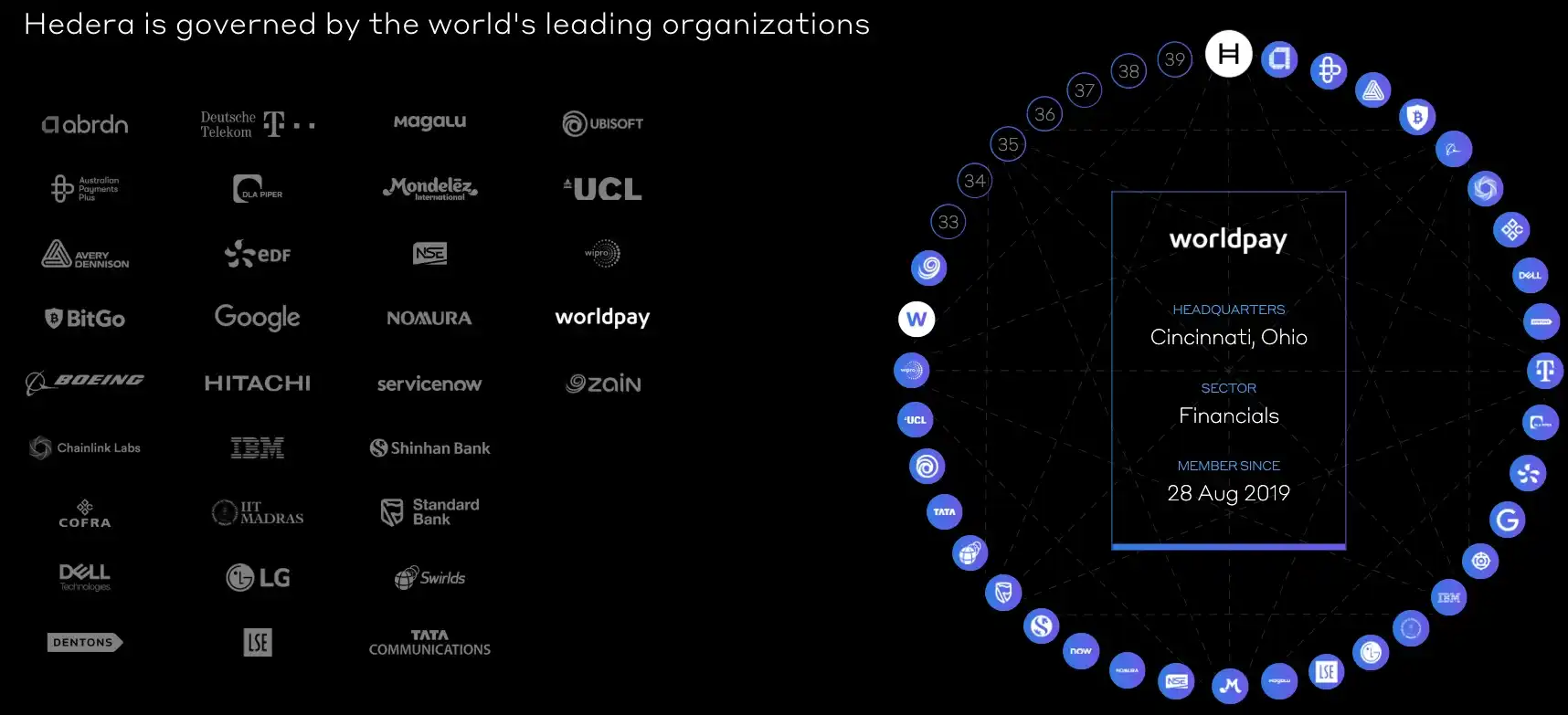
The Hedera blockchain is governed by a board and the Hedera Governing Council, which consists of up to 39 rotating, highly diverse leading organizations and enterprises, including well-known companies and institutions such as Google, Dell, and abrdn.
HBAR is Hedera blockchain's native token, used for network fees and as a staking token for the POS mechanism. The total supply of HBAR is 500 billion, with a current circulation exceeding 381.9 billion, a circulating market cap of 13.28 billion US dollars, and a crypto market rank of 19th.
So far, the impression of Hedera has been nothing more than a run-of-the-mill old L1.
Why Did HBAR Price Skyrocket?
As the price of the HBAR token surged, the market generally attributed the main reason to the favorable HBAR ETF application submitted by Canary Capital on November 13, with HBAR rising over 30% on the day of the announcement.
Generally speaking, token price surges triggered by news events do not last long. On November 26, Bloomberg ETF analyst James Seyffart also stated that the SEC's decision on SOL, XRP, LTC, and HBAR ETFs may be delayed until the end of 2025.
With the favorable news of the ETF still pending, and actual ETF approval a distant prospect, many thought that the HBAR price would retreat. However, the HBAR price remains in an upward trend, reaching levels from the November 2021 bull market. For this reason, Odaily Planet Daily summarizes the following four reasons:
Altcoin ETF Emergence, HBAR Undervalued Compared to Other Tokens
Currently, altcoin ETFs are emerging, with SOL, XRP, LTC, and HBAR ETF applications being submitted in succession. Additionally, according to ETF Store President Nate Geraci, at least one issuer is currently attempting to apply for an ETF for ADA (Cardano) or AVAX (Avalanche). Despite HBAR's token price surging by 104% in the past month, far exceeding the 40%, 32%, and 25% increases for SOL, XRP, and LTC, respectively, HBAR's market capitalization remains low and still ranks below DOT, in 19th place.
In fact, before Canary Capital submitted the HBAR ETF application, in October, Canary Capital launched the HBAR Trust in the United States, specifically catering to eligible individuals and institutional investors. Steven McClurg, CEO of Canary Capital and former CIO of Valkyrie Funds, also stated that this move was to pave the way for the future launch of the HBAR ETF.
Therefore, as one of the few altcoins currently backed by institutions and with an ETF application submitted, investors may believe that the HBAR token is undervalued and still has significant room for growth.
HBAR Board Member Could Become Next SEC Chairman
With the upcoming inauguration of President Trump, the next Chairman of the U.S. Securities and Exchange Commission (SEC) is also drawing significant attention from the crypto market. HBAR board member Brian Brooks is among the potential candidates for the next SEC Chairman. According to prediction market data from Kalshi, while former SEC Commissioner Paul Atkins from the George W. Bush administration has a 70% chance of winning, Brian Brooks still has a 20% chance.
If Brian Brooks is successfully nominated by Trump as the next SEC Chairman, it would not only mean that the SEC may become more crypto-friendly, but it would also be a huge benefit for HBAR. This expectation is also sustaining the upward trend of the HBAR price.
Additionally, according to FOX Business reporter Eleanor Terrett, sources have revealed that Trump will announce the new SEC Chairman to succeed Gary Gensler as soon as tomorrow. It is believed that this answer will be revealed shortly. (BlockBeats Note: Trump announced on December 4th that Paul Atkins was his nominee for SEC Chairman, but sources indicate that Paul Atkins is not willing to take on the position.)
Driving Development in the RWA Track
The RWA track is also gradually gaining momentum, with institutions increasing their investment in RWAs. Stablecoin USDT issuer Tether launched the asset tokenization platform Hadron by Tether on November 14th, and Visa introduced the Visa Tokenized Asset Platform (VTAP). The Hedera blockchain is also actively developing RWAs. According to official Hedera data, the value of assets tokenized through the Hedera blockchain has reached $50 million, providing tokenization services to well-known companies such as Dovu, abrdn, and Shinban Bank.
Steven McClurg, CEO of Canary Capital and former CIO of Valkyrie Funds, also stated that Hedera embodies the type of enterprise technology that connects cryptocurrency to real-world scalability, and he expects further growth in technological applications.
Korean Market FOMO
In terms of trading volume, HBAR is also experiencing Korean market FOMO. According to CoinGecko data, on South Korea's largest exchange Upbit, the highest 24-hour trading volume is for XRP, with a trading volume of over $5.372 billion; next is HBAR, with a 24-hour trading volume of over $1.353 billion, which is 3 times the volume of BTC. Additionally, compared to Binance, HBAR has a trading volume of over $1.289 billion in the last 24 hours, which is less than Upbit.
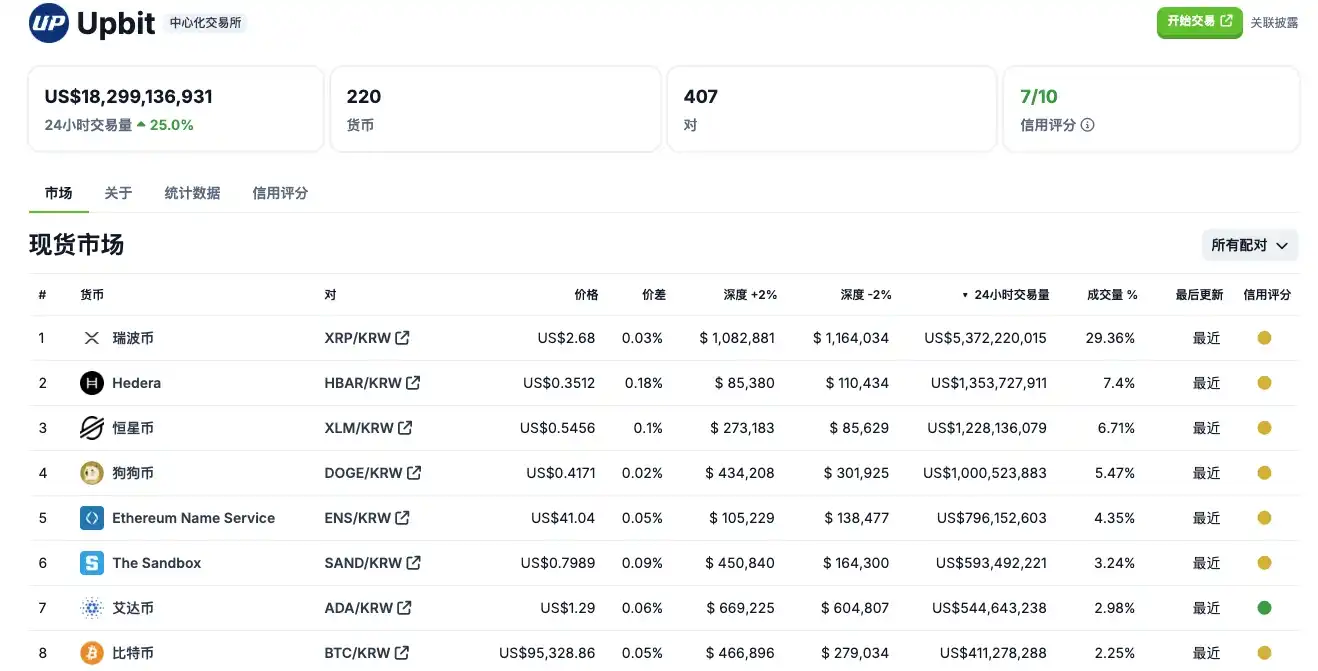
Simultaneously, on another Korean exchange Bithumb, HBAR's 24-hour trading volume reached $1.43 billion, surpassing not only BTC's volume on that platform but even exceeding Upbit's 24-hour HBAR trading volume.
It is evident that the Korean market is not only a major buyer market for XRP but also a major buyer for HBAR.
Altseason Arrives, Old Tokens Can Revitalize
Trends are always unstoppable. In the past year, altcoins have been underperforming, first falling into controversy over VC coins' "high valuation and low circulation" and massive unlockings, then facing the slump in the altcoin market as BTC repeatedly hit new highs, and finally having to deal with the onslaught of meme coins. To the point that even industry veterans, such as Fish the Founder and CEO of Cobo, previously asserted that "this cycle has no altseason."
As a result, the sector rotation, though delayed, has arrived, and altseason has finally come. According to an analysis by Nanzhi from Odaily Star Daily, the funding rate is in the safe zone, and the market share of altcoins has approached the launch point of 2021. (Related Reading: Looking back at market data from the past 4 years, which stage of the bull market are we currently in?)
The market is accustomed to finding reasons for price increases, and HBAR may be just a microcosm, symbolizing that even in a true altseason, even "old tokens" can make market participants dizzy with their rise. Instead of lamenting, it is worth joining the trend.
You may also like

Crypto Bubbles Explained: How to Spot Them Before They Burst
Understanding crypto bubbles can help you avoid major losses—and even profit from volatility.

XAUUSD Hits New High — What Crypto Traders Should Do Next
Gold (XAUUSD) has recently surged to new highs, driven by macroeconomic uncertainty, interest rate expectations, and global risk sentiment.

Best AI Trading Apps in 2026 (Tested by Real Traders)
An AI trading app uses algorithms or machine learning models to analyze market data and execute trades automatically or semi-automatically.

Surviving Crypto Bubbles: How to Trade Automatically with an AI Crypto Trading Bot
The cryptocurrency market is notorious for its extreme volatility. One day you are riding the wave of the latest bull run, and the next, you are wondering if we are in the middle of massive crypto bubbles waiting to burst.
How the US-Iran War Could Affect Oil and Bitcoin Prices (Latest Analysis)
The outbreak of the US-Iran war on February 28, 2026, has provided an unprecedented real-time laboratory for understanding how geopolitical oil shocks interact with an increasingly institutionalized cryptocurrency market. This article examines the relationship between crude oil prices and Bitcoin throughout the conflict, analyzing price movements, correlation patterns, and the underlying transmission mechanisms.

OpenAI Wants to Write Its Own Rules|Rewire News Brief

Chaos Labs Exits, Who Will Pick Up Aave's Risk?
Stealthy Financial War? Iran Collects Strait Transit Fees in Stablecoin

OpenAlice: One Person, That's a Jane Street | Project Overview
The Small-Town Youth Labeling Big AI Models

Morning Report | Strategy increased its holdings by 4,871 BTC last week; Toss plans to develop its own blockchain and issue a native cryptocurrency; OpenAI's CFO privately questioned the timing of the IPO in 2026

Research: Stablecoins have a trading volume of 35 trillion a year, how much of it is real payment?

Galaxy Research: AI agents are giving rise to new species on the blockchain, how zero-human companies activate the financial flywheel

Data Research: How big is the liquidity gap between Hyperliquid and CME crude oil?

WEEX P2P now supports GHS, ETB & ZAR—Merchant Recruitment Now Open
To make crypto deposits easier, WEEX has officially launched its P2P trading platform and continues to expand fiat support. We're excited to announce that the Ghana Cedi (GHS), Ethiopian Birr (ETB) and South African Rand (ZAR) are now available on WEEX P2P!
Why Are GPU Prices Skyrocketing Out of Control?

How to Master Claude Cowork Completely?

70-Page Confidential Letter Alleges First Charge of 'Lying,' Altman Tells Board 'I Can't Change My Personality'
Crypto Bubbles Explained: How to Spot Them Before They Burst
Understanding crypto bubbles can help you avoid major losses—and even profit from volatility.
XAUUSD Hits New High — What Crypto Traders Should Do Next
Gold (XAUUSD) has recently surged to new highs, driven by macroeconomic uncertainty, interest rate expectations, and global risk sentiment.
Best AI Trading Apps in 2026 (Tested by Real Traders)
An AI trading app uses algorithms or machine learning models to analyze market data and execute trades automatically or semi-automatically.
Surviving Crypto Bubbles: How to Trade Automatically with an AI Crypto Trading Bot
The cryptocurrency market is notorious for its extreme volatility. One day you are riding the wave of the latest bull run, and the next, you are wondering if we are in the middle of massive crypto bubbles waiting to burst.
How the US-Iran War Could Affect Oil and Bitcoin Prices (Latest Analysis)
The outbreak of the US-Iran war on February 28, 2026, has provided an unprecedented real-time laboratory for understanding how geopolitical oil shocks interact with an increasingly institutionalized cryptocurrency market. This article examines the relationship between crude oil prices and Bitcoin throughout the conflict, analyzing price movements, correlation patterns, and the underlying transmission mechanisms.


 App
App