
 Buy Crypto
- Markets
 Futures
- Spot
- Copy Trade
- Earn
- More
Will BTC Return to $90,000? In-Depth Analysis of Market Trends After This Week's Crypto Summit

Original Author: lazyvillager1, Institutional Investor & CFO IBD
Original Translation: ChatGPT
Editor's Note: Market sentiment experienced excessive selling pressure due to negative factors such as the SOL crime event and BYBIT hack, with cryptocurrency assets being impacted early on. The impact of the tariff issue on BTC was misinterpreted, although the market was traumatized in the short term, ETF fund flows remained stable, and BTC still exhibits a "chaos hedge" characteristic. The market stumbled after the Trump trade news, with expectations of a recovery by Friday. If the tariff issue remains deadlocked or an agreement is reached, BTC may see relief. Additionally, the market has undervalued the pricing of the Friday event, with the actual impact potentially being greater. Following a short-term correction, BTC is expected to return to the $90,000 level.
The following is the original content (slightly rephrased for better readability):
Let me start off by stating my position clearly: I am long, and I entered my long position from a higher level, so I may be biased (although we added a lot of positions at the lows).
Yesterday we mentioned that the $82 level was an interesting point last night, and it still is now, but as the price moves up or down, the risk range changes as well. Here, I will share some insights on why this level has a degree of asymmetry, which is often hard to come by.
We find the current market situation quite complex (and unique) as multiple unique factors intertwine, leading to pricing pressures. Therefore, to predict what might unfold in the future, we must first understand how we got here.
Ever since I tweeted about "SBR-Lite-Lite" on January 23rd, I believe we were leaning towards going short earlier than others (this needs further validation), and this stance was solely based on one viewpoint—pure market decay alone was enough to push the price down, without other factors.
Of course, there were many bullish factors at the time, such as the FASB 121 accounting rule adjustment, rising interest in stablecoin payments, etc., but I think these practical impacts were relatively limited and unable to shake the fund inflows that had supported prices above $100k (Saylor's purchasing demand + ETF inflows).
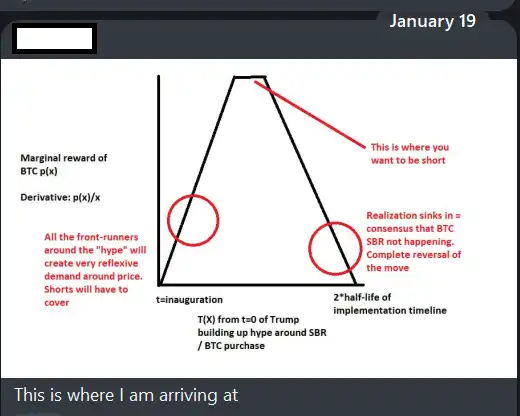
The upcoming tariff policy in early February further reinforced this view. We actually underestimated the market noise this event could bring, and the digital asset reaction was quite intense, with a significant 10% decline (ETH had an even greater drop). This range was very critical, and it's worth noting that during this period, the stock market did not see a significant pullback. On the first trading day after the weekend, ETF inflows played a noticeable buffering role.
Subsequently, the market experienced higher-than-expected CPI data. We believe that due to the options market's gamma effect, vanna, and charm supporting the stock market, market pricing will not significantly deteriorate before OPEX (options expiration). We expect OPEX to be a key point of market decline, unleashing the previously artificially suppressed downward trend.
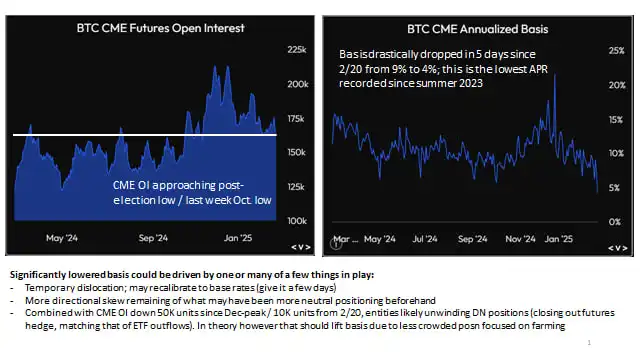
In the following week (February 25), the CME futures basis began to collapse, which caught our attention. I believe many market analysts mistakenly believe that this change has little impact on the market. However, the reality is:
「Looking back at the market turbulence last year (which failed to effectively break through 50K-60K), the CME futures basis remained relatively high (reaching double digits), while local investors (natives) are overall more bearish than traditional institutions (Trad). This can be seen from the stability of the basis or interest rate changes.
Now the situation seems to have reversed, with traditional institutions withdrawing capital, while the perpetual contract funding rate remains above 10%.
In my view, this discrepancy is very noteworthy because the primary demand driving price increases in the second half of 2024 is largely led by traditional institutions.
If this capital flow is declining (affected by various factors), then this capital may not return first and implies that prices may retrace to previous levels. In other words, traditional institutions may be more inclined to take profits in the first half of 2024 rather than make directional bets. By the fourth quarter of 2024, as the basis rises, they may start to increase directional bets, and now the situation is starting to reverse.
... This may indicate that the decline in BTC demand is faster than expected, and we may need to reconsider including BTC in the bearish allocation.」
It is worth noting that the signal of traditional institutions' capital withdrawal indicates market liquidity drought and a decrease in overall risk appetite. This ultimately led to the LTF (long-term trend) support level we believed — slightly below $80,000, which is also where we chose to fill our short positions.
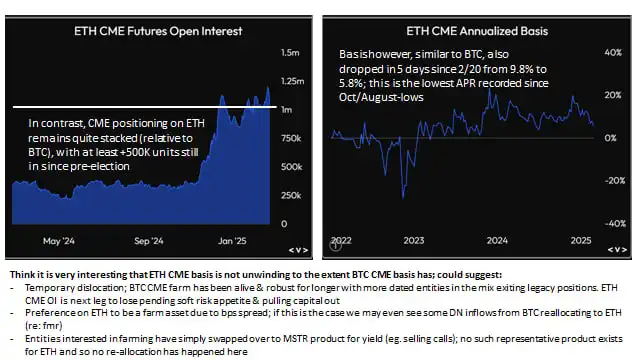
As an early trend judgment, we believe that market momentum has become oversold. A series of recent negative events (PF SOL crime, BYBIT ETH hack) exacerbated this situation, although these events themselves are not the main driving factors.
We chose to go long last weekend based on the following assessment:
「As previously mentioned, the gap between the crypto community/retail traders and passive funds is widening. This gap has been a key feature of the US stock market over the past five years, and now the crypto market is exhibiting a similar trend. ETF funds are actively buying after significant sell-offs, while local investors are hesitant to enter.
This is not merely an 'event-driven' trade but a continuation and evolution of market structure changes. I believe if this event had occurred in any previous week, the market's response would have been more positive. The current cautious sentiment (though justified) is primarily due to losses from leveraged buying. As weekend markets are mainly driven by local investors and traditional institutions trade mostly on weekdays, this vacuum effect in fund structure is causing more pronounced short-term market distortions.
This government window's performance marks the first occurrence of an a. sell the news event and b. profit-taking in the 5 days before the event, making the risk-return profile of going long more attractive at the current level.
I believe Saylor will not announce a large-scale buy-in, or it will be merely symbolic, ranging from $50 to $100 million. However, the market may briefly rally, prompting him to further deploy funds, especially if the SBR progress narrative is reinforced.
Most people may not have realized yet that Trump announced the adjustment of committee/task force arrangements to hold regular summits for supervision. Therefore, the current market level (roughly 95/2.5/180) may naturally become a point of regression, and as this news spreads, the market may digest and reprice.
From a traditional institution's perspective, the March/April tariff issue has already been fully digested by the market, so any delays or improvements (such as reaching agreements, lower tax rates, etc.) will bring upside potential. In short, I believe the current market has already priced in the worst-case scenario. And Z/Trump's display indicates his tough stance on diplomatic affairs, which may prompt Mexico/Canada to compromise on the tariff issue, bringing positive news.
Bessent mentioned in a weekend interview the strategy of controlling the 10-year bond yield to reduce inflation. Additionally, I believe the tariff issue with Mexico/Canada will be a barometer for future US-China tariff trends, so there may be further upside potential in the short term.
The market's overreaction to the impact of NVDA's earnings report (previously seen as a liquidation event), coupled with CTA position adjustments and end-of-month rebalancing (LOs selling $6 billion causing momentum exhaustion), all contributed to a 'perfect storm,' ultimately driving a significant market rebound.」
We had positioned ourselves early in the final stage of negative momentum in the market (although entering too early could also be a mistake). The extension of tariff policies has increased the weight of the China tariff issue, an expectation that the market quickly absorbed, leading to a 10% pullback in NVDA yesterday. I believe this is a highly emotional reaction, as the market still underestimates the correlation between NVDA and BTC—both of which are, in fact, the core pillars of the current risk asset market. At the same time, the market has also overlooked the continued U.S. investment in the semiconductor sector, which could provide some cushion to the market.
Our long security margin is mainly based on the following aspects:
1. The market is currently not pricing in the upcoming summit
This summit is likely to disappoint the market, but we initially assumed that there would be no substantial progress in the first 100 days of Trump's presidency (as he is more focused on foreign policy). Therefore, we need to reassess the current pricing logic.
2. The market's pricing of the tariff issue is inefficient
(1). The impact of tariffs has not been fully reflected in the U.S. stock/S&P index (the market still somewhat believes that Trump is bluffing). However, we believe that the impact of tariffs is mainly a distribution effect rather than a direct impact—this has already been evident in high-risk assets (such as cryptocurrency), as seen in the market turbulence on the first weekend of February and yesterday.
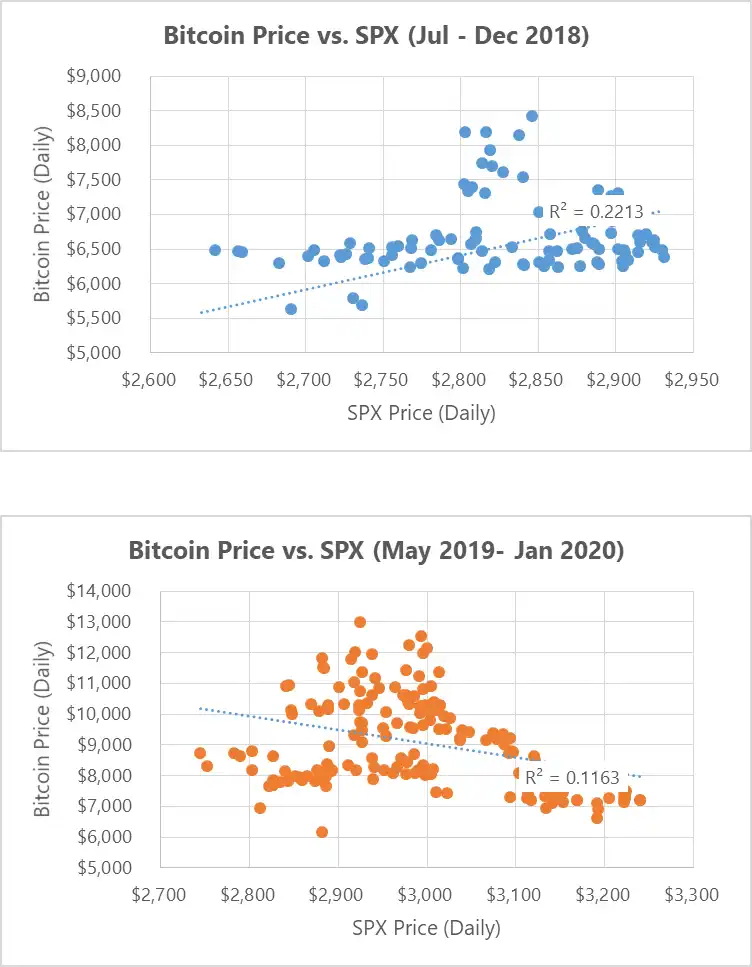
(2.) BTC has always been the market's "chaos hedge tool," dropping first as geopolitical tensions rise, but then rebounding strongly and stabilizing in relative strength. Our research shows that during the 2018/19 U.S.-China trade war, BTC exhibited a similar pattern.
For example, in May 2019, after the U.S. raised tariffs on $200 billion worth of Chinese goods to 25%, BTC rose from $5500 to $8000. In June, as more tariff threats emerged, BTC reached a high of $13,800. This indicates that the correlation between BTC and SPX was broken during the trade war, and statistical regression analysis also supports this conclusion—compared to the 50-70% correlation between BTC and SPX in the past 2-4 years, the correlation during the trade war was very weak.
3. ETF fund flows remain stable, with negative flows slowing down
The market performance last Friday and Monday showed a reduction in negative fund flows. Over $1 billion in outflows (mainly short funds) were recorded on Tuesday and Wednesday last week, but yesterday, a similar market reaction was triggered by only about 1/10 of the fund amount, indicating that the market has largely let out a lot of "hot air." Currently, the open interest (OI) and price structure of BTC, ETH, and SOL indicate that the market has returned to pre-election—even pre-Trump hype—levels, suggesting that a significant amount of speculative funds has exited. The previous "glass ceiling" may now have become a **"glass floor,"** with the support likely above the $70 range, provided there are no new negative catalysts.
4. Saylor did not make any purchases last week, and we do not expect this situation to continue.
His silence may only be temporary, and once he resumes buying, it will provide additional support to the market.
Conclusion:
Within the 80-85 range, we still maintain a long position and believe that the market is likely to return to the 90 range. Overall, the bias is more towards upward movement, especially in the current highly volatile market sentiment.
We expect that the downtrend for this week may reverse (it may have already started to stabilize today, considering many opinions were written at lower levels), but it will not return to last week's level. A clearer direction may be seen around Thursday/Friday.
The market is hit by Trump's trade policy, and the summit may lean more towards procedural rather than substantive progress.
More specific points:
· BTC will not benefit from the tariff game, further escalation is likely a net negative, and it should not be expected to exhibit negative beta to the US stock market.
· Market momentum (momo) is oversold, especially for those assets that were hit first. The outflow of basis trading funds is mainly reallocation, affected by yield compression and the end of the "honeymoon period" (i.e., the market has accepted that there will not be substantial government support in the short term). This may not be a temporary phenomenon.
· If the tariffs are only sustained tug-of-war or eventually resolved, it will be a mitigating factor for BTC.
· Market mispriced the news on Friday, which is more likely a "nothingburger." The probability given by the current market is about 5-10%, but it should actually be closer to 25-30%.
You may also like

The flow of stablecoins and the spillover effects in the foreign exchange market

After two years, Hong Kong's first batch of stablecoin licenses finally issued: HSBC, Standard Chartered make the cut
The person who helped TAO rise by 90% has now single-handedly crashed the price again today

3-Minute Guide to Participating in the SpaceX IPO on Bitget

Top 5 Cryptos to Buy in 2026 Q1: A ChatGPT Deep Dive Analysis
Explore the top 5 cryptos to buy in Q1 2026 including BTC, ETH, SOL, TAO, and ONDO. See price outlooks, key narratives, and institutional catalysts shaping the next market move.

How to Earn $15,000 with Idle USDT Before Altcoin Season 2026
Wondering if altcoin season is coming in 2026? Get the latest market update, and learn how to turn your idle stablecoins waiting for entry into extra rewards up to 15,000 USDT.
Can You Win Joker Returns Without Large Trading Volume? 5 Mistakes New Players Make In WEEX Joker Returns Season 2
Can small traders win WEEX Joker Returns 2026 without huge volume? Yes—if you avoid these 5 costly mistakes. Learn how to maximize card draws, use Jokers wisely, and turn small deposits into 15,000 USDT rewards.

Altcoin Season 2026: 4 Stages to Profit (Before the Crowd FOMO In)
Altcoin Season 2026 is starting — discover the 4 key stages of capital rotation (from ETH to PEPE) and how to position before the peak. Learn which tokens will lead each phase and avoid missing the rally.

Will Alt season come in 2026? 5 Tips to Spot the Next 100x Crypto Opportunities
Will altcoin season arrive in 2026? Discover 5 rotation stages, early signals smart traders watch, and the key crypto sectors where the next 100x altcoin opportunities may emerge.

The bear market has arrived, and cryptocurrency ETF issuers are also getting involved

The richest man had a quarrel with his former boss

BTC Firm Above 70K! Saylor’s "Institutional Logic" vs. Moon’s "Retail Faith": Who is Really Harvesting the Market?
Bitcoin is holding firm above the $70,000 support level following a massive short squeeze that liquidated $427 million. As the "Four-Year Cycle" narrative shifts, the market is split: Michael Saylor’s cold, institutional "indiscriminate stacking" vs. Carl Moon’s high-energy retail "hopium." This article decodes these two polar-opposite strategies for the 2026 bull run and reveals how WEEX’s institutional-grade liquidity and AI trading tools empower every type of investor to convert market volatility into profit.

The Girl Who Created the SBTI Test: A Story of a Doomed Cyber Love, an E-Widow Ratfolk

B.AI Officially Launched: Building AI Agent Financial Bedrock Platform, Driving AGI Era Business Underlying Logic

B.AI Officially Launched: Breaking Down A2A Collaboration Barriers to Unlock the Smart Body Economy's Full Potential
We helped Xu Mingxing write a book called "<OK Life>".

Rare APY of 400%, is TradeXYZ handing out money to oil bulls?
a16z: Perpetual Contracts are Rewriting Global Trading Rules
The flow of stablecoins and the spillover effects in the foreign exchange market
After two years, Hong Kong's first batch of stablecoin licenses finally issued: HSBC, Standard Chartered make the cut
The person who helped TAO rise by 90% has now single-handedly crashed the price again today
3-Minute Guide to Participating in the SpaceX IPO on Bitget
Top 5 Cryptos to Buy in 2026 Q1: A ChatGPT Deep Dive Analysis
Explore the top 5 cryptos to buy in Q1 2026 including BTC, ETH, SOL, TAO, and ONDO. See price outlooks, key narratives, and institutional catalysts shaping the next market move.
How to Earn $15,000 with Idle USDT Before Altcoin Season 2026
Wondering if altcoin season is coming in 2026? Get the latest market update, and learn how to turn your idle stablecoins waiting for entry into extra rewards up to 15,000 USDT.


 App
App