
 Buy Crypto
- Markets
 Futures
- Spot
- Copy Trade
- Earn
- More
WSJ: Behind Bitcoin Frenzy, MicroStrategy Stock Leverage Risk Emerges

Original Article Title: Bitcoin Euphoria Threatens to Break These ETFs
Original Article Author: Jack Pitcher, WSJ
Original Article Translation: zhouzhou, BlockBeats
Editor's Note: This article analyzes leveraged funds launched by Tuttle Capital and Defiance ETFs, focusing on MicroStrategy stock to amplify its Bitcoin-related returns. These funds use derivatives and options for leverage but face liquidity issues, resulting in underperformance. Investors disappointed by the funds' deviation from expected performance criticize that these funds have exacerbated MicroStrategy's stock price volatility and pose a risk that could lead to losses.
The following is the original content (slightly rephrased for better readability):
Investors have flocked to funds aiming to amplify daily returns of MicroStrategy stock, but these ETFs have recently failed to perform as expected.
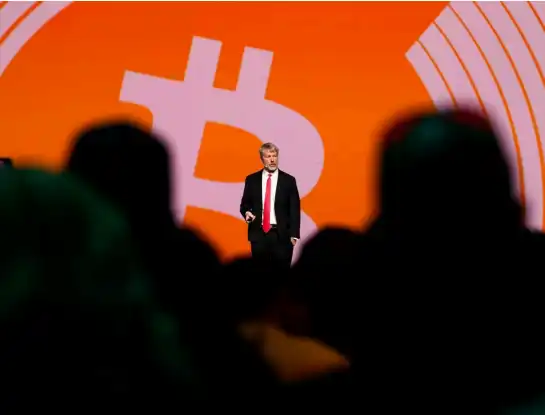
MicroStrategy's founder Michael Saylor, this software company has turned into a Bitcoin buying machine. Image Source: LIAM KENNEDY/ BLOOMBERG NEWS
Investors have rushed into a pair of highly leveraged exchange-traded funds (ETFs), seeking to profit from the momentum of Bitcoin, but these funds carry hidden risks that are not widely understood. These ETFs are designed to amplify the daily return of MicroStrategy, a company that has transformed itself into a Bitcoin-buying machine. Through complex derivative trades, their goal is to provide double the daily stock return, whether it goes up or down.
These funds, launched by asset management companies such as Tuttle Capital Management and Defiance ETFs, inherently carry high risk, as MicroStrategy itself is a leveraged bet on Bitcoin, holding about $35 billion in Bitcoin. However, optimistic investors have already driven its market value to nearly $90 billion, more than double the value of its held Bitcoin, leading skeptics to believe that this situation is unsustainable.
The Defiance Daily Target 2X Long MSTR ETF and T-Rex 2X Long MSTR Daily Target ETF are designed for investors looking to make more aggressive bets on stocks. Since their respective launches in August and September, the total assets of these two funds have swelled to around $5 billion.
Some analysts suggest that these funds are driving the crazy surge in MicroStrategy's stock price. They warn that if the stock were to drop by 51% in a day, these ETFs could potentially collapse entirely, similar to the scenario where some volatility-linked ETFs blew up after the 2018 market turmoil event known as "Volmageddon."
What's even worse is that the recent performance of these two 2X leveraged ETFs hasn't been living up to expectations. On Wednesday, as MicroStrategy's stock price surged by 9.9%, the T-Rex fund only rose by 13.9%, failing to reach the 19.8% target. When the stock fell, the T-Rex fund's performance was also disappointing. On Monday, when MicroStrategy dropped by 1.9%, the fund's share price fell by 6.2%.
This has sparked widespread discussion among investors on social media, with many questioning this discrepancy and feeling deceived.
36-year-old wine merchant and day trader Jesse Schwartz in Washington state has been using these funds to leverage his exposure to stocks, and he was particularly surprised to see the stocks not performing as advertised. Schwartz called his brokerage firm Charles Schwab to inquire about the difference, but he wasn't satisfied with the company's explanation, eventually selling off all his shares before the week's end.
"It's safe to say it's been disappointing," Schwartz said. "I took on more risk on the downside and didn't get the reward on the upside."
Since regulatory approval in 2022, dozens of ETFs targeting individual stocks have been launched by small fund managers. So far, these funds have mostly operated as expected. Popular funds aimed at doubling the daily returns of Nvidia and Tesla typically closely track their targets, benefiting from the use of financial contracts known as total return swaps.
Supporters of these funds argue that they offer regular investors a strategy that Wall Street has long utilized. Critics, however, believe they could be perilous as they lack diversification. Take the MicroStrategy funds, for example, as these funds expose investors to highly volatile stocks through leverage and tie that stock to unpredictable cryptocurrency price movements.
Critics warn that this hype is part of a broader investor frenzy targeting speculative assets that could eventually crash.

MicroStrategy holds about $35 billion in Bitcoin. Image Source: KEVIN SIKORSKY
The manager of the MicroStrategy fund has stated that they may struggle to achieve their target of 2x returns as their primary broker—a company that provides securities lending and other services to professional investors—has reached the limit of the swap exposure it is willing to offer.
Leveraged ETFs typically achieve their intended effect through the use of swaps, which are widely available for the largest, most liquid stocks. The payouts of swap contracts are directly linked to the performance of the underlying asset, allowing the fund to precisely amplify the daily performance of a stock or index.
Matt Tuttle, the manager of the Tuttle Capital and Rex Shares 2x leveraged MicroStrategy fund, has stated that he cannot obtain a sufficient amount of swaps needed to support the rapid growth of his fund. He mentioned that his primary broker currently offers him swap exposures ranging from $20 to $50 million, whereas at one point last week, he could have accessed $1.3 billion in swaps.
Both Tuttle and Sylvia Jablonski, CEO of Defiance ETFs, have indicated that they are turning to the options market to achieve leverage for the MicroStrategy fund. Traders can effectively use options to double the daily returns of an asset, but analysts suggest that this is a less precise method.
Option prices fluctuate, and large buyers like ETFs can influence the market. Tuttle stated that using options is a major contributor to tracking errors.
On November 25th, the Defiance ETF experienced a decline nearly three times that of the underlying stock. Last Friday, while MicroStrategy fell by only 0.35%, the ETF dropped by 1.76%.
Analysts believe that the introduction of leveraged MicroStrategy ETFs has accelerated the stock's volatility. These ETFs must adjust their exposure daily to achieve their leveraged effect. Market makers providing swaps and options typically buy and sell actual MicroStrategy shares to hedge their risks.
“It’s like driving with a cinder block tied to your foot, you can still control the accelerator, but the default is floored,” said ETF industry veteran Dave Nadig, who has worked at VettaFi and FactSet.
You may also like

How the US-Iran War Could Affect Oil and Bitcoin Prices (Latest Analysis)
The outbreak of the US-Iran war on February 28, 2026, has provided an unprecedented real-time laboratory for understanding how geopolitical oil shocks interact with an increasingly institutionalized cryptocurrency market. This article examines the relationship between crude oil prices and Bitcoin throughout the conflict, analyzing price movements, correlation patterns, and the underlying transmission mechanisms.

OpenAI Wants to Write Its Own Rules|Rewire News Brief

Chaos Labs Exits, Who Will Pick Up Aave's Risk?
Stealthy Financial War? Iran Collects Strait Transit Fees in Stablecoin

OpenAlice: One Person, That's a Jane Street | Project Overview

The Small-Town Youth Labeling Big AI Models

Morning Report | Strategy increased its holdings by 4,871 BTC last week; Toss plans to develop its own blockchain and issue a native cryptocurrency; OpenAI's CFO privately questioned the timing of the IPO in 2026

Research: Stablecoins have a trading volume of 35 trillion a year, how much of it is real payment?

Galaxy Research: AI agents are giving rise to new species on the blockchain, how zero-human companies activate the financial flywheel

Data Research: How big is the liquidity gap between Hyperliquid and CME crude oil?

WEEX P2P now supports GHS, ETB & ZAR—Merchant Recruitment Now Open
To make crypto deposits easier, WEEX has officially launched its P2P trading platform and continues to expand fiat support. We're excited to announce that the Ghana Cedi (GHS), Ethiopian Birr (ETB) and South African Rand (ZAR) are now available on WEEX P2P!
Why Are GPU Prices Skyrocketing Out of Control?

How to Master Claude Cowork Completely?

70-Page Confidential Letter Alleges First Charge of 'Lying,' Altman Tells Board 'I Can't Change My Personality'

Is Altcoin Season Starting in 2026? What Traders Should Watch Now
Altcoin season signals are becoming clearer in 2026 as capital rotation across crypto markets accelerates. Here’s what traders should watch and how strategy-based participation is evolving in the current market cycle.

Bitcoin ETF Inflows in 2026: Impact on BTC Price and Crypto Market Trends
Bitcoin ETF inflows are reshaping BTC price trends and crypto market liquidity in 2026. See how institutional capital is influencing volatility, trading behavior, and portfolio allocation strategies across crypto markets.
Visa's Stablecoin Strategy: Cards, Settlement, and the Future

Stock Market Split
How the US-Iran War Could Affect Oil and Bitcoin Prices (Latest Analysis)
The outbreak of the US-Iran war on February 28, 2026, has provided an unprecedented real-time laboratory for understanding how geopolitical oil shocks interact with an increasingly institutionalized cryptocurrency market. This article examines the relationship between crude oil prices and Bitcoin throughout the conflict, analyzing price movements, correlation patterns, and the underlying transmission mechanisms.


 App
App