
 Buy Crypto
- Markets
 Futures
- Spot
- Copy Trade
- Earn
- More
YziLabs Invests in Derivatives Trading Platform KiloEx to Explore High-Speed Trading

Source: KiloEx
Gas: The Culprit Hindering On-Chain Prosperity
Starting from the DeFi summer, on-chain finance has been developing for four years. However, to this day, centralized exchanges still hold the majority of liquidity and attract more web3 users. The reason behind this is that CEXs have some obvious advantages: simpler operation and very fast transaction processing, among others. In contrast, DEXs, due to their obscure concepts, complex operations, and numerous steps, keep most web3 users at bay.
Furthermore, DEXs are even more disastrous for new users joining the space. For example, almost all new web3 users have a common question: What is gas? Which token should I use as gas? How much gas specifically needs to be prepared? In fact, these are just the first steps that users need to understand when using a DEX, yet they are enough to intimidate most users and make them hesitant.
In addition, using a DEX requires users to first learn how to use a wallet and understand how to sign transactions. For some actions, users may even need to sign multiple times to complete an operation. Transaction execution time can also become very slow for various reasons. Obviously, these are not what we want to see.
Exploring the Current Gasless Transaction Model
As a perpetual contract DEX invested by YziLabs (formerly BinanceLabs), KiloEx is actively exploring how to achieve gasless transactions to help users easily complete transactions on the platform.
Currently, the mainstream gasless implementation methods mainly include the following two:
1. EOA Based Paymaster
This scheme was proposed by the BNB Chain team based on the EIP-4337 (an account abstraction via Entry Point contract specification) protocol.
EIP-4337 allows third parties to pay for users' transaction fees, enabling users to complete transactions without holding ETH. However, although EIP-4337 introduces a Paymaster mechanism suitable for smart contract wallets, there are still many users in the EVM ecosystem relying on EOA accounts (externally owned accounts). Therefore, BNB Chain has proposed an innovative Paymaster solution designed specifically for EOAs, eliminating the need to migrate EOAs to a smart contract wallet to enjoy transaction fee coverage and a better user experience. The goal of this solution is to popularize gas fee coverage, making blockchain interactions for BNB Chain users more convenient and cost-effective.
In this scheme, there has been a significant change in the transaction processing method. Validators no longer individually validate the Gas price of transactions in a block. Instead, two separate roles, Builder and Proposer, work together to complete the process. The builder is responsible for block assembly, including selecting transactions from the public transaction pool and private transaction stream and combining them. The Proposer validates the block, selecting the most profitable block from those proposed by multiple Builders to be added to the chain.
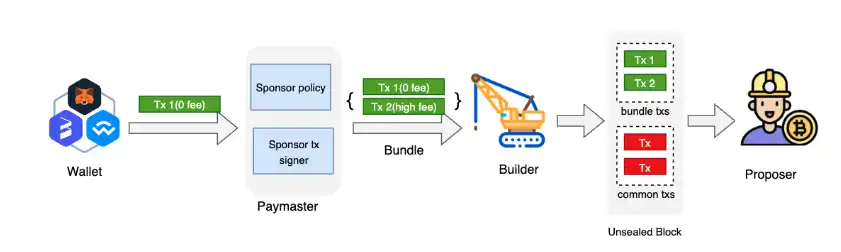
The specific process of this scheme is as follows: users initiate transactions using a compatible wallet with Gas price set to 0 to potentially sponsor the transaction. Subsequently, the wallet submits this 0 Gas transaction to a Paymaster (a sponsorship mechanism, an infrastructure component supporting transaction sponsorship for processing).
Next, the Paymaster verifies the transaction against preset sponsorship rules, which may involve sender or recipient addresses, token types, or transaction amounts. If the transaction meets the sponsorship conditions, the Paymaster creates a sponsored transaction and sets its Gas price. Then, the original transaction and the sponsored transaction are bundled together. If the transaction does not meet the sponsorship requirements, it is either rejected or returned to the user for regular transaction processing.
Once packaged, this transaction bundle is submitted to multiple MEV Builders for processing. MEV Builders select a suitable transaction bundle and include it in a block proposal. Subsequently, the Proposer (block validator) selects the most profitable block from multiple block proposals to be added to the chain. Finally, the user's original transaction and the sponsor's transaction are atomically executed to ensure integrity.
After the transaction is completed, the Paymaster Manager updates the sponsor's account and deducts the corresponding Gas fee. This entire process relies on the Proposer-Builder Separation (PBS) architecture of BEP322, ensuring the efficiency and security of Gas sponsorship, providing users with a smoother blockchain interaction experience.
However, this approach is limited by whether wallet projects have integrated this component. As of now, mainstream wallets like MetaMask still do not support it, so KiloEx has abandoned this scheme.
2. ERC-2771 (Meta Transaction)
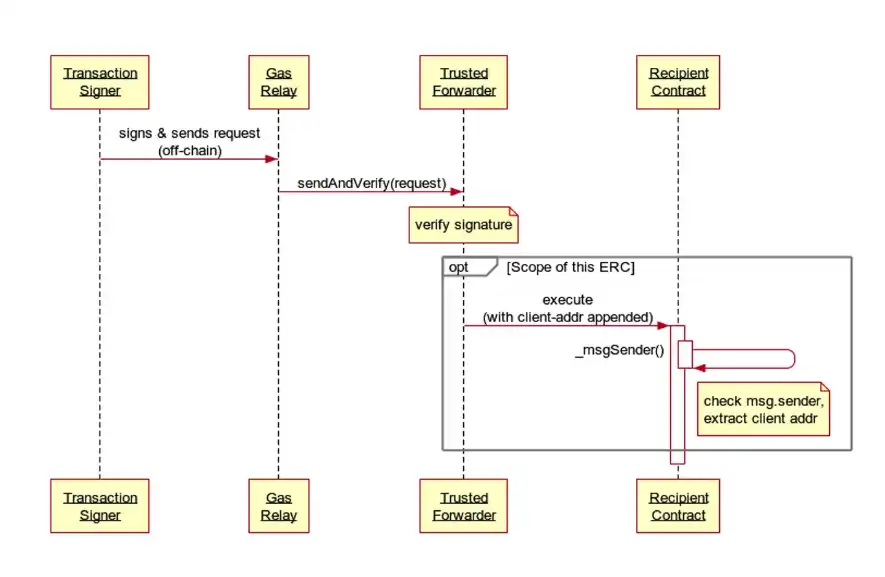
First, let's explain what a Meta Transaction is. In a Meta-Transaction mechanism, users can complete transactions without holding gas tokens by relying on a Gas Relay proxy to pay the Gas fee, enabling seamless on-chain interaction. The entire process is collaboratively carried out by the Transaction Signer, Gas Relay, Trusted Forwarder, and Recipient Contract.
First, the Transaction Signer is responsible for locally signing the transaction, and the signature can be completed through the main wallet. It is important to note that the Transaction Signer does not directly interact with the blockchain. Instead, it performs encryption operations locally and submits the encrypted signature data to the backend through an interface, rather than broadcasting it to the blockchain directly.
Subsequently, the Gas Relay (backend service) receives the transaction signature data and is responsible for submitting the transaction to the blockchain. The Gas Relay interacts with a Trusted Forwarder to ensure that the transaction can be validly executed. The Trusted Forwarder contract validates the signature's legitimacy before it is submitted to the blockchain and prevents replay attacks. Once validated, it interacts with the recipient contract to finalize the transaction execution.
KiloEx Instant Transaction Solution: 1CT wallet + Meta Transaction
The 1CT wallet eliminates the need for user interaction with the wallet during transactions, enabling a more efficient one-click transaction (1CT) process that significantly reduces transaction time. It uses a derived External Owned Account (EOA) wallet to submit transactions and incorporates a Trade Delegation mechanism to ensure transaction security and convenience.
When a user first uses the 1CT wallet, they need to set a 4-digit PIN and sign this PIN with their wallet using a prefix message. The website then uses this signed message as a seed to generate a Secp256k1 key pair, encrypts the key material, and stores it on the user's local device. With the introduction of the transaction delegation mechanism, users do not need to manually sign each transaction but rather have the 1CT wallet automatically submit transactions, greatly enhancing transaction efficiency.
After comparing multiple solutions and considering practicality, KiloEx ultimately adopted the Meta-Transaction scheme to achieve gasless transactions. Building on this, KiloEx combined it with the 1CT wallet to provide users with an incredibly smooth transaction experience.
For KiloEx users experiencing the instant transaction mode, they only need to sign before the initial transaction to create the 1CT wallet, authorize the amount, and establish the binding relationship. Subsequent transactions do not require reactivation of the main wallet for signing. Compared to the traditional path, the transaction processing speed in instant transaction mode is faster. Most importantly, users do not even need to hold gas tokens in their wallet, only requiring stablecoins like USDT/USDC to complete smart contract transactions.
This article is contributed content and does not represent the views of BlockBeats.
You may also like

Uniswap is trapped in an innovation dilemma

What is the key to competition in crypto banking?

The flow of stablecoins and the spillover effects in the foreign exchange market

After two years, Hong Kong's first batch of stablecoin licenses finally issued: HSBC, Standard Chartered make the cut
The person who helped TAO rise by 90% has now single-handedly crashed the price again today

3-Minute Guide to Participating in the SpaceX IPO on Bitget

Top 5 Cryptos to Buy in 2026 Q1: A ChatGPT Deep Dive Analysis
Explore the top 5 cryptos to buy in Q1 2026 including BTC, ETH, SOL, TAO, and ONDO. See price outlooks, key narratives, and institutional catalysts shaping the next market move.

How to Earn $15,000 with Idle USDT Before Altcoin Season 2026
Wondering if altcoin season is coming in 2026? Get the latest market update, and learn how to turn your idle stablecoins waiting for entry into extra rewards up to 15,000 USDT.
Can You Win Joker Returns Without Large Trading Volume? 5 Mistakes New Players Make In WEEX Joker Returns Season 2
Can small traders win WEEX Joker Returns 2026 without huge volume? Yes—if you avoid these 5 costly mistakes. Learn how to maximize card draws, use Jokers wisely, and turn small deposits into 15,000 USDT rewards.

Altcoin Season 2026: 4 Stages to Profit (Before the Crowd FOMO In)
Altcoin Season 2026 is starting — discover the 4 key stages of capital rotation (from ETH to PEPE) and how to position before the peak. Learn which tokens will lead each phase and avoid missing the rally.

Will Alt season come in 2026? 5 Tips to Spot the Next 100x Crypto Opportunities
Will altcoin season arrive in 2026? Discover 5 rotation stages, early signals smart traders watch, and the key crypto sectors where the next 100x altcoin opportunities may emerge.

The bear market has arrived, and cryptocurrency ETF issuers are also getting involved

The richest man had a quarrel with his former boss

BTC Firm Above 70K! Saylor’s "Institutional Logic" vs. Moon’s "Retail Faith": Who is Really Harvesting the Market?
Bitcoin is holding firm above the $70,000 support level following a massive short squeeze that liquidated $427 million. As the "Four-Year Cycle" narrative shifts, the market is split: Michael Saylor’s cold, institutional "indiscriminate stacking" vs. Carl Moon’s high-energy retail "hopium." This article decodes these two polar-opposite strategies for the 2026 bull run and reveals how WEEX’s institutional-grade liquidity and AI trading tools empower every type of investor to convert market volatility into profit.

The Girl Who Created the SBTI Test: A Story of a Doomed Cyber Love, an E-Widow Ratfolk

B.AI Officially Launched: Building AI Agent Financial Bedrock Platform, Driving AGI Era Business Underlying Logic

B.AI Officially Launched: Breaking Down A2A Collaboration Barriers to Unlock the Smart Body Economy's Full Potential


 App
App